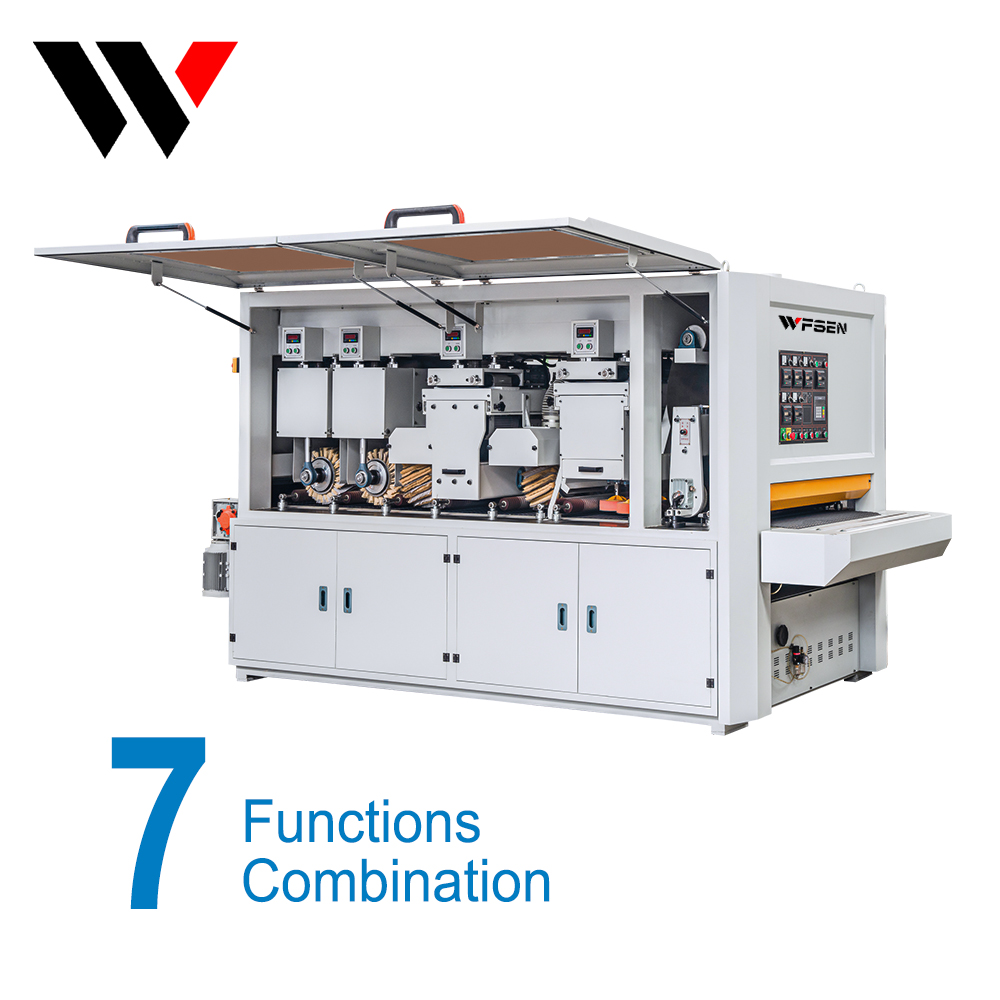
Short answer: a wood polishing machine is built from polishing units, and the unit count alone will not tell you which machine you are looking at. Our two machines both described as six-unit do not weigh the same and do not carry the same number of discs: one is 4,500 kg with 11 discs, the other is 2,000 kg with discs counted as 11 × 2. Across the range the published working thickness runs from 2 mm to 180 mm, feed speed splits into two distinct groups, and machine weight spans 60 kg to 5,000 kg.
This page reads the specification of the six polishing machines we build, one field at a time, and says where a product page publishes no value rather than filling the gap.
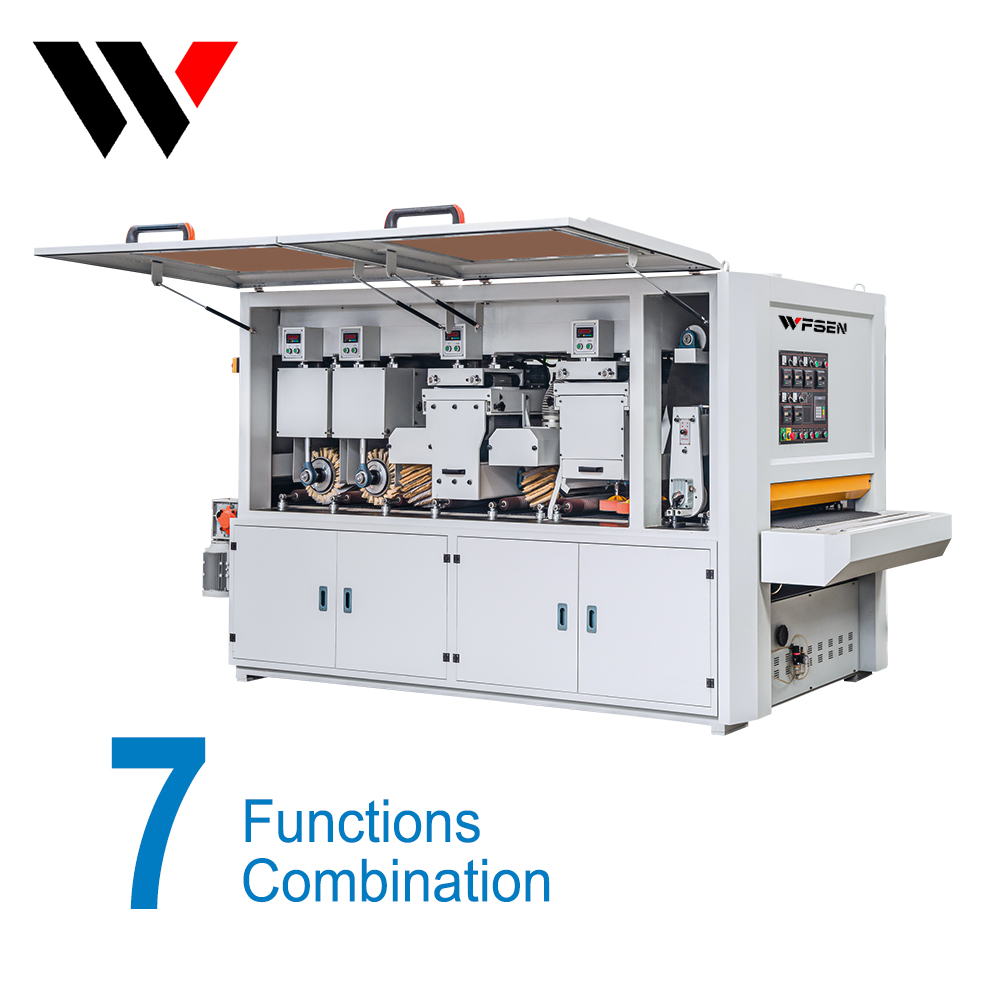
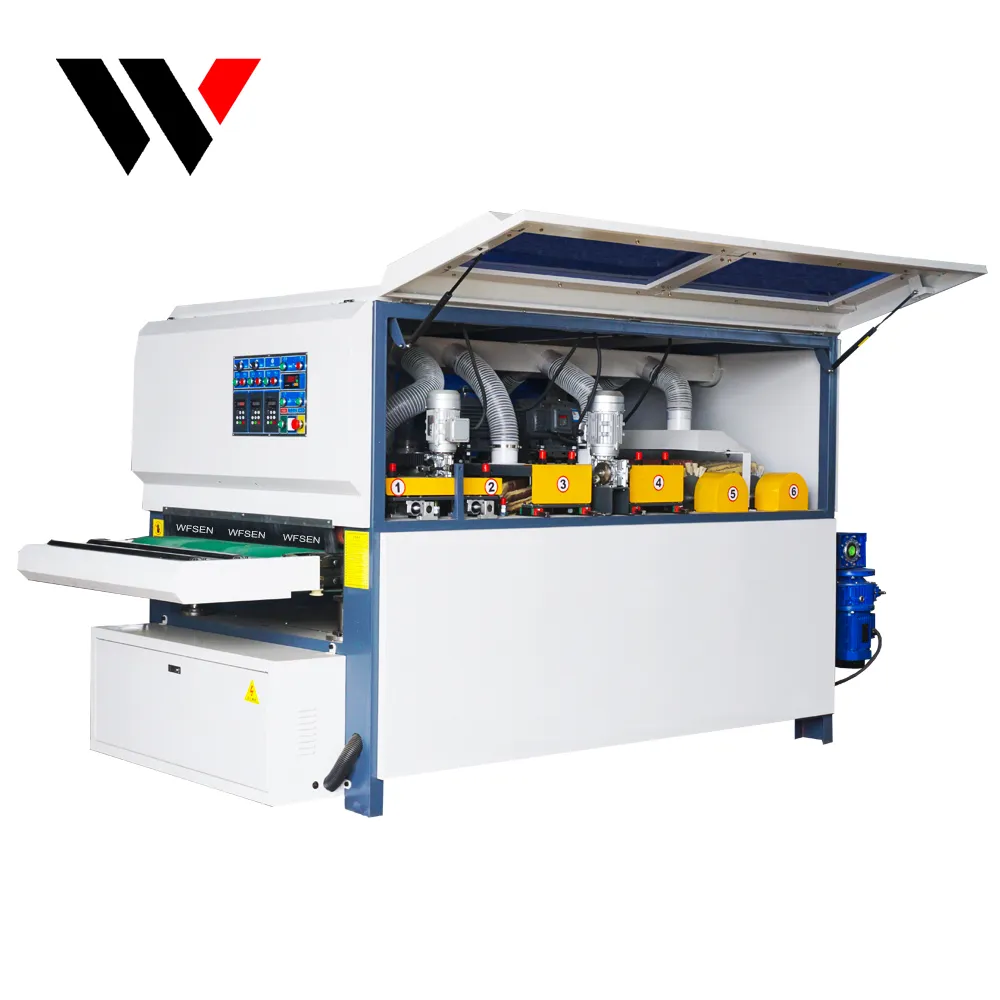
A polishing machine finishes the surface a sander has already levelled. Where the sander removes material, the polisher works the surface — and it does that with a set of polishing units arranged along a conveyor, each one a different consumable doing a different job.
The unit types published across our range are worth naming, because they are what a quotation is actually built from:
That list is the reason the unit count on its own is a weak number. Six units could be six discs, or a mix of discs and rollers, and the mix is what decides what the machine does to the surface. The full range by consumable type is listed on the polishing machine page, and the difference between polishing and sanding as processes is set out in types of sanders.
This is the comparison worth making before any quotation, because the headline number is identical on both and almost nothing else is.
| Published field | SK1300-6S | SF1300-6S |
|---|---|---|
| Units (page wording) | 6 units | 6 units |
| Weight | 4,500 kg | 2,000 kg |
| Disc count | Disc 11pcs | Disc 11pc × 2 |
| Vertical roller | 9pcs | 9pcs |
| Working thickness | 5-160 mm | 5-180 mm |
| Feed speed | 5-18 m/min | 3-10 m/min |
| Working width | 1300 mm | 1300 mm |
| Outline size | 3400 × 2100 × 2100 mm | 3700 × 2000 × 1800 mm |
Two machines that both publish "6 units" differ by 2,500 kg and by a factor of two in disc count. The heavier machine is also the shorter one — 3,400 mm against 3,700 mm — so this is not a machine that got bigger in every direction, it is a machine built on a different frame with a different set of heads.
The practical consequence is simple. If a quotation says "six units" and nothing else, it does not yet describe a machine. The questions that separate these two are the disc count, the working thickness and the feed speed — and all three are published.
A note on the model numbers, because it matters for how you read the rest of this page: the product pages describe the SK1300-6S as having 6 units and the SK1300-7S as having 7 units, but none of the six product pages explains the naming rule itself. Read the unit count from the specification, not from the letters in the model code.
Every machine in the 1300 series publishes the same 1300 mm working width, so width does not separate them. Thickness does.
The gap at the thin end is the one to watch. 3 mm of difference sounds small until the panel is 3 mm thick — if you finish veneer or thin decorative board, the two SK1300 machines are eliminated by specification before price is discussed, and the SF machines are the ones that qualify.
Feed speed is often read as a ranking, with the highest number winning. On this range it falls into two clean groups instead:
The grouping follows the consumable, not the price: disc units run faster, roller and brush units run slower. If your work needs a roller or brush finish, the 3-10 m/min figure is not a downgrade — it is the speed that consumable runs at. Reading it as "half the speed for the same money" is how the wrong machine gets bought.
| Model | Type | Units / working elements | Working width | Working thickness | Feed speed | Weight | Outline size |
|---|---|---|---|---|---|---|---|
| SK1300-6S | Disc polishing machine | 6 units; Disc 11pcs, Vertical roller 9pcs | 1300 mm | 5-160 mm | 5-18 m/min | 4,500 kg | 3400 × 2100 × 2100 mm |
| SK1300-7S | Disc polishing machine | 7 units; Disc 11pcs, Vertical roller 9pcs | 1300 mm | 5-160 mm | 5-18 m/min | 5,000 kg | 4100 × 2100 × 2100 mm |
| SF1300-6S | Brush polishing machine | 6 units; Disc 11pc × 2, Vertical roller 9pcs | 1300 mm | 5-180 mm | 3-10 m/min | 2,000 kg | 3700 × 2000 × 1800 mm |
| SF4R-1300 | Cloth roller polishing machine | Cloth roller 15 kW × 3, Cotton roller 11 kW | 1300 mm | 2-180 mm | 3-10 m/min | 1,800 kg | 2700 × 1900 × 1800 mm |
| SM-3F | Combination machine | 3 functions: sand belt, sand column, polishing brush | Not published | Not published | Converter adjusted | 100 kg | 1000 × 1000 × 900 mm |
| SM-1V | Small polishing machine | Not published | Not published | Not published | Converter adjusted | 60 kg | 600 × 600 × 900 mm |
Only one machine in the range publishes a total power figure: the SK1300-6S at 14.47 kW. The other five publish their motors individually — cloth roller and cotton roller on the SF4R-1300, for example — or not at all. If you are sizing a supply, ask for the total rather than adding up partial figures yourself.
The published weights in this range span 60 kg to 5,000 kg — a factor of just over eighty — and that single field splits the range into three installation classes.
Notice that the two heaviest machines are also the shortest of the full-size group, at 3,400 mm and 4,100 mm of length. Weight in a polishing machine is frame and drive, not length — which is the same pattern that turns up across the rest of the range.
Electrical supply is the field most often estimated from the size of the machine, and on this range that shortcut fails.
Only one machine publishes a total power figure: the SK1300-6S at 14.47 kW. That is the 4,500 kg machine carrying six units, eleven discs and nine vertical rollers.
The SF4R-1300 publishes no total, but it does publish its motors: cloth roller 15 kW × 3 and cotton roller 11 kW. Those listed motors alone come to 56 kW — close to four times the figure published as the SK1300-6S total — on a machine weighing 1,800 kg, less than half as much. (The two pages are not published in the same format, so treat this as a comparison of what each page states, not as a like-for-like total.)
The cause is structural. A disc unit drives a group of discs from one motor, while a cloth roller or cotton roller is itself a powered, full-width roller — each one its own motor. The SF4R-1300 sits on a smaller footprint than the SK1300-6S, 2,700 × 1,900 mm against 3,400 × 2,100 mm, and weighs 40% of it, and it still asks for more drive power.
So do not size the supply from the machine's footprint or weight, and do not add partial motor figures yourself: ask for the published total for the machine you are quoting. On four of the six machines in this range, that total is not stated on the product page at all.
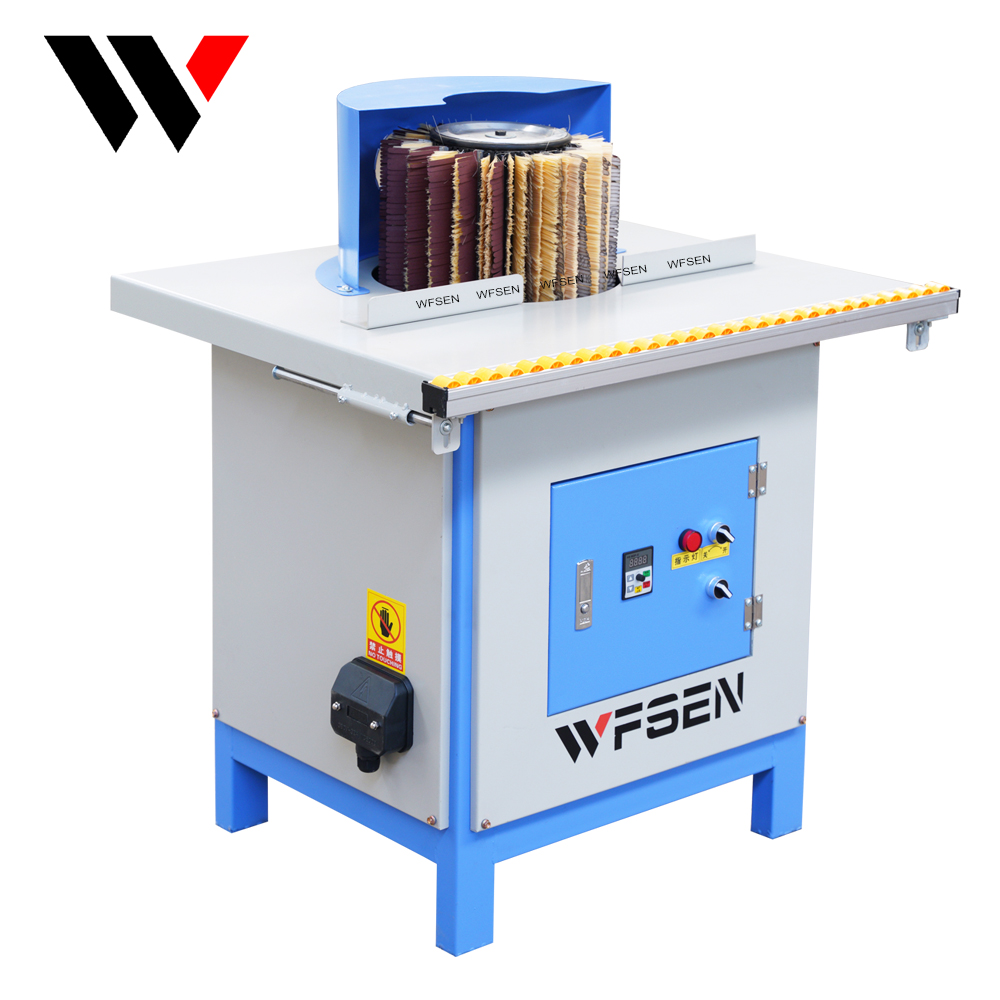
The two small machines are not scaled-down versions of the line machines. The SM-3F combination polishing machine is published with three functions — sand belt, sand column and polishing brush — on a 100 kg frame, which makes it a machine for shaped work and touch-up rather than for flat panels. The SM-1V small polishing machine is 60 kg on a 600 × 600 × 900 mm footprint, with speed adjusted by converter.
Both publish their speed as converter adjusted rather than as a fixed range, which is what you would expect on machines where the operator is presenting the work by hand.
Four questions settle it, and each one maps onto a published field rather than an opinion.
1. What is the thinnest panel you run? Under 5 mm eliminates both SK1300 machines, which are published at 5-160 mm. The SF4R-1300, published at 2-180 mm, is the machine that accepts the thin end, and the SF1300-6S at 5-180 mm sits between them.
2. Disc finish or roller and brush finish? This is the choice that decides how the machine is built rather than how big it is. Disc machines run at 5-18 m/min; roller and brush machines at 3-10 m/min. If you are comparing the two on speed alone, you are comparing two different consumables rather than two grades of the same machine.
3. What will the floor take? The split is 4,500-5,000 kg for the SK1300 machines, 1,800-2,000 kg for the SF machines, and 60-100 kg for the two SM machines. On the two heaviest, the published footprint of up to 4,100 × 2,100 mm has to exist before delivery.
4. Flat panels or shaped work? Flat panel production points to the 1300 series. Shaped work, edges and touch-up point to the SM-3F combination machine, whose three published functions — sand belt, sand column and polishing brush — are not a scaled-down panel line at all.
How many units does a wood polishing machine need?
The answer lies in the finish and the output, not in a fixed rule — and the unit count alone does not describe the machine. Our two machines both published as six-unit differ by 2,500 kg in weight and by a factor of two in disc count.
What is the thinnest panel these machines will polish?
The SF4R-1300 is published at 2-180 mm, which is the widest range in the line. The SF1300-6S is 5-180 mm and the SK1300-6S and SK1300-7S are 5-160 mm.
What working width do they cover?
Every machine in the 1300 series publishes a working width of 1300 mm, so width is not what separates them.
How fast do they run?
The disc machines, SK1300-6S and SK1300-7S, are published at 5-18 m/min. The brush machine SF1300-6S and the cloth roller machine SF4R-1300 are published at 3-10 m/min. The two SM machines publish converter-adjusted speed.
What do the numbers in the model names mean?
The product pages describe the SK1300-6S as having 6 units and the SK1300-7S as having 7 units, but the naming rule itself is not published on any of the six product pages. The specification table is the reliable source for what a machine carries.
How heavy is the largest machine?
The SK1300-7S is published at 5,000 kg on a 4100 × 2100 × 2100 mm footprint. The smallest, the SM-1V, is 60 kg.
Polishing is a finishing operation, and what reaches it has already been shaped, pressed and sanded. On a panel line it comes after sanding; on a plywood line it comes after the press. That position is why the working thickness range matters more than the width here — the machine has to accept whatever the stage before it produces, including the thin end.
The rest of the sequence is documented on this site: types of sanders covers the stage before polishing, plywood pressing line covers the press stage upstream of it, and panel cutting machines is where the panel size is set in the first place.
Tell us the panel material, the finish you are aiming for, the thinnest and thickest panel you run, and your output per shift. With those four answers we can tell you which of these six machines fits — the individual models are on the polishing machine page, and you can reach us from the contact page.