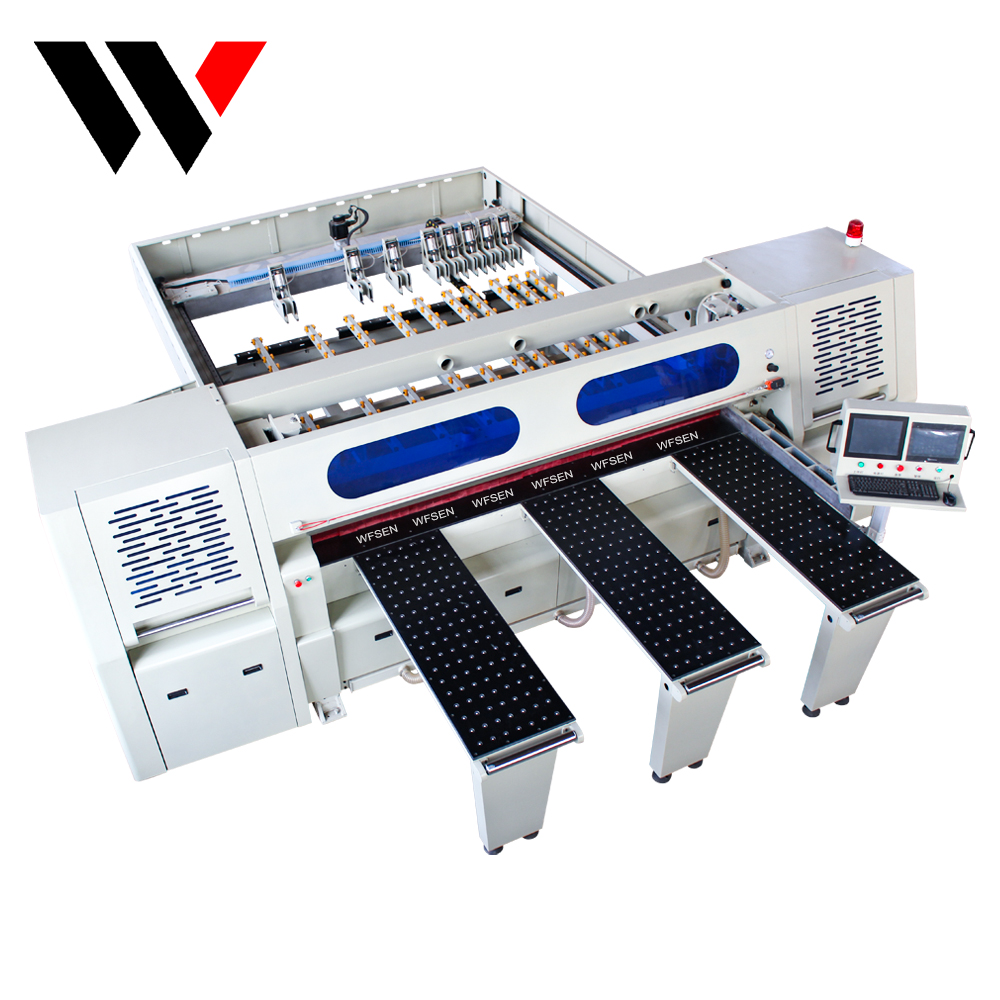
Short answer: there are three ways to cut a panel down to size, and they are not the same machine used differently. A CNC beam saw runs the saw head over a stack of panels under computer control; a vertical panel saw stands the panel up and runs the head across it; a sliding table saw pushes the panel past a tilting blade on a sliding carriage. The published figures for our six models put the choice in one line: the cutting size is nearly identical across the vertical panel saws, so what you are paying for is automation and accuracy — and the published accuracy across the range runs from ±0.02 mm to ±0.3 mm, a spread of fifteen times.
This page compares the six panel cutting machines we build on their published specifications — cutting size, saw power, spindle speed, accuracy and weight — and says plainly where a product page does not publish a value.
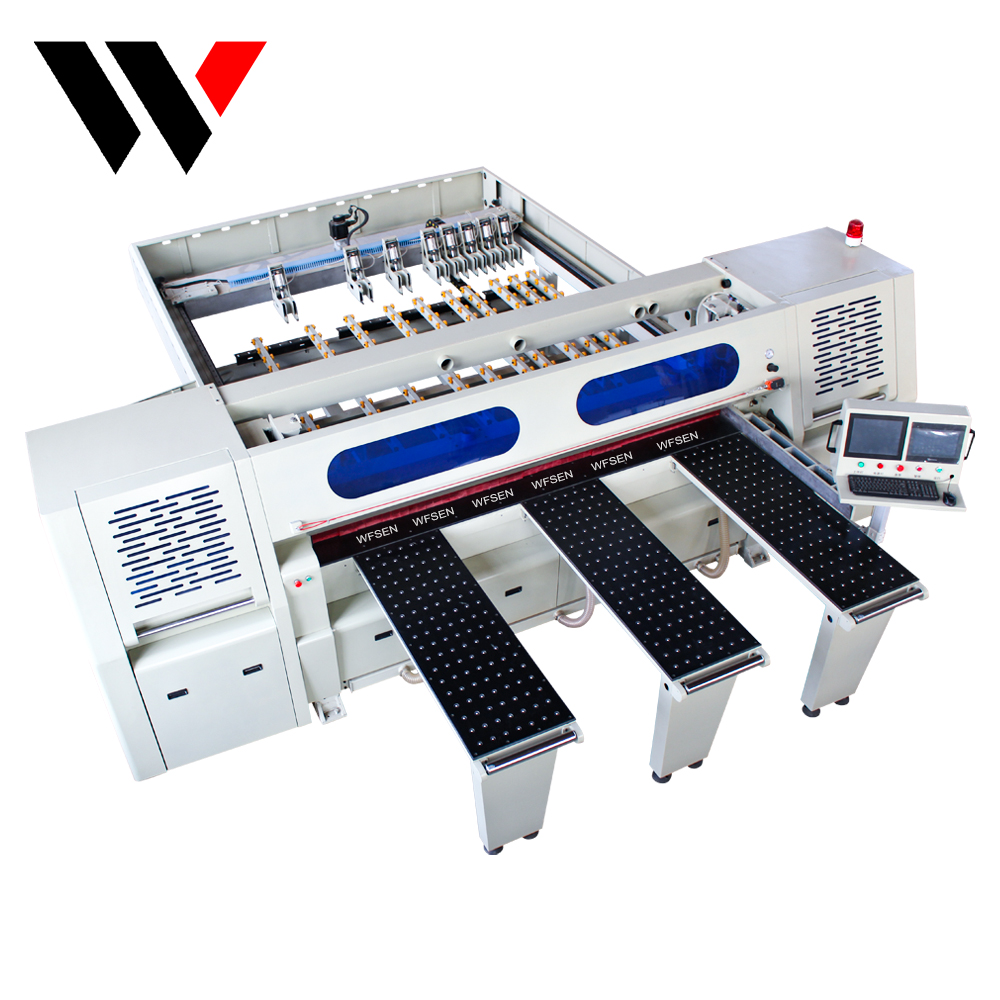
Each class solves a different problem, and none of them replaces the others.
The dividing line in practice is not panel size, because all three classes cut the same sheet goods. It is how many panels per shift, and how repeatable the cut has to be. The specification reading for the sliding table saw alone is covered separately in sliding table saw: what the specification means.
The CNC beam saw machine is published with two variants — MJ2700 and MJ3300 — and the published saw length is 2700 mm and 3300 mm respectively. The model number is the cutting length. That is the first decision on a beam saw, and it is worth reading the code rather than the marketing copy.
Its published figures: head saw motor 7.5 kW / 11 kW / 18 kW depending on variant, grooving saw motor 1.5 kW, saw drive servo 1.5 kW, automatic feeding motor 1.5 kW, high pressure blower 2.2 kW. Main saw blade diameter is published as 355 / 400 / 460 mm, main saw blade speed 3950 / 4500 rpm, grooving saw blade speed 5400 rpm, and saw thickness 75 / 100 / 120 mm. The saw carriage is published at 0-120 m/min forward and 60-120 m/min return. Overall dimensions are 5500 × 5600 × 1700 mm or 6100 × 6200 × 1700 mm and the machine weighs 5000 kg or 6000 kg.
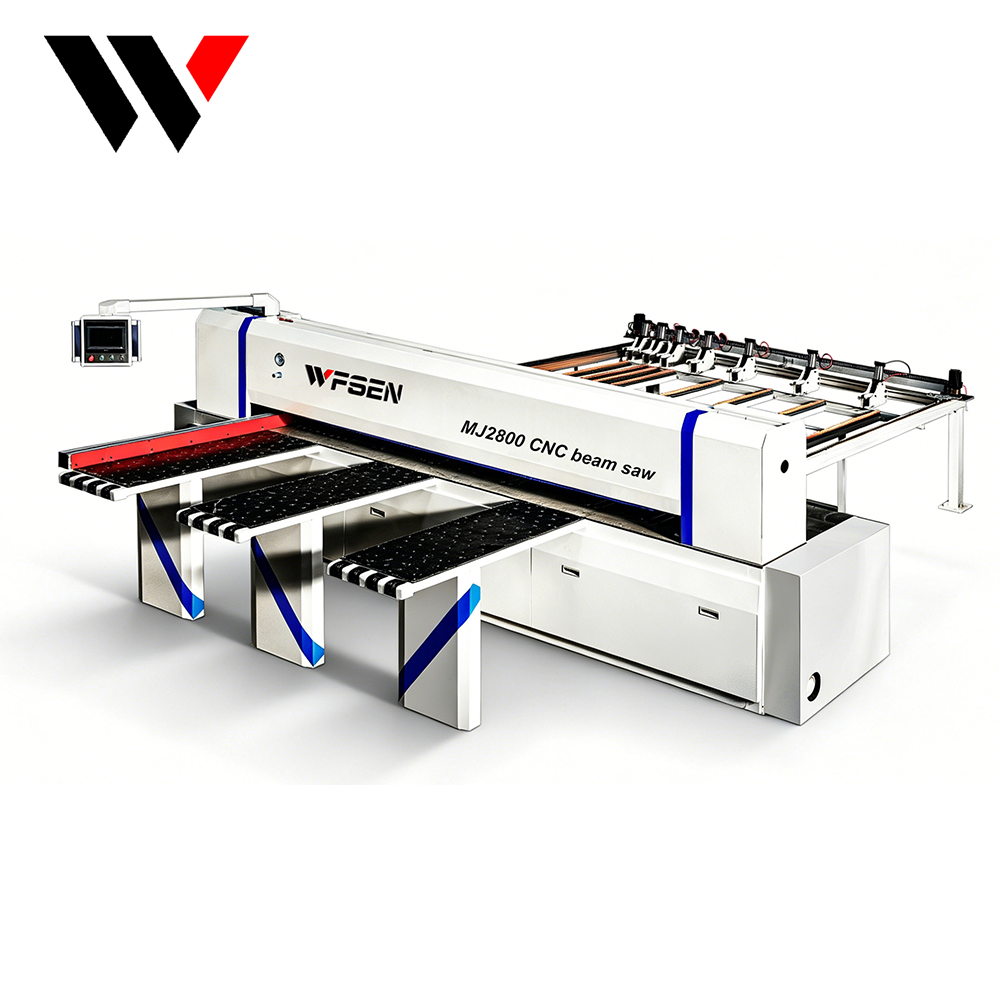
The MJ2800 CNC beam saw is the smaller machine on the same principle: main saw motor 7.5 kW, small saw motor 1.5 kW, three servo motors at 0.75 kW each, main saw blade Φ355 mm and small saw blade Φ250 mm. Its published cutting width is 2800 mm and maximum cutting thickness 60 mm. It weighs 1700 kg on a 4700 × 4660 × 1700 mm footprint, and its published cutting size is customizable — the page gives 3000 / 3300 / 3600 / 3800 mm as examples.
Put the two side by side and the interesting number is the weight. The MJ2800 is 1700 kg and the larger beam saw is 5000-6000 kg — a difference of roughly three times, on a footprint that grows by less than a third. The extra mass is in the frame and the automatic handling, not in the cutting envelope.
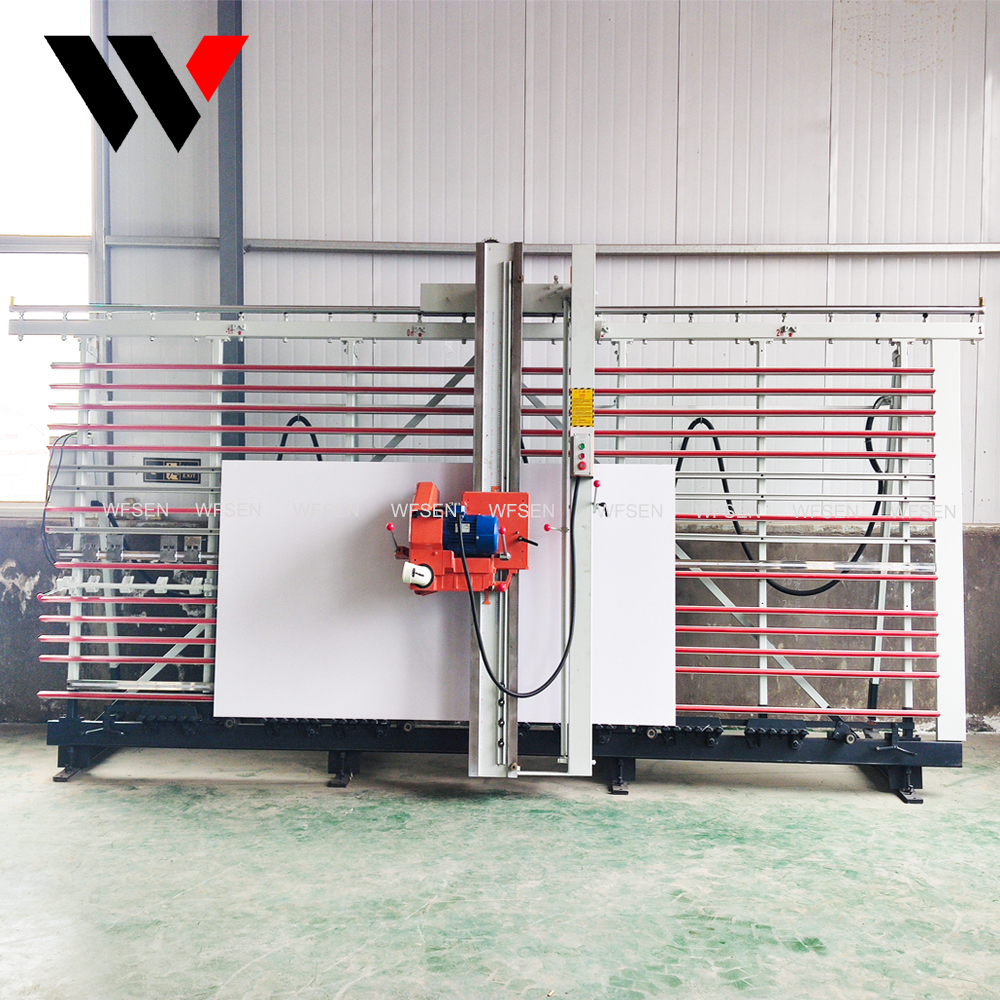
This is the part of the range that surprises people. We build three vertical panel saws and all three publish the same cutting size: 4100 × 1600 mm.
| Model | Cutting size | Main motor | Motor speed | Max cutting thickness | Grooving depth | Weight |
|---|---|---|---|---|---|---|
| MJF4116 full auto vertical panel saw | 4100 × 1600 mm | 7 kW | 5400 r/min | 60 mm | 0-20 mm | 1000-1200 kg |
| MJF4116 manual vertical panel saw | 4100 × 1600 mm | 6 kW | 2800 r/min | 60 mm | 0-20 mm | 1100 kg |
| MJ4116 vertical panel saw | 4100 × 1600 mm | 4 kW | 2900 r/min | 60 mm | 0-8 mm | 1000-1200 kg |
So the question a buyer should ask is not "which one cuts bigger" — none of them does. It is "which one do I need", and the table answers it in two columns.
The MJ6232TD Europe table saw is published as a family of five (MJ6232TD / TE / TF / TG / TS) with cutting lengths of 2800 / 3000 / 3200 / 3600 / 3800 mm and a maximum cutting width of 1250 mm. Main motor 5.5 kW, scoring motor 1.1 kW, main saw blade 300 mm, scoring saw blade 120 mm, main spindle diameter 30 mm, main saw spindle speed 4500-6000 rpm and scoring saw spindle speed 7000-8000 rpm.
Two published figures decide whether this machine belongs in your shop. The blade tilts to 45 degrees, and the sliding table is 380 mm wide — neither of which a beam saw or a vertical panel saw offers. If your work includes angled cuts, this is the class that does them. Height of cut is published at 90 mm at 90 degrees and 60 mm at 45 degrees. Gross weight is 800-1200 kg.
Note also what the same family table publishes about automation, because it changes with the model suffix: the main saw angle title is manual on TD / TE / TF / TG and auto on TS, and the main saw up-and-down movement is manual on TD and TF, auto on TE, TG and TS. The model code is not decoration — it tells you which movements you will be turning by hand.
Cutting accuracy is the specification most often skimmed and most likely to decide whether the next stage of production runs. These are the published figures, per machine:
Read that list as a buying tool rather than a ranking. The gap between ±0.02 mm and ±0.2 mm is a factor of ten, and it is not a rounding difference — it is the difference between a machine built around a servo-controlled carriage and one built around a solid frame. Whether you need it depends on the next operation: an edge bander or a drilling machine will absorb some variation, but a visible joint between two panels will not. What each figure means for the panel you actually sell is the reason we publish them at all.
| Model | Class | Cutting size / length | Max cutting thickness | Main motor | Weight | Outline size |
|---|---|---|---|---|---|---|
| MJ2800 | CNC beam saw | cutting width 2800 mm; length customizable (3000 / 3300 / 3600 / 3800 mm) | 60 mm | 7.5 kW | 1700 kg | 4700 × 4660 × 1700 mm |
| MJ2700 / MJ3300 | CNC beam saw | saw length 2700 / 3300 mm | 75 / 100 / 120 mm | 7.5 / 11 / 18 kW | 5000 / 6000 kg | 5500 × 5600 × 1700 mm or 6100 × 6200 × 1700 mm |
| MJF4116 full auto | Vertical panel saw | 4100 × 1600 mm | 60 mm | 7 kW | 1000-1200 kg | 5500 × 1900 × 2500 mm |
| MJF4116 manual | Vertical panel saw | 4100 × 1600 mm | 60 mm | 6 kW | 1100 kg | 5400 × 1900 × 2500 mm |
| MJ4116 | Vertical panel saw | 4100 × 1600 mm | 60 mm | 4 kW | 1000-1200 kg | 5400 × 1300 × 2600 mm |
| MJ6232TD family | Sliding table saw | cut length 2800 / 3000 / 3200 / 3600 / 3800 mm; cutting width 1250 mm | 90 mm at 90°, 60 mm at 45° | 5.5 kW | 800-1200 kg | 2850-3850 × 3150 × 900 mm |
The span from 800 kg to 6000 kg across these six machines is not a footnote. It decides floor preparation, lifting equipment and where the machine can be installed at all.
Watch the units on two of the published fields as well. Working pressure on the CNC beam saw machine is published as 5-7 kg/cm, which is not the MPa figure used elsewhere on our site — convert before you compare. And the machine heights split into two groups: the beam saws and table saw publish heights of 900-1700 mm, while the vertical panel saws are 2500-2600 mm tall, which matters if your shop has a low ceiling.
Which vertical panel saw cuts the largest panel?
All three. The MJF4116 full automatic, the MJF4116 manual and the MJ4116 each publish a cutting size of 4100 × 1600 mm.
What is the difference between the three vertical panel saws?
Motor power, motor speed, grooving depth and automatic versus manual traverse. Grooving depth is 0-20 mm on both MJF4116 machines and 0-8 mm on the MJ4116.
How accurate are these machines?
The published figures are ±0.02 mm on the CNC beam saw machine, ±0.2 mm on the MJ2800 and ≤ 0.3 mm on the MJF4116 full automatic. The remaining models do not publish a directly comparable accuracy figure in their parameter tables.
How many panels thick will a beam saw cut?
The CNC beam saw machine publishes saw thickness of 75 / 100 / 120 mm depending on variant, and the MJ2800 publishes a maximum cutting thickness of 60 mm.
Can a table saw cut at an angle?
Yes. The MJ6232TD family publishes a tilting saw blade to 45 degrees, with a height of cut of 60 mm at 45° and 90 mm at 90°. Neither the beam saws nor the vertical panel saws publish an angled cut.
What floor space does the largest machine need?
The CNC beam saw machine is published at 5500 × 5600 × 1700 mm, or 6100 × 6200 × 1700 mm on the larger variant, at 5000-6000 kg.
The panel saw is the first operation in a panel line, and its accuracy travels down the whole line. A cut that is 0.5 mm out becomes a visible joint after banding, and a panel cut to the wrong size wastes the tape and the labour that follow it.
The sequence from there is well documented on this site: the edge banding machine guide covers the bander that seals the cut edge, the types of drilling machines page covers hole drilling, and what edge banding is and how the machine works explains why the cut edge matters at all. The full saw range is listed on the saw machine page.
Tell us the panel size you buy, how many panels a shift you need to cut, whether any cuts are angled, and how deep a groove your work needs. Those four answers usually settle which of these six machines is the right one — and you can reach us from the contact page.