A surface planer and a thicknesser are not two sizes of the same machine. One makes a face flat. The other brings the board to a number. Buy them in the wrong order of thinking and you end up with boards that are all the same thickness and all twisted.
We build three planing machines at WFSEN, and their published figures show what separates them: a 400 mm surface planer at 3 kW, a 400 mm thicknesser at 3 kW, and a 1300 mm heavy thicknesser at 26 kW. Same 4 mm maximum depth of cut on all three. The differences lie elsewhere.
A rough sawn board is not flat in any direction. It can be cupped across its width, bowed along its length, and twisted corner to corner. A thicknesser cannot fix any of that, because it registers off the face you feed against it — run a twisted board through a thicknesser and you get a twisted board of a precise thickness.
So the surface planer goes first. It establishes one flat reference face. Only after that face exists can the thicknesser work to it, planing the opposite side parallel and to a set dimension. Shops that skip the first step spend the rest of the job fighting the same twist.
Two machines, two jobs, one sequence. That is the whole reason both belong in a joinery shop even though they look similar on the floor.
| MB504 surface planer | MB104 thicknesser | B1300 heavy wide thicknesser | |
|---|---|---|---|
| Max working width | 400 mm | 400 mm | 1300 mm |
| Max working thickness | not published | 180 mm | 10–150 mm |
| Max depth of cut | 4 mm | 4 mm | 4 mm |
| Spindle speed | 6000 rpm | 6500 rpm | not published |
| Motor power | 3 kW | 3 kW | 26 kW |
| Feeding speed | not published | 10 m/min | 6–30 m/min |
| Knives | 3 pcs | not published | not published |
| Guide plate tilting angle | 45°–90° | — | — |
| Overall size | 2080 × 920 × 1080 mm | 760 × 830 × 1270 mm | 2050 × 1650 × 1620 mm |
| Weight | 400 kg | 500 kg | 1800 kg |
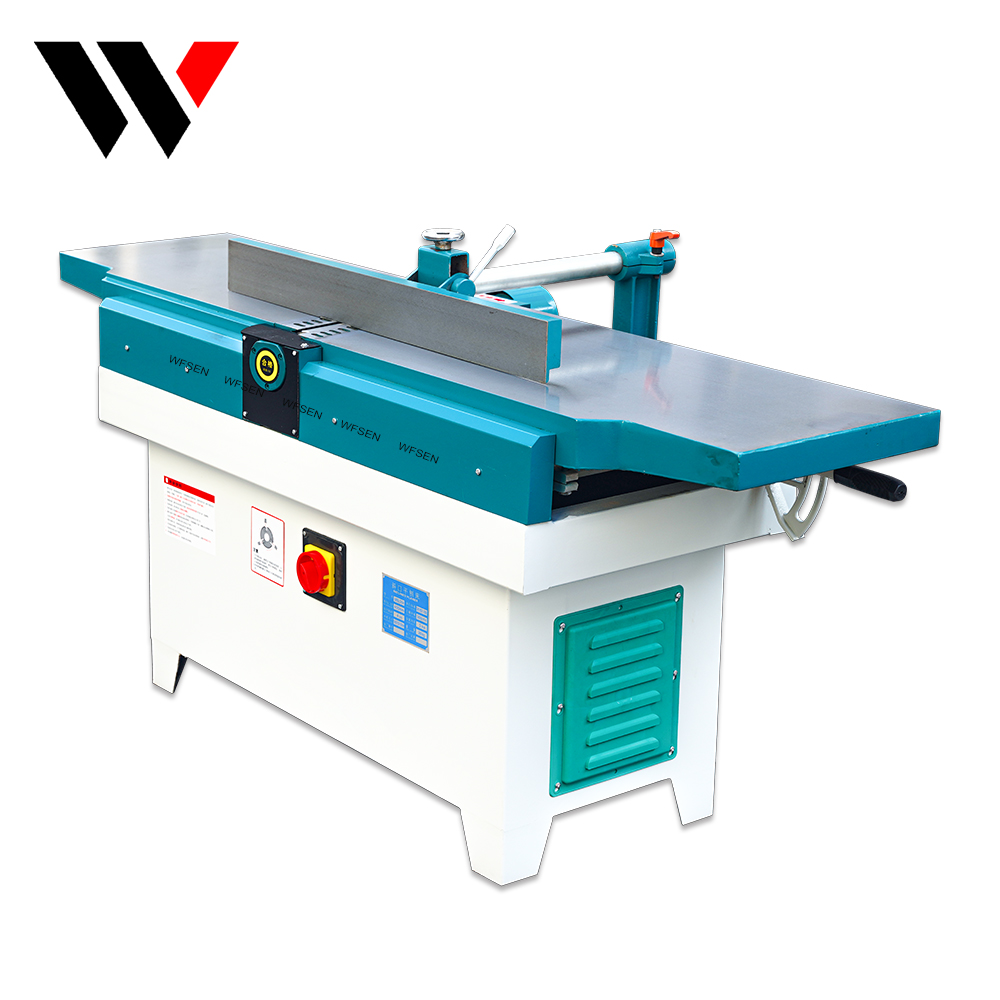
The MB504 surface planer runs a three-knife head at 6000 rpm across a 400 mm width, driven by a 3 kW motor. The table is 2080 × 920 mm and the machine weighs 400 kg — light enough to move with a pallet truck, heavy enough to stay put while you push a board across it.
The guide plate tilts from 45° to 90°. That range is what makes this machine useful beyond flattening: at 90° you are squaring an edge to the face, and at the angles below it you can hold a bevel while you plane it. Shops that only flatten faces miss that half of the machine's job.
The MB104 thicknesser planer takes boards up to 400 mm wide and 180 mm thick, with a spindle speed of 6500 rpm — a little faster than the surface planer's head, which helps the finish on the second face.
Feeding speed is published at 10 m/min, a single figure rather than a range. The machine itself is small: 760 × 830 × 1270 mm and 500 kg. It is a bench-scale industrial machine, not a line machine, which suits joinery work where boards are handled one at a time.
Both machines have the same 4 mm maximum depth of cut. That is normal — depth of cut is set by the cutter head and the feed geometry, not by how large the machine is. Do not expect to take heavier passes because you bought a bigger planer.
The overall dimensions of these three machines are a quiet clue to how each one works.
The surface planer measures 2080 × 920 × 1080 mm. The thicknesser measures 760 × 830 × 1270 mm. Look at the first number: the surface planer is nearly three times as long, on a machine of similar weight — 400 kg against 500 kg. Length is table. You push a board across a surface planer by hand, and that board needs somewhere to be while you do it, so the tables run long and support the timber either side of the cutter.
The thicknesser needs no such runway. Its own feed rollers take the board from you and drive it through, so the body can be short and the height taller — 1270 mm against the planer's 1080 mm.
The B1300 reverses that pattern again: 2050 mm long but 1650 mm deep, because it has to hold cutters and a bed wide enough for 1300 mm of timber. Width shows up on the floor as depth.
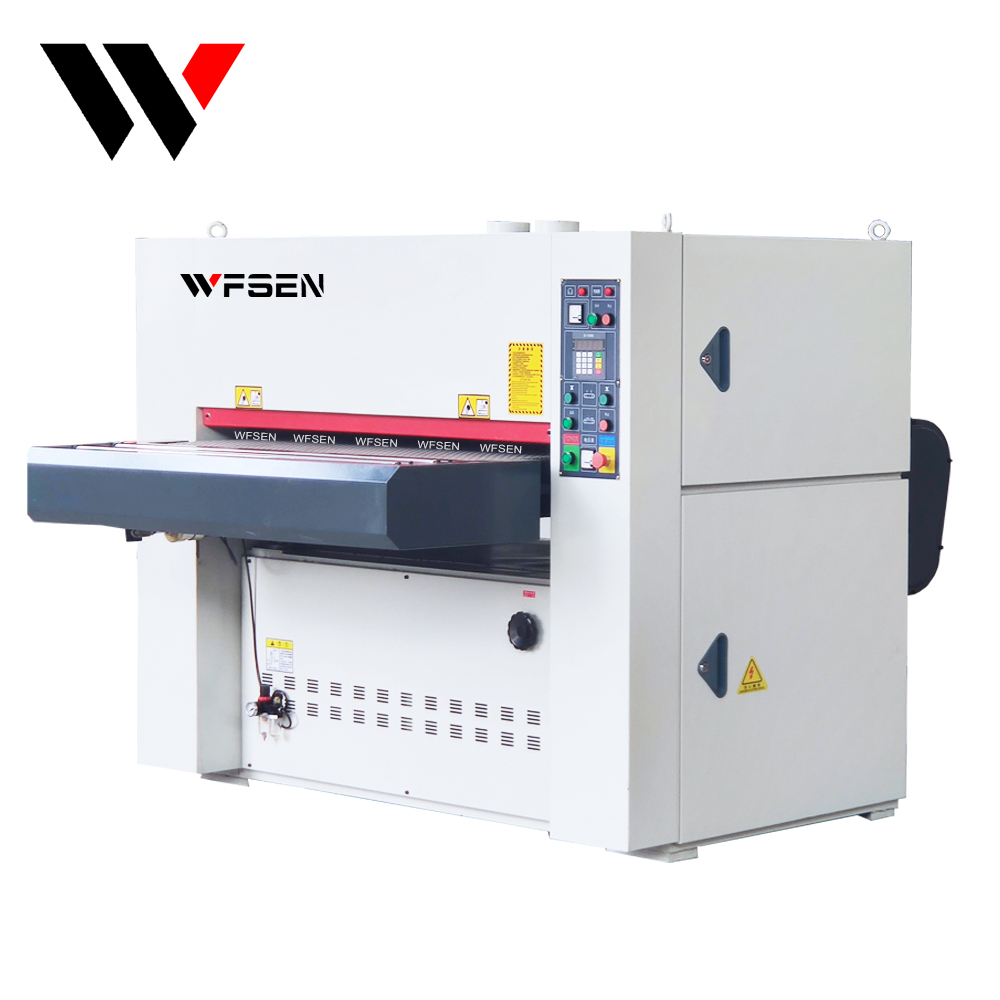
Now put the B1300 next to the MB104. The B1300 heavy wide thickness planer is published at 1300 mm working width — 3.25 times the MB104. Its motor is 26 kW, which is 8.7 times the MB104's 3 kW. It weighs 1800 kg against 500 kg.
Look at the shape of those numbers rather than their size. Width goes up 3.25 times; power goes up 8.7 times. A wider cut means more knives in contact with more timber at the same moment, and that load climbs faster than the width does. The B1300 is not a scaled-up MB104 — it is a different class of machine with a different power-to-width relationship.
Feed speed also becomes a range: 6–30 m/min against the MB104's fixed 10 m/min. On a wide machine that variability matters, because the right speed for a softwood board and for a dense hardwood at 1300 mm wide are not the same. Published maximum thickness is 10–150 mm, and maximum working length 300 mm.
One note on the figures: the B1300 page also states a working thickness of 3–110 mm in its opening text, against 10–150 mm in the parameter table. We quote the table. If a specific range is critical to your job, ask for it in writing at quotation stage.
Two more machines sit in the same catalogue and are often confused with planers. They are not.
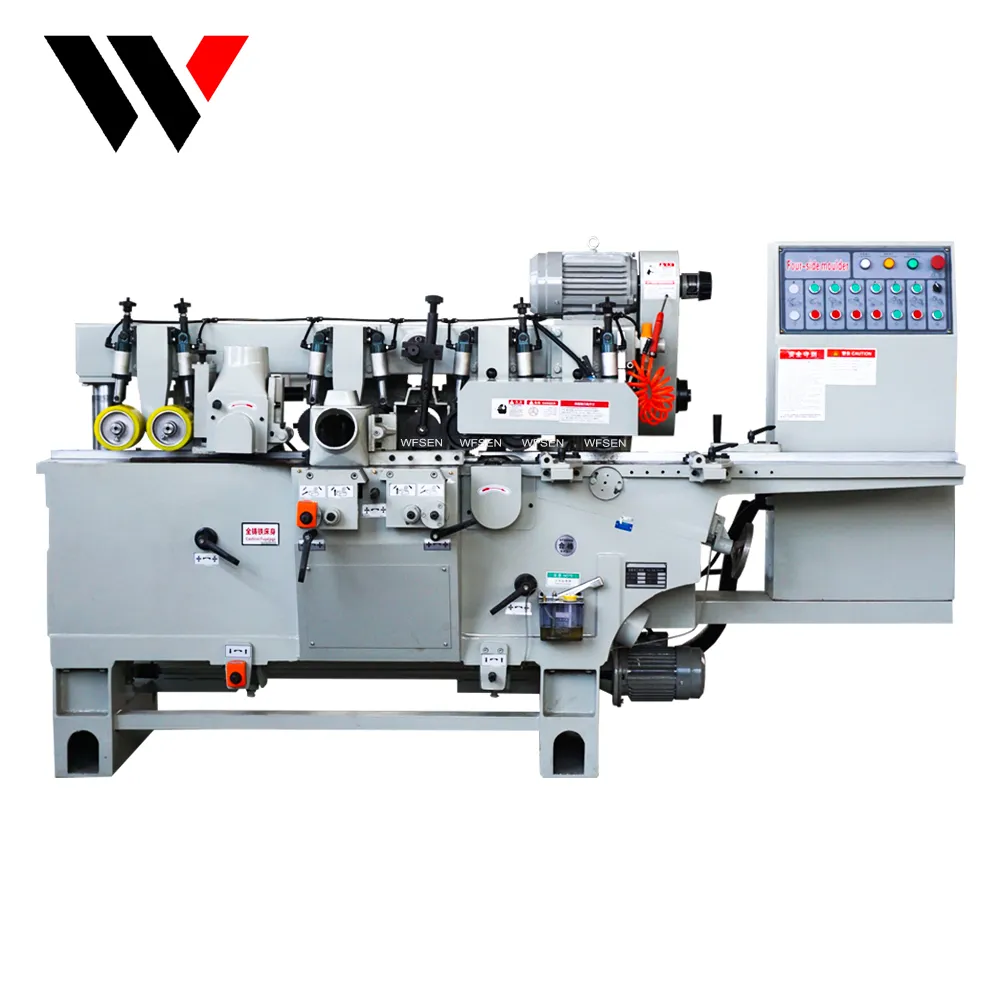
The MB4015 four sides moulder takes 20–150 mm working width and 8–100 mm thickness, with a knife speed of 6000 r/min. Its power is listed as separate shafts rather than one figure: lower shaft 2.3 kW, upper shaft 4 kW, right side 2.2 kW, cross beam 0.37 kW and a 1.5 kW feed motor — 12.47 kW total. It also publishes a maximum turning circle of 115 mm. This machine shapes all four faces in one pass; a surface planer plus a thicknesser needs two passes to do two of them.
The MX5117B spindle moulder is the shaping machine: 400 mm working width, 5.5/7.5 kW, and a spindle that runs at 6000 / 8000 / 10000 r/min in either direction, on a 35 mm spindle with a 1100 × 670 mm table. Three speeds and reverse exist because tooling diameters differ — a large cutter head needs a slower spindle than a small one to hold the same surface speed at the cutting edge.
Several fields are absent across these pages, and knowing which ones to chase is part of buying well.
Ask for the missing rows in writing. A supplier who can produce them is a supplier who knows the machine.
Can a thicknesser replace a surface planer?
No. A thicknesser registers off the face already against its bed, so it copies whatever twist the board already has. The surface planer creates the flat face the thicknesser works from.
Does a wider thicknesser take a deeper cut?
The published maximum depth of cut is 4 mm on the 400 mm MB104 and 4 mm on the 1300 mm B1300. Width and depth are separate limits.
Why does the wide machine need so much more power?
More width means more knives cutting at the same instant. On these figures width rises 3.25 times while motor power rises 8.7 times.
What is the difference between a four-sided moulder and a spindle moulder?
The four-sided moulder dresses all four faces of a square section in one pass. The spindle moulder shapes a profile, runs a range of spindle speeds and is the machine you use for curved and moulded work.
Does a surface planer also square an edge?
Yes. The MB504's guide plate tilts from 45° to 90°, so at 90° you are squaring an edge against the face you have just planed, and at the angles below it you can hold a bevel while you cut. That range is the reason a surface planer does more than flatten boards.
How many knives do these machines run?
The MB504 is published with 3 cutter knives. Knife count is not given on the parameter tables for the MB104, B1300, MB4015 or MX5117B — ask for it if your finish specification depends on it. Note that knife marks per inch depend on both knife count and spindle speed, and those two figures differ across this range: 6000 rpm on the MB504, 6500 rpm on the MB104, and 6000 r/min on the four-sided moulder.
Solid wood preparation sits upstream of most panel work, and the machines that follow it are covered in the planing and moulding range. If your boards are already dimensioned, the next stages are sanding and edge banding.
Send the section sizes you machine and the daily volume to the WFSEN engineering team, and you will get a machine combination sized to that work.