Sand the face of a board and you are finishing a surface. Sand its edge and you are finishing a profile — and the two jobs use different machines. A wide belt sander cannot follow the curve of a door frame, and a hand-held sander will not hold the same edge for four hundred doors.
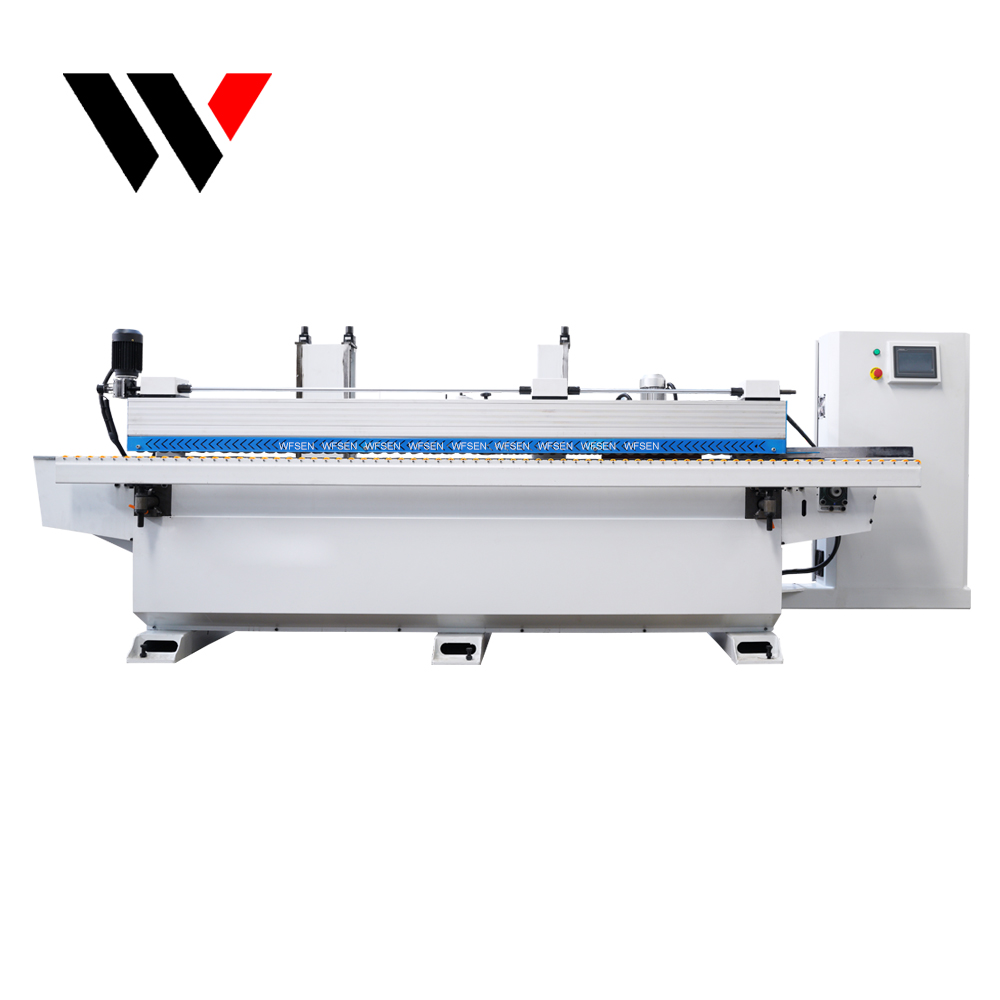
We build three edge sanding machines, and the way to tell them apart is to measure the work rather than the machine. One takes edges up to 1800 mm wide in a continuous line. One is built for picture frames and mouldings with a pre-milling head in front of the sanding belt. One stands a narrow belt vertically for edges you present by hand. Machine weights run 280 kg, 800 kg and 1600 kg.
Our largest edge sander is called the 1S1C1P1P, and the letters are not decoration. The catalogue defines them directly:
Read it as a sequence of stations: the strip goes through belt sanding, then a corner unit, then a belt polisher, then a brush polisher, and comes out finished. Four processes, one pass, no handling between them. When a supplier quotes you a model number in this family, the code already tells you how many stations you are paying for. Ask that question before the conversation reaches price.
The electrical figures match the station count. This machine publishes six separate motors: a 2.2 kW feed motor, 2.2 kW belt sanding, 0.12 kW swing belt sanding, 1.1 kW corner, 1.5 kW belt polishing and 1.5 kW brush polishing. Add them and you have 8.62 kW of installed motor power doing six different jobs — which is why the machine weighs 1600 kg.
These two get mixed up constantly, and they solve different problems. Edge banding glues a strip of PVC, ABS or veneer onto the raw edge of a panel. It covers the core. Edge sanding machines do not add anything — they shape and finish material that is already there: solid timber edges, moulded profiles, frame stock, the sides of a door.
A cabinet shop running melamine panels needs banding. A joinery making solid oak doors needs edge sanding. Some shops need both, on different benches. If you are not sure which side of the line your work falls on, look at the part: does the edge need a strip glued to it, or does it need shaping?
The three machines above are all on the sanding side.
| 1S1C1P1P | SE1BF | MM2617 | |
|---|---|---|---|
| Working width | 100–1800 mm | not published | not published |
| Working thickness | 5–80 mm | 60 mm max | 170 mm sanding height |
| Pre-milling head | no | 4 kW | no |
| Belt size / speed | not published | not published | 3120 × 170 mm / 18 m/s |
| Feeding | 5–30 m/min, frequency control | frequency control | hand guided |
| Overall size | 4200 × 1100 × 1500 mm | 3500 × 1200 × 1500 mm | 1900 × 650 × 1100 mm |
| Weight | 1600 kg | 800 kg | 280 kg |
The published working range is 100–1800 mm wide and 5–80 mm thick, with frequency-controlled feeding from 5 to 30 m/min. Overall size is 4200 × 1100 × 1500 mm and the machine runs on PLC control.
That width figure is the one to check against your product. At 1800 mm it will take a full cabinet side or a long door stile through edge-on. If your parts are smaller than a metre, you are buying capacity you may not need — and paying 1600 kg of machine weight for it.
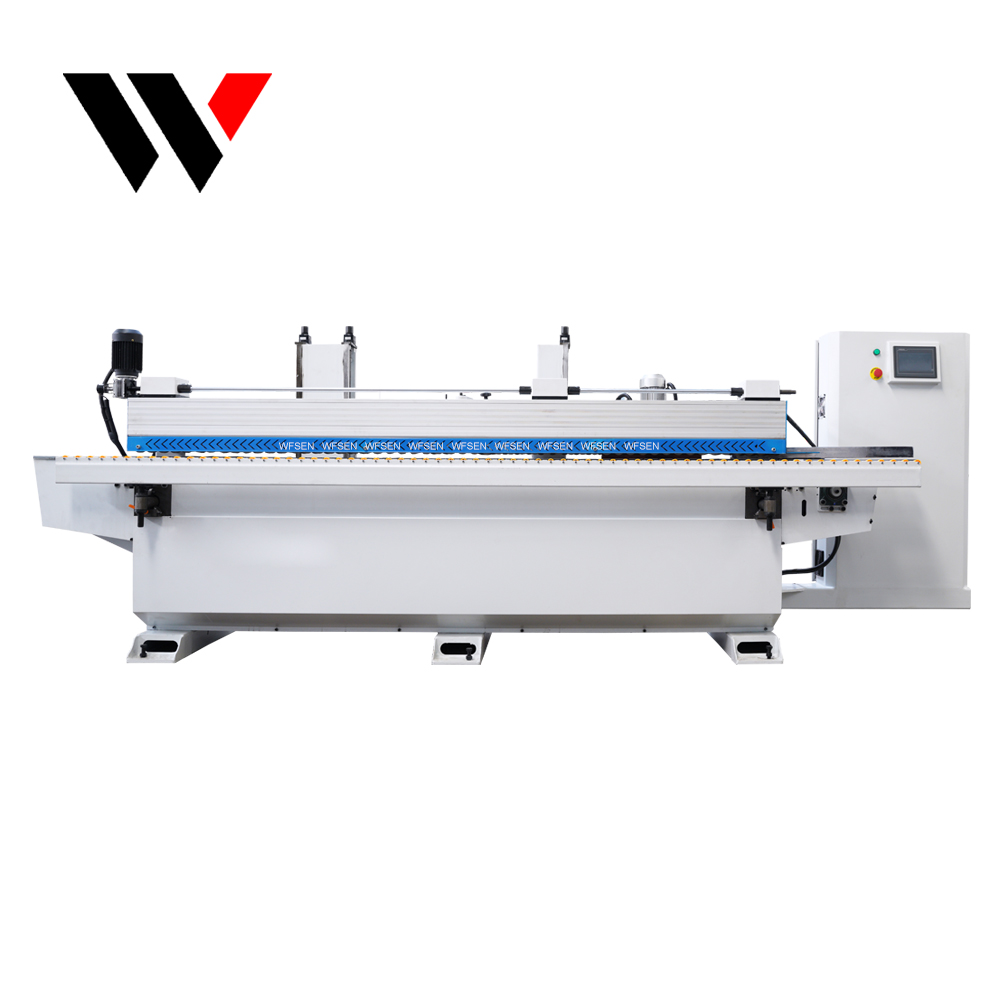
The SE1BF edge sanding machine is built around picture frames, mouldings and narrow solid sections. Its published working thickness is 60 mm and its minimum working length 60 mm — a short part is not a problem for this machine.
What sets it apart is the power layout: 2.2 kW feed, 4 kW pre-milling, 1.5 kW × 2 belt sanding, and 0.75 kW × 2 roller polishing. The pre-milling head is the one no other machine in this group carries. It cuts the edge square before the belt touches it, which is what makes a consistent mitre on a frame rather than a rounded-over corner. On short parts that matters more than belt width does.
Feeding speed is listed as frequency control rather than a range, and overall dimensions are 3500 × 1200 × 1500 mm at 800 kg.
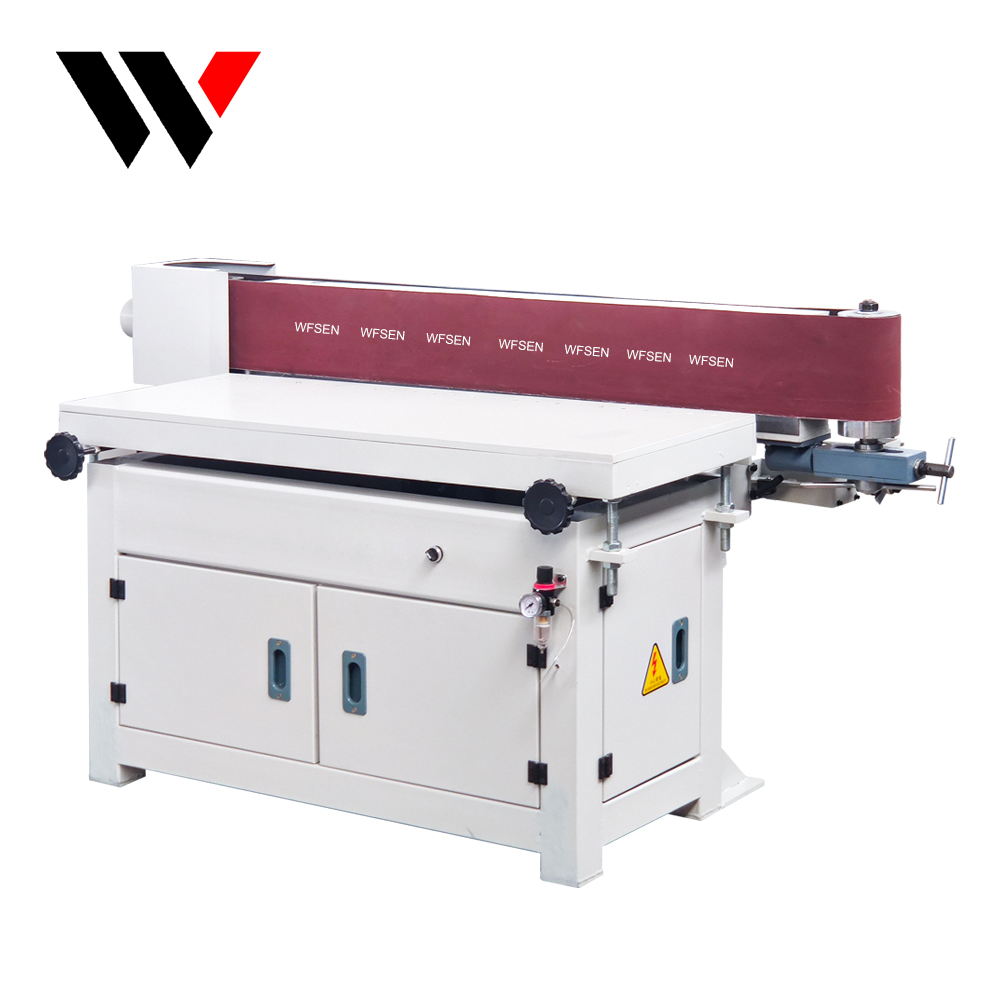
The MM2617 vertical belt edge sanding machine takes the opposite approach. It is a 280 kg machine with a single 4 kW motor driving a sanding belt of 3120 × 170 mm at a belt speed of 18 m/s, spindle speed 2890 r/min. Overall size is 1900 × 650 × 1100 mm.
It is the only one of the three that publishes a belt size and a belt speed, and the only one you present work to by hand rather than feed through. Maximum sanding height is 170 mm — the same number as the belt width, which is how a vertical machine works: the belt is as wide as the edge it can reach in one pass.
Where does a machine like this earn its place next to a full line? Short runs and one-offs. Setting up a 1600 kg line to touch up four doors costs more in setup than the doors are worth.
Two numbers decide almost every enquiry: the longest edge you sand in one piece, and whether that edge is straight or shaped.
Long straight edges in volume point to the 1S1C1P1P, which carries a part up to 1800 mm through four finishing stations without an operator touching it. Short parts with a mitre — frame stock, mouldings, small solid sections — point to the SE1BF, where the 4 kW pre-milling head and a 60 mm minimum length matter more than working width. And curved or irregular edges take you off the through-feed machines entirely: those are hand-guided, which is the gap the MM2617 sits in.
Weight tells you the same story from another direction. 280 kg, 800 kg, 1600 kg. The heavier the machine, the more of the work it does without you holding the part.
Add up the published motors on each machine and the ranking is worth a second look.
The 1600 kg 1S1C1P1P lists six motors totalling 8.62 kW. The 800 kg SE1BF lists five motors totalling 10.7 kW: 2.2 kW feed, 4 kW pre-milling, two 1.5 kW belt sanding motors and two 0.75 kW roller polishing motors. The 280 kg MM2617 runs a single 4 kW motor.
So the middle machine draws the most. Half the weight, 24% more installed power, and its price reflects that too. Blame the pre-milling head. Taking a 4 kW cut before the belt ever touches the edge costs more electricity than four finishing stations running at once. If you are sizing a supply or estimating running cost, weigh the motors, not the machine.
The 280 kg machine is a different case again. One motor. No feed drive. No polishing stations. It is cheap to run because it does one job, and cheap to move because it fits through a standard doorway at 1900 × 650 mm.
One more figure for anyone planning a shop layout. On a weight basis the SE1BF carries more installed power per kilogram than either of the other two. That is not a sales argument — it is a reminder that on this class of machine, weight measures structure and belt stability, while power measures what the cutting heads can do. Two separate specifications. Neither one implies the other.
A few fields are missing, and they are the ones worth asking about before you order.
Ask for them in writing at quotation stage. On a machine that will run for a decade, a missing number now is a phone call later.
What does 1S1C1P1P mean?
It is the station list. 1S is sanding by belt, 1C is corner by belt, and the two 1P stations are polishing by belt and polishing by brush.
Do I need pre-milling?
If your edge has to finish square — picture frames, mitred mouldings — the 4 kW pre-milling head on the SE1BF cuts the profile before the belt touches it. On straight panel edges that has already been cut clean, it adds less.
Can these machines sand curved edges?
The 1S1C1P1P and SE1BF are through-feed machines: the part travels, the belt stays. Curved and shaped edges are hand-guided work, which is what the vertical MM2617 is for.
How fine does the finish get?
That depends on your belt grit sequence, not the machine. What the machine controls is consistency — the same pressure and the same belt speed on every part.
Sand edges and faces are two halves of the same finishing operation; the face side is covered in sanding machine types. If your edges are banded rather than sanded, the equivalent choice sits in the edge banding range, and the full machine list is in the sanding machine range.
Send the longest edge you sand, the section size and your daily volume to the WFSEN engineering team and we will match the machine to the work.