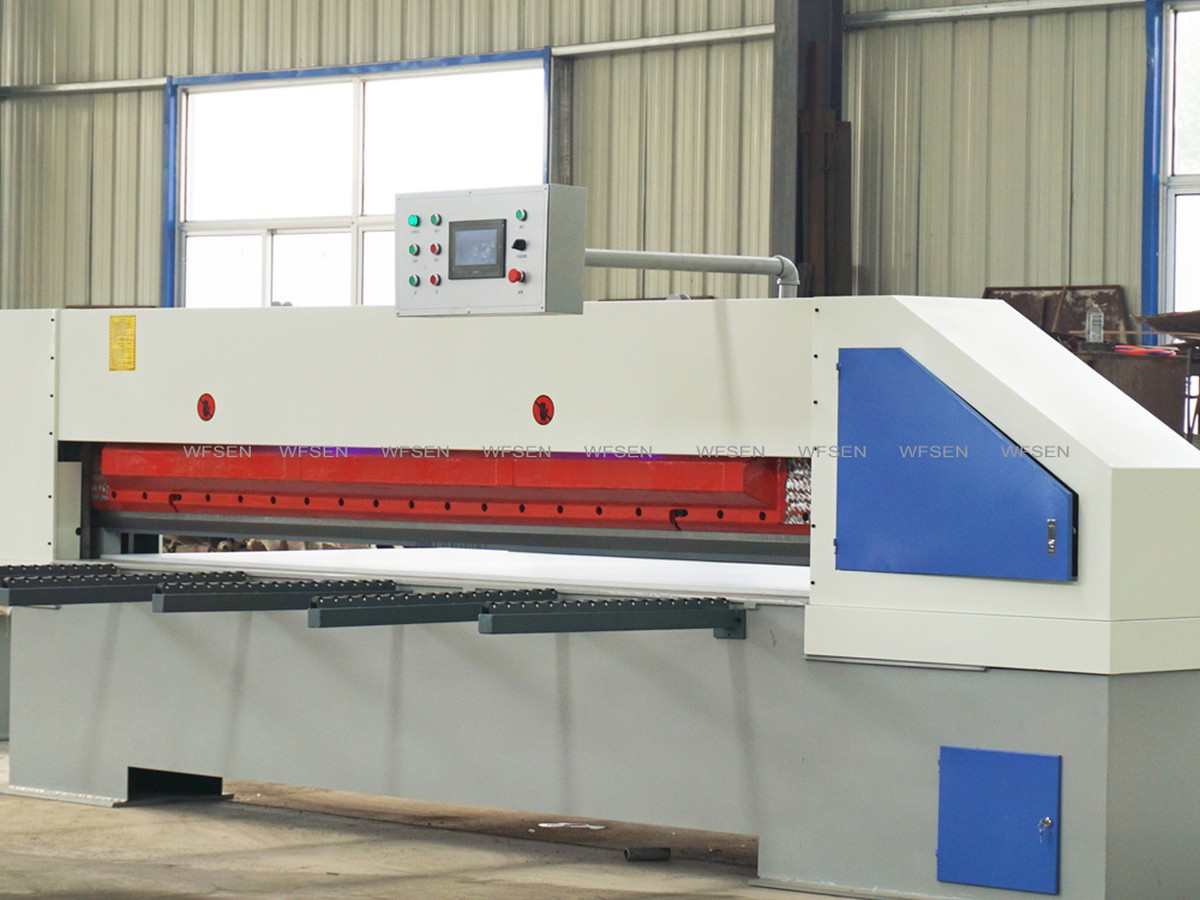
A veneer clipper is the machine that turns a continuous ribbon of veneer into sheets you can actually lay up. It sits early in a plywood line, before the adhesive is applied, and it is the last place where you can remove a defect at almost no cost — once a bad patch has been glued into a panel, the only remedy is scrap.
It is also the simplest large machine in the line, which is exactly why it is easy to buy badly. A clipper has one specification that decides whether it fits your work — cutting length — and a set of secondary figures that decide how it behaves in daily use. This guide covers both, using the three sizes in the WFSEN veneer clipper range as the worked example.
Veneer does not arrive as sheets. It arrives as a ribbon peeled off a log, or as a stack of oversized leaves, and it has to be cut to rectangles of a fixed length before anything else can happen to it. The clipper does that with a single straight knife that comes down across the full width of the machine in one stroke.
In most plywood plants it does one of two jobs, and which one you are buying for sets the specification:
Both jobs use the same machine, and both need the same thing from it: a clean, square cut with no crushing of the veneer under the knife.
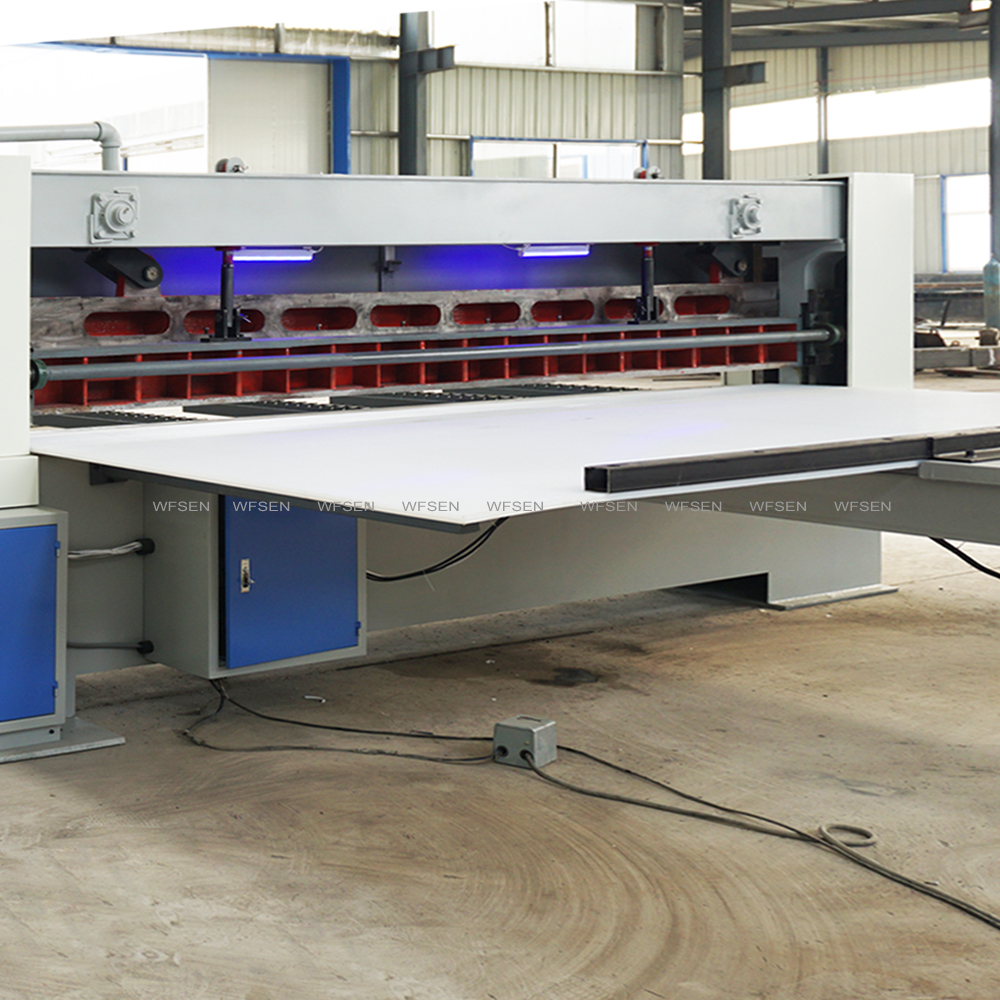
A veneer clipper is not a guillotine that chops. The sequence is what makes the edge clean, and it happens in a fraction of a second:
On the machines shown here the cycle is started from a foot pedal on the floor rather than from a button on the beam. That choice is deliberate. Both hands stay on the veneer to hold it square against the back gauge, and the operator keeps the same rhythm all shift without reaching up.
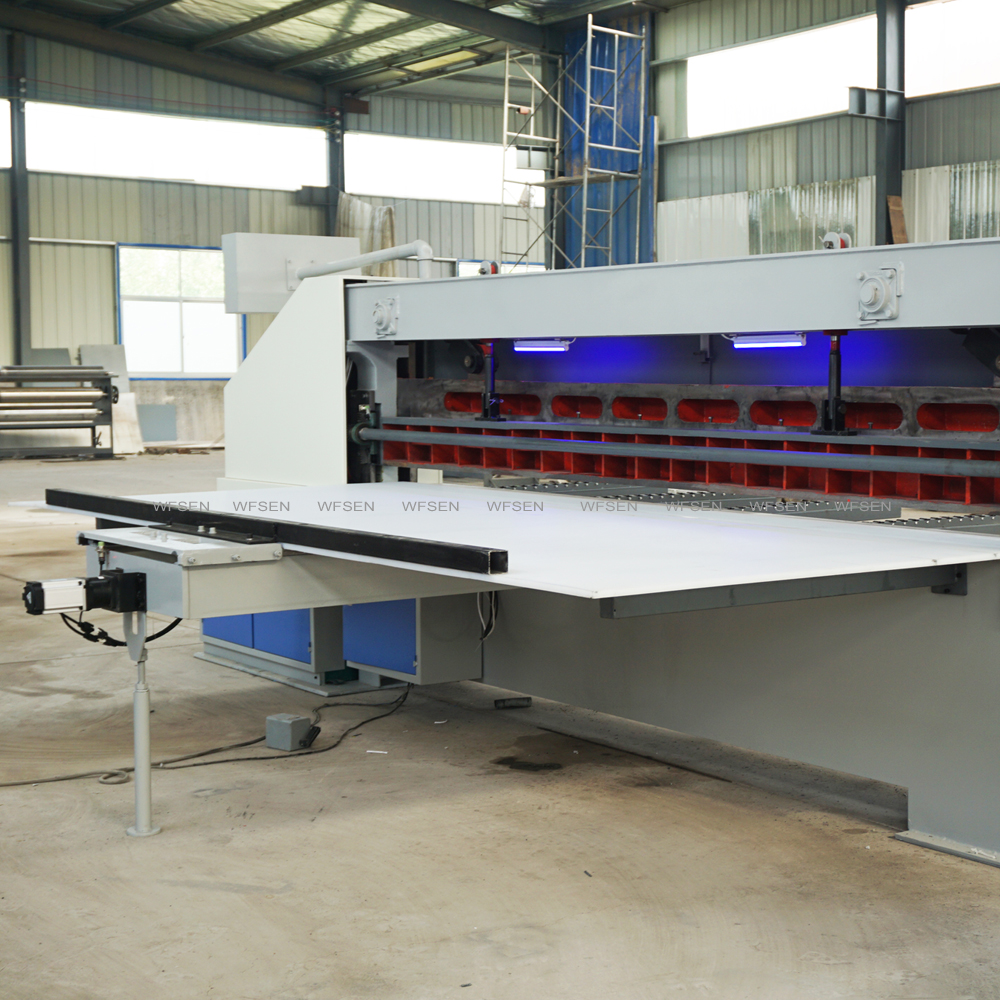
Everything else on a veneer clipper is secondary to cutting length, because cutting length sets what you can feed the line and how much floor the machine takes up. In the WFSEN range the three sizes exist for exactly one reason: the length of the sheet you need to produce.
Work backwards from your finished panel:
Then check the floor, because the three sizes grow in one direction only. Overall length goes from 2900 mm to 4100 mm to 4700 mm, while the width stays at 1400 mm and only widens to 1500 mm on the largest machine. A clipper is a long, thin machine, and it is the length — plus the clear space you need at each end to feed and take off a full sheet — that decides where it fits.
The range is built in both hydraulic and pneumatic versions, and the choice is usually made by what the rest of your plant already runs rather than by the clipper itself.
A pneumatic clipper needs a compressed air supply at 0.4–0.7 MPa, which almost every plywood plant already has for other equipment, and it is simple to maintain because there is no oil to manage. A hydraulic version develops its clamping and cutting force from an oil power unit, which suits plants that already run hydraulic presses and have the oil, filtration and service routine in place.
The practical point is that the choice should not change your sizing decision. All three models in this range are quoted at the same 4.4 kW motor power and the same air pressure band, whichever build you take. What you are buying at the larger sizes is a longer knife and a longer beam, not more power — which matters when a quotation makes a long machine look like a heavier machine.
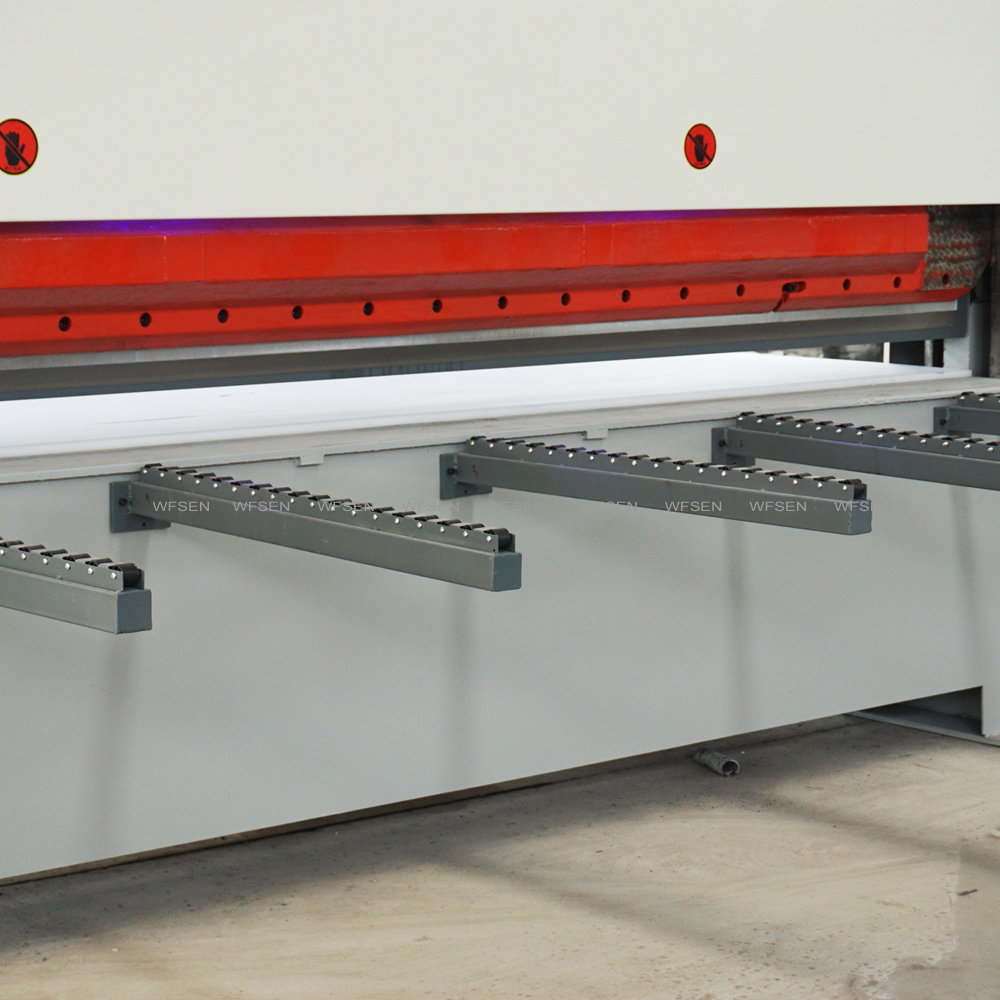
The part of a clipper that gets least attention in a specification sheet is the part that decides how much veneer you damage: what happens to the sheet after it is cut.
A full-width veneer sheet is thin and unsupported, and if it drops off the knife as soon as it is severed it folds, creases and picks up dirt on the floor. That is why a clipper of this class carries a row of roller support arms on the outfeed side, cantilevered off the machine body at table height. They carry the sheet clear of the knife and keep it flat until the operator lifts it off, and they are a more useful thing to inspect on a used machine than almost anything else on the frame.
Check these points when comparing machines: that the arms are long enough to take your longest sheet without it tipping off the end, that the rollers still turn freely, and that the table height matches the height of the stack or conveyor the sheet goes to next. A clipper that is correct on paper but half a metre out of line with the rest of the line is a machine that two people have to work around all day.
It is worth being clear about the sequence, because it explains why the cutting length has to match the machines around it, not the finished panel alone.
Veneer is peeled and dried, then sized on the clipper. The sheets go to the adhesive stage — on a plywood line that is normally a glue spreader applying the film — and then into the press stage, where cold pressing holds the stack flat and a hot press cures the bond. Our guide to the plywood pressing line covers that half of the process in detail, and the plywood production line page shows the whole sequence.
Two consequences follow for the clipper itself:
Most complaints about a clipper are one of five symptoms, and each points at a different part of the machine or the process.
1. A ragged or torn edge on one side of the cut. The pressure beam is not clamping evenly along the full cutting length, so the knife drags the sheet on that side. Check the beam before you blame the blade.
2. A clean edge at the ends and a poor edge in the middle. The knife has lost its straightness along its length, or the beam is bowing in the centre on a long machine. On a 3200 mm knife this shows up sooner than on a 1500 mm one, which is part of what the heavier knife section on the larger machines is there to control.
3. The cut length drifts over a shift. The back gauge is moving, or the operator is positioning by eye because the gauge is hard to read. A repeatable stop is worth more than any other upgrade on this machine.
4. Crushed or marked veneer under the beam. Clamping pressure is too high for the veneer you are cutting, or the beam face has picked up dirt and glue. The same clipper setting that is correct for a thick pack will mark a single thin leaf.
5. The sheet folds instead of stacking flat. This is not a cutting fault at all — it is the outfeed. Support arms that are too short, rollers that no longer turn, or a stack position that is too low will all fold a perfectly cut sheet.
The figures below are the published specification of the WFSEN range, including the MQ320 CNC veneer clipper. Read the three columns against each other rather than individually: what changes between them is length, knife section and weight, and what stays the same is the power unit.
| MQ150 | MQ260 | MQ320 | |
| Max. cutting length | 1500 mm | 2600 mm | 3200 mm |
| Max. cutting thickness | 40 mm | 40 mm | 40 mm |
| Knife size | 1500 × 105 × 14 mm | 2600 × 125 × 14 mm | 3200 × 145 × 14 mm |
| Air pressure | 0.4–0.7 MPa | 0.4–0.7 MPa | 0.4–0.7 MPa |
| Motor power | 4.4 kW | 4.4 kW | 4.4 kW |
| Overall dimensions | 2900 × 1400 × 1900 mm | 4100 × 1400 × 1900 mm | 4700 × 1500 × 2000 mm |
| Weight | 2000 kg | 2500 kg | 3000 kg |
One figure deserves a comment, because it is the one buyers misread. Maximum cutting thickness is 40 mm on all three models. That is not a board-thickness figure — it is the depth of veneer the knife will pass through in one stroke, which is what you need for a pack of leaves or a bundle being trimmed at the same time. A clipper sizes and trims veneer; it is not a panel saw.
How long does my veneer clipper need to be?
Long enough to cut the longest sheet you intend to sell, plus the trim allowance, because you are cutting to a finished size rather than simply dividing a ribbon. If 2440 mm and 2500 mm panels are your market, a 2600 mm clipper covers both; if you need 3050 mm or longer, the step up to 3200 mm is the difference between cutting and joining.
Can a veneer clipper cut a stack of sheets at once?
It will cut through 40 mm of material in one stroke, which is intended for a pack or bundle of veneer rather than for panels. Whether you should cut a stack depends on how square your sheets are already — a stack that is not perfectly aligned will produce a stepped edge.
Hydraulic or pneumatic — which should I choose?
Choose the one that matches the services and maintenance you already have. Both builds are quoted at the same 4.4 kW motor power and the same 0.4–0.7 MPa air pressure band, so the decision does not change your sizing or your output. A plant that already runs hydraulic presses will usually prefer hydraulic; a plant that does not will usually prefer pneumatic for its simpler upkeep.
Does the clipper have to be part of a CNC line?
No. The machine is built with automated cutting control and a touch-screen panel, and it will run as a standalone station with an operator feeding it by hand. It is the cutting length and the outfeed that decide how well it integrates, not whether the rest of your line is automated.
What should I look at on a used veneer clipper?
The knife for straightness along its full length, the pressure beam for even clamping, the back gauge for repeatability, and the outfeed rollers for free rotation. Those four items are where a worn clipper shows itself, and they are all inspection items rather than rebuild items.
WFSEN has been building woodworking machinery in Qingdao since 2008, on a 16,000 m² site, and the veneer clipper is built in three sizes on one design so that the cutting length can be matched to the panel you sell rather than to a catalogue. The build is offered with safety protection as standard and a two-year warranty.
Send us the following — the longest sheet you need to produce, the veneer thickness and how many leaves you cut at a time, and whether your plant already runs on compressed air or hydraulics — and we will tell you which of the three sizes fits and what the layout has to allow at each end of the machine. Contact our engineers to start.