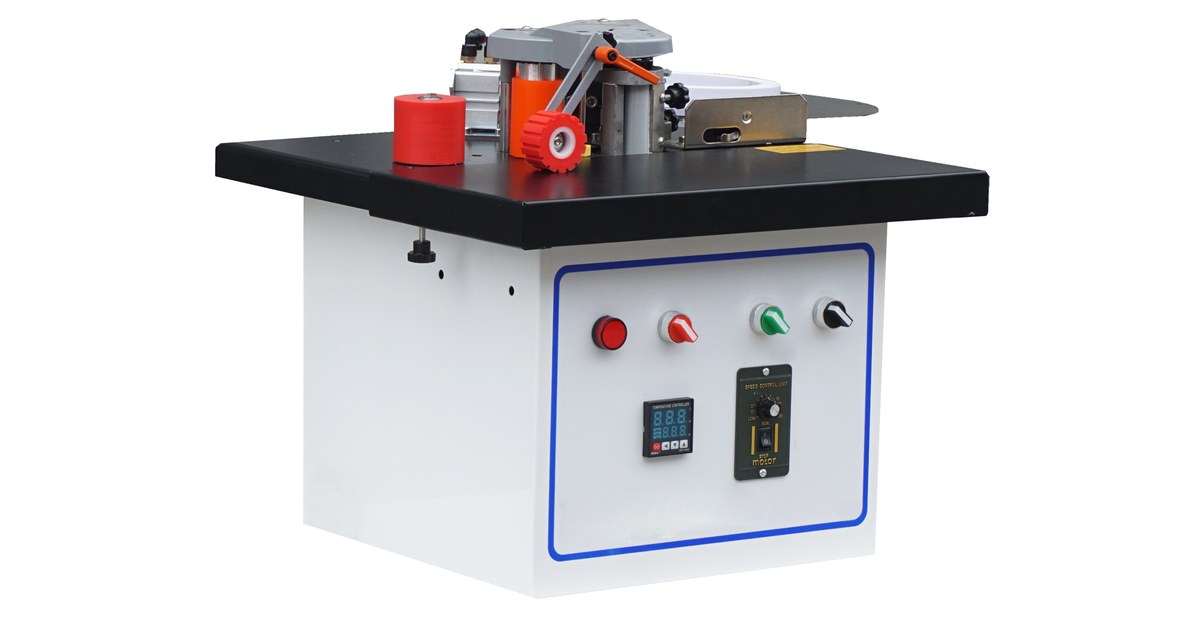
Short answer: a portable edge banding machine is the class you buy when the panel comes to the machine, not the other way round — installed cabinets, on-site door adjustments, and small batches that are not worth setting up a line. Our portable class has two machines, and they are not a large and a small version of the same thing: the MF170B is a 30 kg unit specified for edge belt 0.4–3 mm, panel thickness up to 60 mm and feed 0–6 m/min, while the MF160B is a 15 kg mini specified for edge belt 0.3–3 mm and feed 2–6 m/min. The lighter machine takes the thinner tape; the heavier machine is the one that can be brought down to a standstill for shaped work.
A portable edge banding machine exists for the jobs a fixed production line cannot reach: the cabinets that are already installed, the door that has to be adjusted on site, the small batch that is not worth setting up a full line for. The MF170B portable edge bander is the compact end of the WFSEN range — a 30 kg tabletop unit that glues, presses and cuts the tape at the workpiece instead of bringing the workpiece to the machine. This guide covers what the portable class actually does, the specifications that decide whether it fits your work, the controls you use on site, and the point at which a compact straight-line machine takes over. If you are still choosing between machine classes, start with the edge banding machine selection guide.
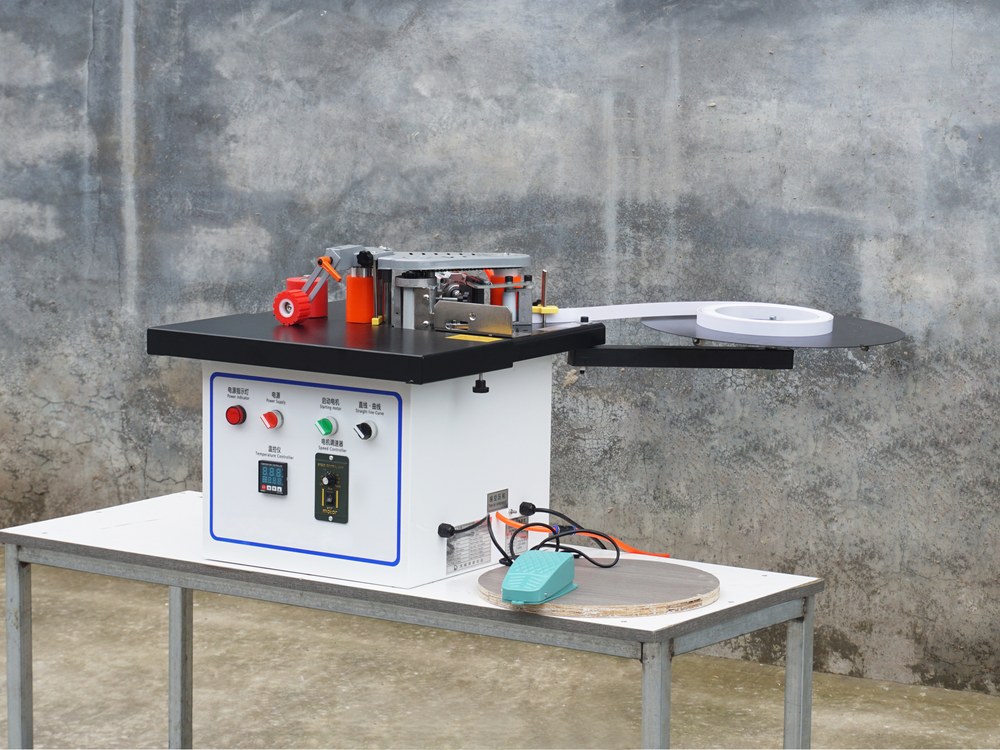
A portable bander carries its own glue pot, pressure roller and cutting unit on a single tabletop body. You guide the panel across the table by hand — or work the foot pedal and keep both hands on the board — and the machine glues the tape, presses it onto the edge and cuts it to length. On the MF170B the tape is cut automatically: the machine is specified with an auto cutting belt, so the operator does not reach for snips at the end of every stroke. The whole unit stands on a 500 × 500 × 480 mm footprint and weighs 30 kg, which is why it can sit on a bench in a small shop or travel to a site.
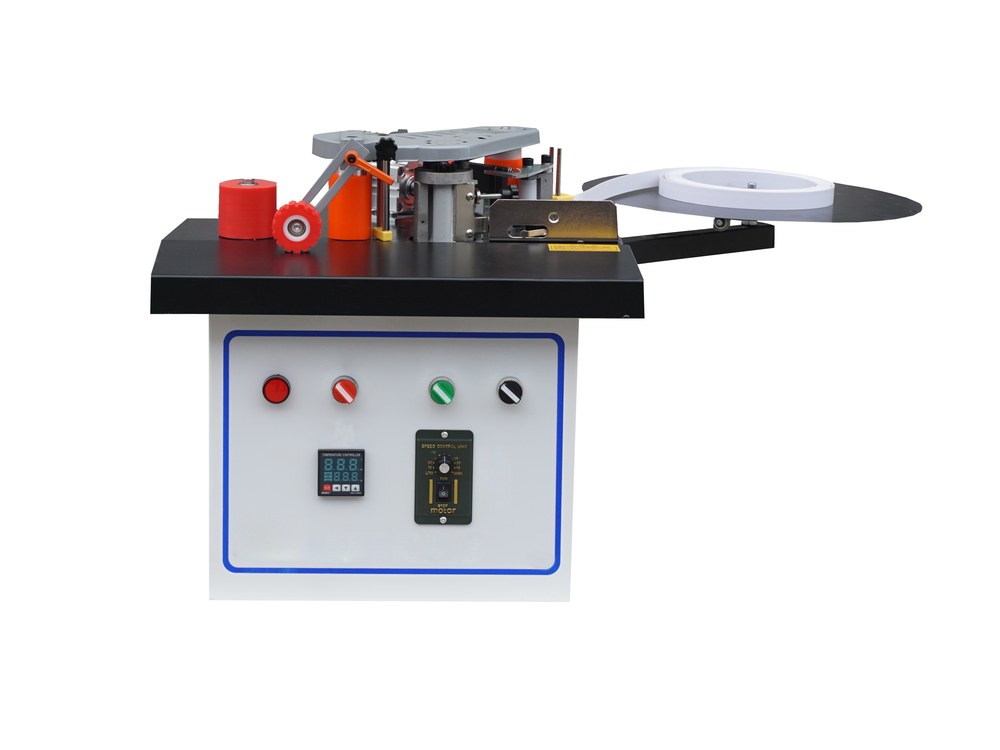
The most common buying mistake in this class is assuming the smaller machine is simply a weaker one. Read the published figures for both and the difference turns out to run in opposite directions:
| Parameter | MF170B | MF160B |
| Weight | 30 kg | 15 kg |
| Outline size | 500 × 500 × 480 mm | 380 × 330 × 380 mm |
| Power | 1.2 kW | 800 W |
| Feeding speed | 0–6 m/min | 2–6 m/min |
| Edge belt thickness | 0.4–3 mm | 0.3–3 mm |
| Max. workpiece thickness | 60 mm | not published |
| Cutting type | Automatic | not published |
Read the two rows that move in opposite directions. The MF160B is half the weight and half the footprint, and its edge belt range starts lower — 0.3 mm against 0.4 mm. If your work is thin decorative tape on light panels, the lighter machine is not the compromise, it is the better match. But its feed speed starts at 2 m/min, where the MF170B goes down to 0 — and that is the row that decides shaped work. A profile you feed slowly, one hand guiding and one hand supporting, is exactly the case where you want the speed to reach near zero. The MF170B is also the one published with an automatic cutting belt and a 60 mm workpiece thickness; the MF160B publishes neither figure.
So the choice is not bigger or smaller. It is thin tape on light panels against slow control on shaped edges.
Five numbers on the specification sheet matter more than the rest, because they are the ones that decide whether a portable bander fits the boards you actually run:
The full specification of the MF170B portable edge bander is listed below.
| Parameter | MF170B |
| Power | 1.2 kW |
| Max. workpiece thickness | 60 mm |
| Workpiece type | Straight and curve |
| Edge belt thickness | 0.4–3 mm |
| Feeding speed | 0–6 m/min |
| Cutting type | Automatic |
| Glue type | Double sizes |
| Outline size | 500 × 500 × 480 mm |
| Weight | 30 kg |
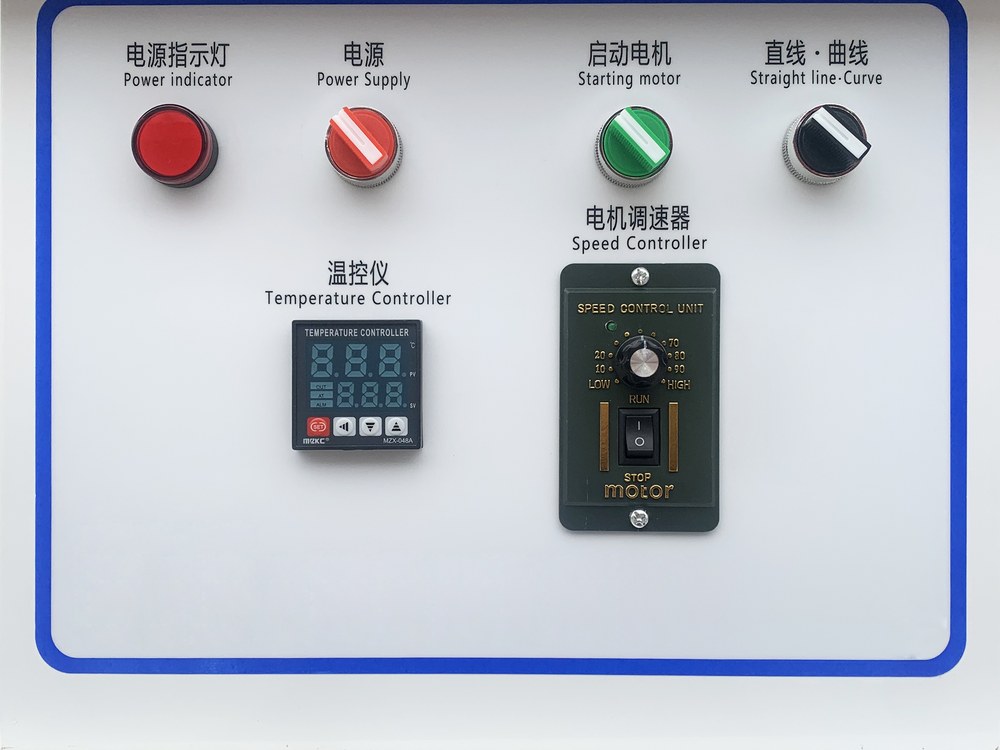
The front panel of a portable bander is deliberately short, because it is operated by hand and often by one person. On the MF170B you get a power indicator, the power supply switch, a start button for the motor, the straight line·curve selector, a digital temperature controller for the glue pot, and the speed control unit with a LOW–HIGH dial plus a run/stop switch. The temperature controller holds the glue at the set point you choose from your adhesive supplier's data sheet; the speed dial and the straight/curve selector are the two adjustments most operators touch during a working day.
Before the machine lands, get a level bench at a comfortable working height in place, buy the glue and edge tape you intend to run, and sort out shop air — the unit carries a labelled air inlet for its automatic functions, so plan the compressor and a dry line in advance. Keep the working table clean and the pressure roller free of glue build-up, and the machine will hold its edge quality through the shift.
Portable is the lightest of three classes that people often lump together. The published weights make the steps plain: the portable machines are 15 kg and 30 kg, the MF202 compact straight-line machine is 80 kg, and the manual straight-line banders start around 180 kg.
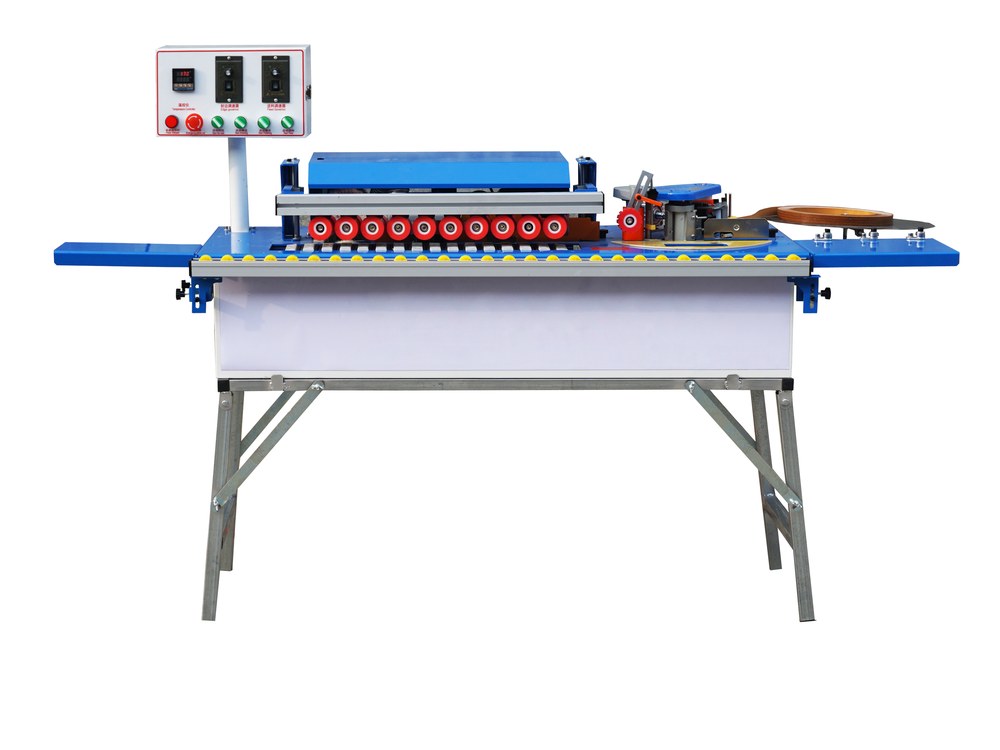
That 80 kg step changes how the panel travels. A portable machine is hand-guided, so the operator's own steadiness sets the edge quality. The MF202 holds the workpiece on a track and runs gluing, auto feeding, end cutting, trimming and polishing in one continuous pass — the panel is carried, not steered. What it gives up is reach: it is a workshop machine on a stand, not something you carry into a fitted kitchen.
One figure further up the range runs counter to the assumption that heavier always means a wider tape range. The 180 kg manual banders are published for edge tape 0.15–5 mm — wider than the 30 kg portable at 0.4–3 mm, and in fact wider than our 2,200 kg full-automatic line, which is specified at 0.4–3 mm. A heavy automatic machine is built for volume on standard tape; it is not built to take the extremes. If your work runs to very thick or very thin edge tape, class weight will not tell you the answer — the tape range row will. The full comparison is in edge banding machine sizes and weights.
Three signals tell you the portable class has done its job and something else should take over: the batch stops being small, the edges stop being varied, and the finish has to be identical panel after panel. A portable bander is hand-fed, so its output depends on the operator; a track machine holds the panel and adds end cutting, trimming and polishing in the same pass.
That is where the MF202 edge bander fits. It runs gluing, auto feeding, end cutting and trimming, then polishing, in one continuous pass, for straight line and curve line work — a step up in output without moving to a full production line.
| Parameter | MF202 |
| Process | Gluing → Auto feeding → End cutting + Trimming → Polishing |
| Workpiece type | Straight line and curve line |
| Workpiece thickness | 5–50 mm |
| Feeding speed | 0–6 m/min |
| Heat power | 2 kW |
| Cutting + scraping power | 0.8 kW × 2 |
| Polishing power | 0.37 kW × 2 |
| Outline size | 1300 × 500 × 500 mm |
| Weight | 80 kg |
WFSEN builds woodworking machinery in Qingdao, Shandong — established in 2008, on a 16,000 m² site with 200 workers — and the edge bander range runs from portable units like the MF170B to full-automatic lines. The machines ship to North America, Europe, Australia, South America, the Middle East, Southeast Asia and Africa. Buying factory direct means the people who build the machine help you size it: send the panel material, the tape thickness you run, whether the edges are straight or shaped, and your daily output, and the WFSEN engineering team will point you at the machine class that fits.
Can a portable edge bander handle curved edges?
Yes. The MF170B is specified for straight and curve work, and the working mode is selected on the control panel. Feed speed goes down to 0 m/min, which is what lets you slow the tape onto a profile rather than steering it.
What edge tape thickness can it run?
The specified edge belt thickness is 0.4–3 mm on the MF170B, which covers thin decorative PVC through to thick structural tape. The MF160B mini edge banding machine is published at 0.3–3 mm, so if your tape is thinner than 0.4 mm it is the one to look at.
How thick a board can I edge?
Max. workpiece thickness is 60 mm on the MF170B.
What is the difference between the MF170B and the MF160B?
Weight and compromise. The MF160B is 15 kg against 30 kg and takes tape down to 0.3 mm, but its feed speed starts at 2 m/min against 0 m/min, and its product page does not publish a maximum workpiece thickness. For thin tape on light panels the smaller machine is the better match; for slow shaped work the MF170B is.
Does it need an air compressor?
The machine has a labelled air inlet for its automatic functions, so plan a compressed air supply and a dry line before installation.
Portable, or a straight-line machine?
If most of your work is straight edges in volume, compare the MF202 edge bander and the rest of the edge banding machine range before deciding.
Send us the panel material, the edge tape thickness, straight or shaped edges and your daily output target — we will size the machine to the work rather than the other way round. Common questions about edge banding are answered on the WFSEN FAQ page.