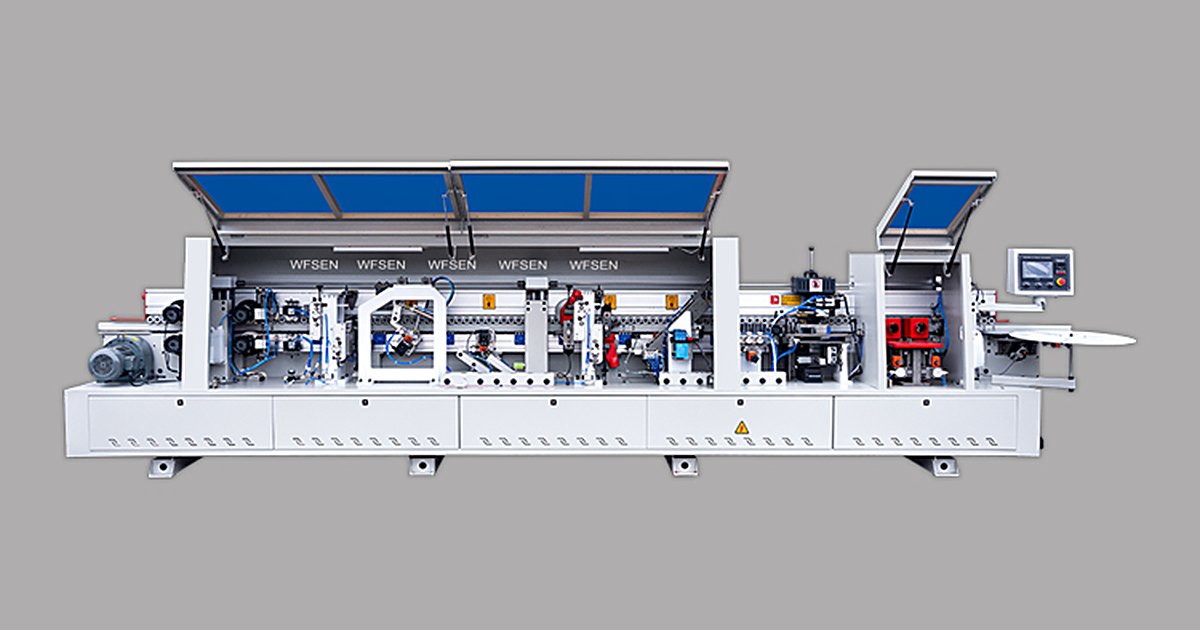
Short answer: there are four classes of edge banding machine and the class is decided by two things — edge shape and panel volume. Straight edges at volume need a fixed straight-line machine; curved and shaped profiles need a curve or folding-arm model; repair and installation work needs a machine that travels to the job. In our own range the four classes span 15 kg to 2,200 kg and 0.15 mm to 5 mm of edge tape — and the widest tape range does not belong to the heaviest machine.
An edge banding machine seals the raw core of every board that leaves your workshop - plywood, MDF, particle board or blockboard. Choosing the wrong class of edge bander wastes money twice: on a machine too slow for your output, or too heavy for the jobs you actually run. The shortcut is to sort your work first - straight edges or shaped ones, a few panels a day or a full production line - and let that decide between portable, manual, full-automatic and curve machines. WFSEN builds the whole range in Qingdao, from the compact MF170B portable edge bander to the MF630A full-automatic edge banding machine, so this guide maps each machine class to the workshop it fits.
Ask two questions before any purchase: what boards do you edge - kitchen doors, office furniture, display panels - and are the edges straight, or curved and shaped? Straight-line work at volume points to a fixed straight-line machine; curved profiles need a curve or folding-arm model; repair and installation jobs need a machine that travels to the job. PVC, ABS, melamine and veneer tapes all work across the classes, so choose the class by panel volume and edge shape, not by tape type.
One piece of vocabulary is worth fixing before you compare anything. A straight-line machine runs the panel past fixed stations on a track; a curve machine follows a shaped edge with a guide shoe; a folding-arm machine presses the tape on by hand-guided control. The first is a production tool, the other two are craft tools. They are not interchangeable and no single machine in our range does all three — which is why most workshops that do both end up with two machines rather than one compromise. The process itself, and what each station does to the panel, is described separately in what edge banding is and how the machine works.
When boards arrive in small numbers - door adjustments, shop fitting, on-site installation - a portable unit keeps you mobile. The MF170B portable edge bander trims and bands at the workpiece, while the MF160B mini edge banding machine suits countertops, panels and prototype work. Expect slower feed and manual control; the payoff is price, portability and the ability to edge boards that are already assembled.

The published figures for the two small machines explain the trade. The MF170B is 30 kg on a 500 × 500 × 480 mm footprint, draws 1.2 kW, feeds at 0-6 m/min, takes boards up to 60 mm thick and edge tape 0.4-3 mm. The MF160B is smaller again — 15 kg, 380 × 330 × 380 mm, 800 W, feeding 2-6 m/min, tape 0.3-3 mm. Both are genuinely one-person machines: at 15 kg the MF160B can be carried to a job and set on a bench, which is why it exists at all. The portable edge banding machine guide covers the on-site controls in more detail.
When the edges are straight and quantities grow past one-off work, a straight-line bander with an integrated trimmer brings consistency to a small workshop. Models such as the MF260T manual edge bander and the MF260B manual edge banding machine hold the panel on a straight track and finish flush trimming in the same pass, without the footprint or the price of an automatic line. The MF202 edge bander adds capacity for mid-size batches as your order book grows.
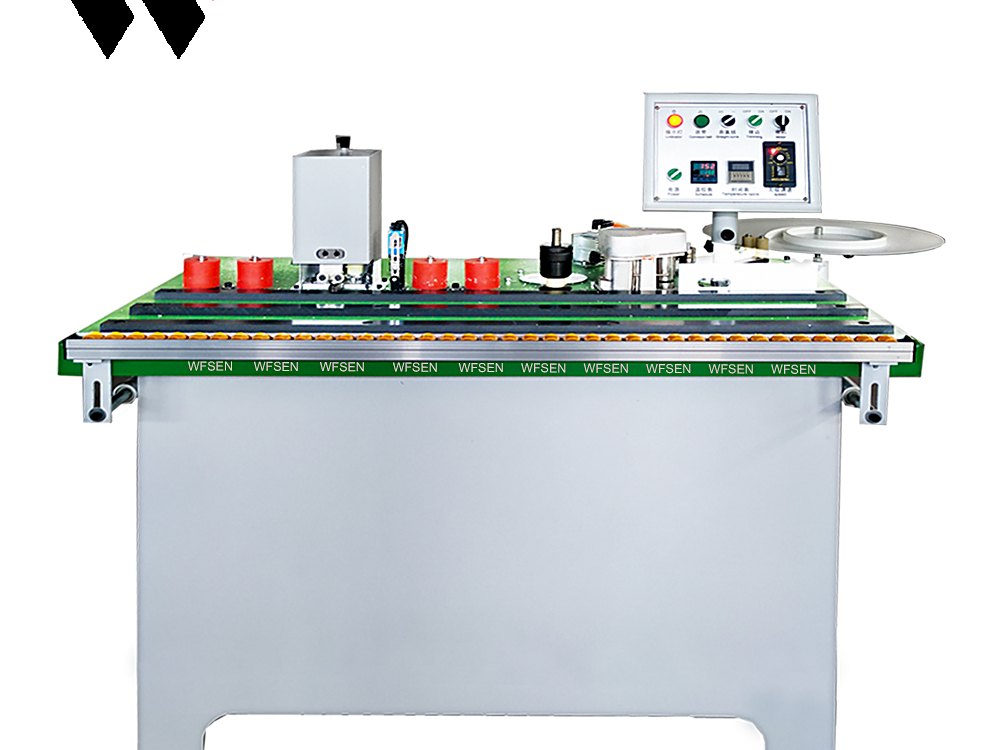
This is the class where the specification is most often misread. The MF260T, MF260B and MF260D all publish an edge tape range of 0.15-5 mm and a minimum banding radius of 20 mm. The MF202 publishes 5-50 mm of panel thickness and feeds at 0-6 m/min on a 1300 × 500 × 500 mm frame. Compare those tape figures with the automatic machines below, and a buyer's assumption breaks: the small manual machines take the widest range of tape in the whole range. The manual edge banding machine page explains what the 0.25 kW motor will and will not do.
Production shops live on consistency: every panel edged the same way, at line speed, shift after shift. A full-automatic edge banding machine carries the panel through pre-milling, glue application, pressing, end trimming, edge trimming and buffing in one continuous pass. The MF630A full-automatic edge banding machine is the reference build for straight-line cabinet and door production, and the MF360B full-automatic model covers mid-range lines - with the MF360D and MF60S extending the range to other production scales in the full edge banding machine range.

The automatic class is where the feeding speed finally separates the models. The MF630A and MF360B both publish 13-23 m/min; the smaller MF360D is published at a single 15 m/min; the MF60S is 0-14 m/min. Panel thickness is 10-60 mm on the MF630A, MF360B and MF360D, and edge tape is 0.4-3 mm — a narrower band than the manual machines, because an automatic line is built around the tape thicknesses it will run all day rather than the extremes it can accept once. The full automatic edge banding machine page covers the six-station and eight-station question.
Rounded tabletops, arched door panels and decorated frames defeat a straight-line machine. Curve models follow the radius with a guide shoe, while a folding-arm bander presses the tape onto shaped profiles with hand-guided control. The MF260M folding-arm curve edge bander handles short-radius and irregular work with full control, and the MF260D curve edge banding machine covers shaped and straight jobs in one unit.
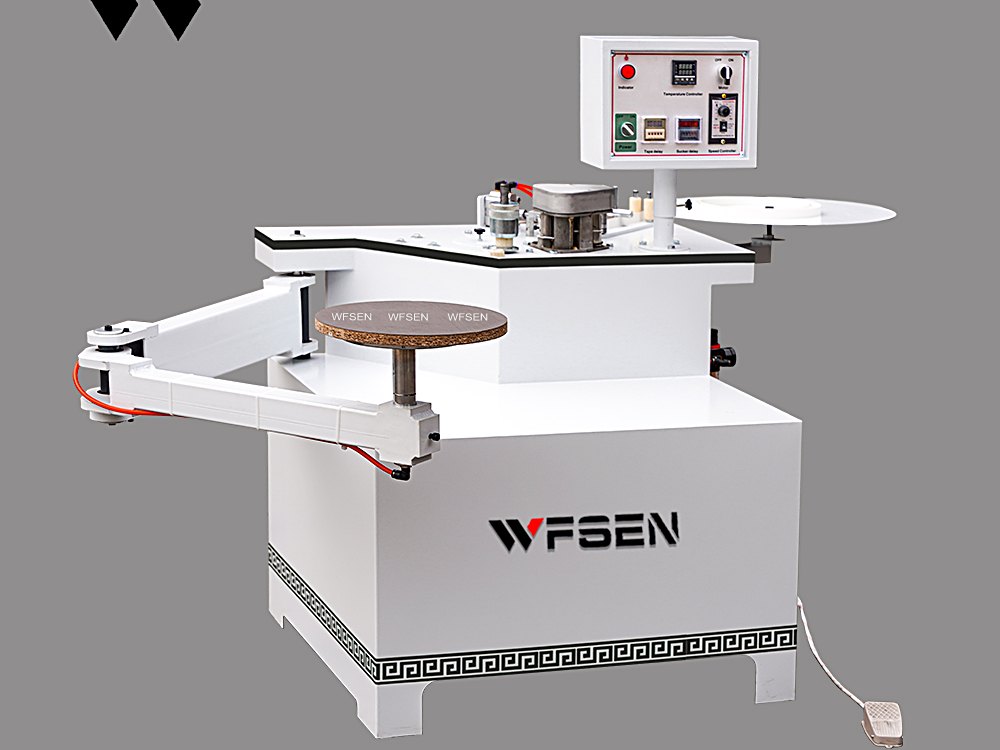
Read the two curve models carefully, because their published figures are not written in the same units. The MF260M is published with a feed speed of 0-20 cm/s — centimetres per second, not metres per minute — which works out at about 12 m/min, and an edge tape range of 0.5-2 mm. The MF260D is published in metres per minute like the rest of the range: 0-14 m/min, tape 0.15-5 mm, minimum radius 20 mm. Both are 180 kg. If you are comparing the two on a quotation, convert the units first — 0-20 cm/s is not slower than 0-14 m/min, it is a different way of writing a similar number.
Every model in the range on the published figures. Where a product page does not publish a value, it is marked as not published rather than estimated.
| Model | Class | Weight | Outline size | Edge tape | Feed speed | Panel thickness |
|---|---|---|---|---|---|---|
| MF630A | Full automatic, 8 stations | 2,200 kg | 6550 × 750 × 1550 mm | 0.4-3 mm | 13-23 m/min | 10-60 mm |
| MF360B | Full automatic | 1,400 kg | 4100 × 1000 × 1600 mm | 0.4-3 mm | 13-23 m/min | 10-60 mm |
| MF360D | Full automatic | 600 kg | 2300 × 500 × 1350 mm | 0.4-3 mm | 15 m/min | 10-60 mm |
| MF60S | Automatic, compact | 200 kg | 1600 × 800 × 1100 mm | 0.3-3 mm | 0-14 m/min | Not published |
| MF260T | Manual straight-line | 180 kg | 1100 × 900 × 1000 mm | 0.15-5 mm | 0-14 m/min | Not published |
| MF260B | Manual straight-line | 180 kg | 1100 × 900 × 1000 mm | 0.15-5 mm | 0-14 m/min | Not published |
| MF260D | Curve | 180 kg | 1100 × 900 × 1000 mm | 0.15-5 mm | 0-14 m/min | Not published |
| MF260M | Folding arm, curve | 180 kg | 1200 × 900 × 1000 mm | 0.5-2 mm | 0-20 cm/s | Not published |
| MF202 | Compact straight-line | 80 kg | 1300 × 500 × 500 mm | Not published | 0-6 m/min | 5-50 mm |
| MF170B | Portable | 30 kg | 500 × 500 × 480 mm | 0.4-3 mm | 0-6 m/min | 60 mm |
| MF160B | Mini | 15 kg | 380 × 330 × 380 mm | 0.3-3 mm | 2-6 m/min | Not published |
The full table — including power figures, working air pressure and minimum banding radius for every model — is in edge banding machine sizes and weights.
Most of the decision is carried by four published figures. Read them in this order and the class usually picks itself.
1. Weight — 15 kg to 2,200 kg. This is the number that decides whether the machine can be moved to the work. Everything under about 200 kg is a machine a small workshop can reposition; at 600 kg (MF360D) you are planning where it lives; at 1,400 kg and 2,200 kg (MF360B, MF630A) it arrives on a truck and is set in place by lifting equipment.
2. Edge tape range — and who has the widest. The manual MF260-series and the MF260D publish 0.15-5 mm. The full-automatic MF630A, MF360B and MF360D publish 0.4-3 mm. So the heaviest machine in the range does not take the widest tape: a 2,200 kg automatic line is built around 0.4-3 mm, while a 180 kg manual machine handles 0.15 mm through 5 mm. If your work includes 4 mm or 5 mm solid edging, the automatic line is the wrong machine regardless of its price.
3. Minimum banding radius. Published as 20 mm on the MF260T, MF260B and MF260D — and not published on the automatic machines at all, because a straight-line machine is not built to follow a radius. If your work has curves and you are looking at a straight-line machine, the missing number is the answer.
4. Feed speed — and where it stops mattering. The only place feed speed genuinely separates machines is inside the automatic class: 13-23 m/min on the MF630A and MF360B against 15 m/min on the MF360D. Between a 180 kg manual machine and a 15 kg mini, both of which are fed by hand, the published speed difference is a fraction of the time the operator spends handling the panel.
A common expectation is that the price of an edge bander tracks its size. It does not, exactly. What moves the price between these models is how many operations happen without the operator — the stations, motorised trimming, the frame and feed system — rather than simply kilograms of steel.
Two figures make the point. The MF630A and the MF360B publish the same panel thickness (10-60 mm) and the same edge tape range (0.4-3 mm), so the whole price step between them buys stations and the automation around them, not extra material capacity. And the 80 kg MF202 is not one-seventh of the price of the 600 kg MF360D for one-seventh of the machine — it is a different class with a different job. The variables that actually move a quotation are set out in edge banding machine price: what drives the cost.
Every WFSEN edge bander is built in Qingdao, and the range is deliberately sized from compact portable units to full-length automatic lines - so the practical question is matching output volume and edge shape to the right machine class. Factory-direct means the engineers who build the machine help you size it, and the same team answers your questions after it ships. Send your panel material, edge thickness, straight or shaped work and daily output target to the WFSEN engineering team and receive a recommendation across the range.
How many classes of edge banding machine are there?
Four: portable and mini, manual straight-line, full-automatic straight-line, and curve or folding-arm. The class is set by edge shape and panel volume, not by tape type — PVC, ABS, melamine and veneer all run across the classes.
Which machine takes the widest edge tape?
The manual and curve models, not the automatics. The MF260T, MF260B and MF260D are published at 0.15-5 mm; the full-automatic MF630A, MF360B and MF360D are published at 0.4-3 mm.
What is the lightest machine in the range?
The MF160B mini at 15 kg, on a 380 × 330 × 380 mm footprint. The MF170B portable is 30 kg at 500 × 500 × 480 mm.
Can one machine do both straight and curved edges?
The MF260D is published as covering shaped and straight jobs in one unit. A straight-line automatic cannot follow a radius — the curve models are the ones that publish a minimum banding radius, 20 mm on the MF260T, MF260B and MF260D.
How fast do the automatics run?
The MF630A and MF360B are published at 13-23 m/min and the MF360D at 15 m/min. On a 2,440 mm panel that is roughly 6 to 11 seconds in the machine — usually less than the time to load it and turn it round.
What panel thickness do the machines accept?
The full-automatic MF630A, MF360B and MF360D publish 10-60 mm; the MF202 publishes 5-50 mm; the MF170B portable publishes boards up to 60 mm. The remaining manual and curve models do not publish a panel thickness figure.
For quick answers - which machine suits MDF door skins, or how many panels a full-automatic line edges per shift - visit the WFSEN FAQ page.
An edge bander is one station in a sequence, and what arrives at its infeed is decided upstream. Panels are cut to size first, and the bander is usually the last operation before drilling and finishing — which is why the tape range and the panel thickness you can actually feed it matter more than the machine's headline speed.
If the panel is edged before drilling, the finished edge is available as a reference for the drilling machine; if it is edged after, the panels have to come back. The types of drilling machines page covers that sequencing question, and the small edge banding machine page covers the compact end of the range for workshops with limited floor space.
Tell us the panel material, the tape thickness you use, whether the edges are straight or shaped, and how many panels a day you need to edge — with those four answers the class is usually decided in one message.