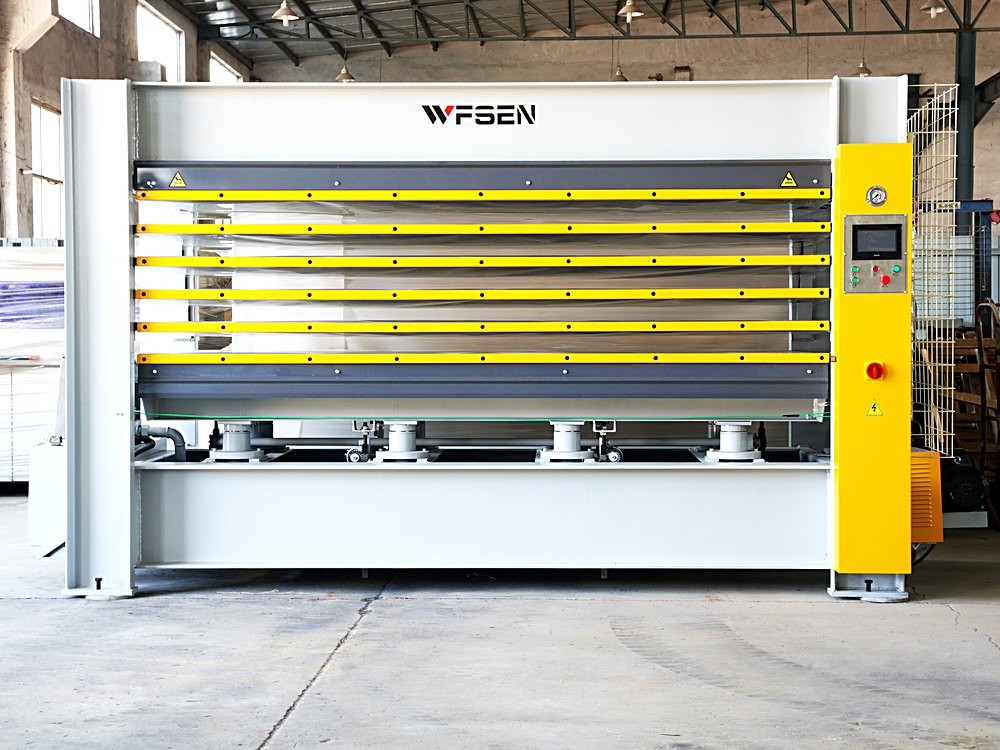
A 300-ton press will not press a bigger board than a 160-ton one. In our range it presses a smaller one: the six-layer 300T carries a 1600 × 1200 mm platen, while the five-layer 160T carries 3300 × 1300 mm. Tonnage is about pressure per square centimetre, not about board format — and that one fact sorts out most of the confusion buyers arrive with.
Here is what the numbers on a hot press specification sheet actually decide, using the five models we build. Every figure below is quoted from the machine's own published parameter table.
Measure the largest panel you will press, add handling room on each side, and that gives you the platen. Across our five models the platen ranges from 1600 × 1200 mm to 3300 × 1300 mm, and the widest does not belong to the strongest press.
| Model | Layers | Pressure | Platen size |
|---|---|---|---|
| HT-160 × 5 layers | 5 | 160 ton | 3300 × 1300 × 42 mm |
| HT-120 × 3 layers | 3 | 120 ton | 2500 × 1300 × 42 mm |
| HT-120 × 2 layers | 2 | 120 ton | 3000 × 1300 × 42 mm |
| HT-100 × 1 layer | 1 | 100 ton | 2500 × 1300 × 42 mm |
| HT-300 × 6 layers | 6 | 300 ton | 1600 × 1200 × 42 mm |
Put the first and last rows side by side. The 300-ton machine has nearly twice the force and roughly half the pressing area. It exists to press small, dense, high-value work in six layers at once — not to press wide boards. If a sales conversation starts with tonnage, it is starting in the wrong place.
Divide the tonnage by the platen area and the gap widens again. The 160-ton machine spreads its force across 4.29 m² — roughly 37 tonnes per square metre. The 300-ton machine puts 300 tonnes into 1.92 m² — roughly 156 tonnes per square metre. Same catalogue, same brand, and 4.2 times the pressure on the board. Those two machines are not competitors. They are built for different materials.
Note the platen thickness too: 42 mm on every model. A 42 mm steel platen holds heat and spreads it across the board rather than letting it drop away between the oil channels — which matters more on a wide platen than a narrow one.
A layer is one board per cycle. Going from one layer to five multiplies output per shift without touching the platen size, which is why multi-opening presses dominate plywood and veneer work. The trade is height: every extra opening adds to the machine's overall dimensions, and the frame has to be tall enough to open all of them at once.
Compare the published overall dimensions. The five-layer 160T stands 4500 × 1700 × 2300 mm. The three-layer 120T is 3700 × 1700 × 2000 mm. The single-layer 100T is 3600 × 1700 × 2000 mm. Same family of widths, but the five-layer machine is almost a metre longer and 300 mm taller. Check ceiling height and crane access before you commit to layer count — a tall press that cannot be loaded from above loses much of what the extra layers bought you.
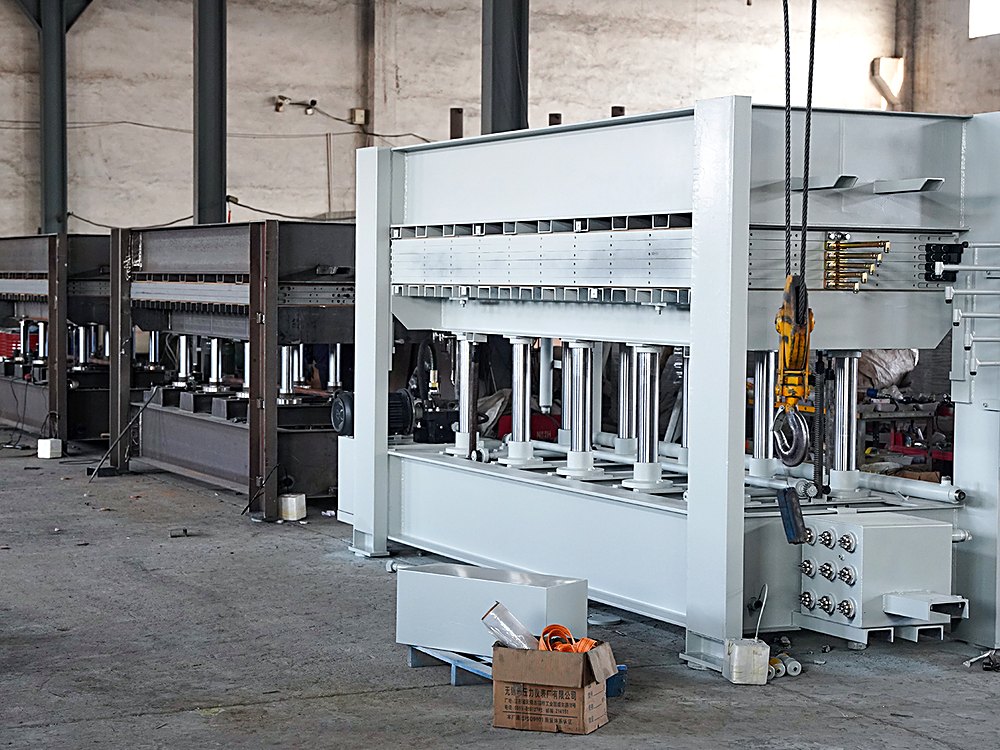
Here is a detail that rarely appears in a quotation but changes how a press behaves. Our two 120-ton machines do not use the same cylinders.
The three-layer 120T runs on 6 × Φ100 mm cylinders. The two-layer 120T runs on 8 × Φ85 × 300 mm cylinders, and it publishes an opening of 150 mm. The six-layer 300T runs on 4 × Φ200 mm lifting cylinders plus a 1 × Φ120 mm promote cylinder, with a plate gap of 100 mm and cylinder distance of 600 mm.
More, smaller cylinders spread force more evenly across a wide platen. Fewer, larger cylinders suit a compact platen carrying heavy load. The hydraulic motor is 5.5 kW on four of the five models and 7.5 kW on the 300T — the one machine with twice the tonnage to move.
Ask for "a 120-ton press" and you have not finished the specification. Two machines can carry the same tonnage and still be built for different boards.
Thermal oil heating runs through channels inside the platen, and the furnace has to heat the steel that is actually there. That is why the published furnace power tracks the platen area rather than the pressure figure.
The 300-ton machine draws a 63 kW furnace because it heats a 1600 × 1200 mm platen. The 160-ton machine draws 98 kW because it heats 3300 × 1300 mm. If you are planning electrical supply, the furnace — not the hydraulic motor — is the number that decides your cable and breaker sizing.
Oil heating holds the whole platen at one temperature instead of running hot near the inlet and cool at the far edge. On a 3300 mm platen that difference used to be visible in the glue line; with circulation it is not.
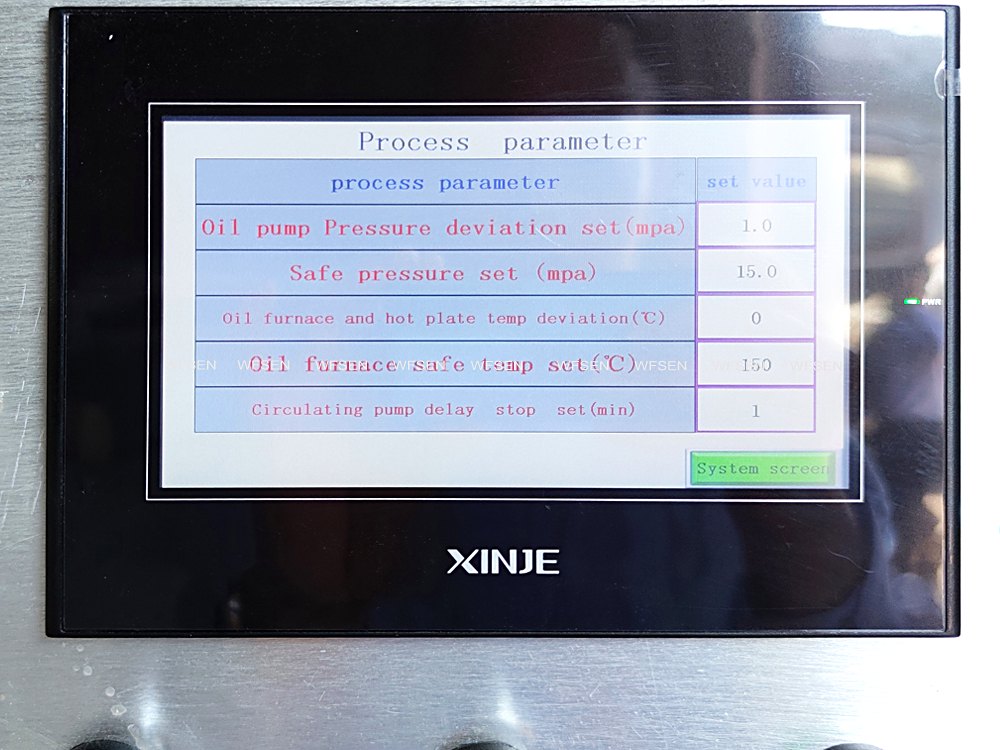
A press repeats the same cycle hundreds of times a shift. The reference machine runs PLC control with a touchscreen HMI, automatic pressing and automatic temperature control: the operator enters pressure, temperature and pressing time for the job, and the machine holds that cycle board after board.
The practical value shows up when you change products. A shop pressing plywood in the morning and veneered door skins in the afternoon needs the recipe to change, not the operator's memory. Ask what happens on a product changeover — if the answer involves re-dialling valves by hand, you will feel it every time the order book shifts.
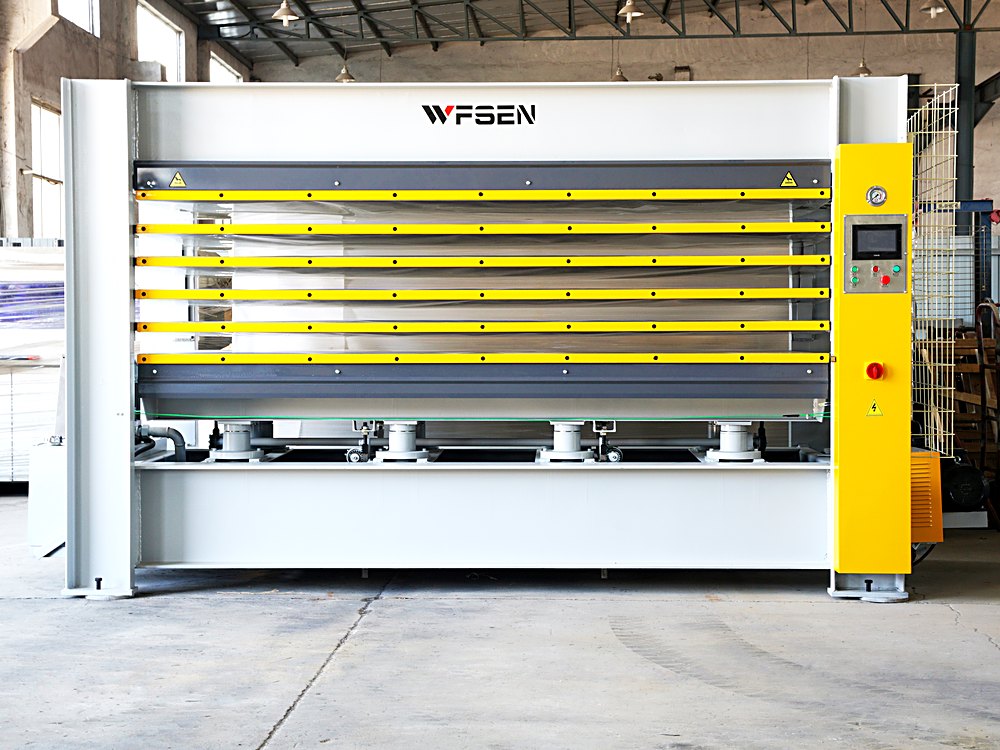
A hot press stacks heat, hydraulic pressure and heavy moving platens in one footprint, and the protective package belongs in the specification from the start rather than arriving as an afterthought. The reference machine carries an electromagnetic emergency stop switch, an emergency stop pull rope running along the machine, and protective netting around the heating furnace.
Get these settled before the machine ships: a level floor rated for the installed weight, crane or forklift access for the frame sections, three-phase supply sized for the furnace, and space behind the press for the thermal oil furnace and pipework. The furnace is a separate unit with its own footprint — it is not part of the press dimensions in the table above. Confirm the required safety configuration with your local authority and your insurer, and ask for a written list of protective devices in the quotation.
Only one of the five models publishes a weight: the two-layer 120T, at 7000 kg. The others state dimensions but not mass, and the six-layer 300T states neither weight nor overall size. If installed weight matters for your floor slab or your shipping plan, ask for it in writing at quotation stage — it is not on the public sheet.
| Model | Cylinders | Opening | Overall size | Weight |
|---|---|---|---|---|
| 5 layers 160T | 8 × Φ100 mm | not published | 4500 × 1700 × 2300 mm | not published |
| 3 layers 120T | 6 × Φ100 mm | not published | 3700 × 1700 × 2000 mm | not published |
| 2 layers 120T | 8 × Φ85 × 300 mm | 150 mm | 4200 × 1700 × 2000 mm | 7000 kg |
| 1 layer 100T | 6 × Φ100 mm | not published | 3600 × 1700 × 2000 mm | not published |
| 6 layers 300T | 4 × Φ200 mm + 1 × Φ120 mm | Plate gap 100 mm | not published | not published |
Qingdao WFSEN Mechanical And Electrical Co., Ltd. builds hot press machines in Qingdao, Shandong, and supplies them factory direct to plywood, veneer, MDF and panel plants. Working layers, platen size and total pressure are matched to your board format as a normal part of the order, and the machine carries a two-year warranty with worldwide service. Factory visits are welcome — you can watch the press run before it is packed.
Send your panel size, thickness and daily output target to the WFSEN engineering team and you will get a configuration matched to your volume. If the press is part of a larger line, it is worth reading how the plywood pressing line and the cold press machine sit either side of it, since the hot press is one stage of three. For the mechanics of what happens inside the press, see how a hot press machine works; for the glue stage that feeds it, see glue spreader settings.
Does more tonnage mean a bigger board?
No. Tonnage is force; platen size is area. Our 300-ton machine presses 1600 × 1200 mm and our 160-ton machine presses 3300 × 1300 mm.
How many layers should I buy?
Work back from daily output. Layers multiply boards per cycle; they also add height to the machine and to your loading method, so ceiling clearance and crane access set the ceiling on layer count.
Why two oil pumps of different power on the same tonnage?
Because the platen areas differ. The three-layer 120T runs a 3.7 kW pump on a 2500 × 1300 mm platen; the two-layer 120T runs 1.5 kW on 3000 × 1300 mm. Pump and furnace follow the steel they have to heat.
What temperature do the presses run at?
Only the six-layer 300T publishes a figure on its parameter table: max. temperature 180°C. The other four pages state furnace power rather than a temperature range. Ask for the working temperature for your adhesive at quotation stage.
Is the furnace included in the machine dimensions?
No. The thermal oil furnace is a separate unit with its own footprint and pipework. Plan floor space and electrical supply for it separately from the press itself.
Common questions about sizing a press are also answered on the WFSEN FAQ page.