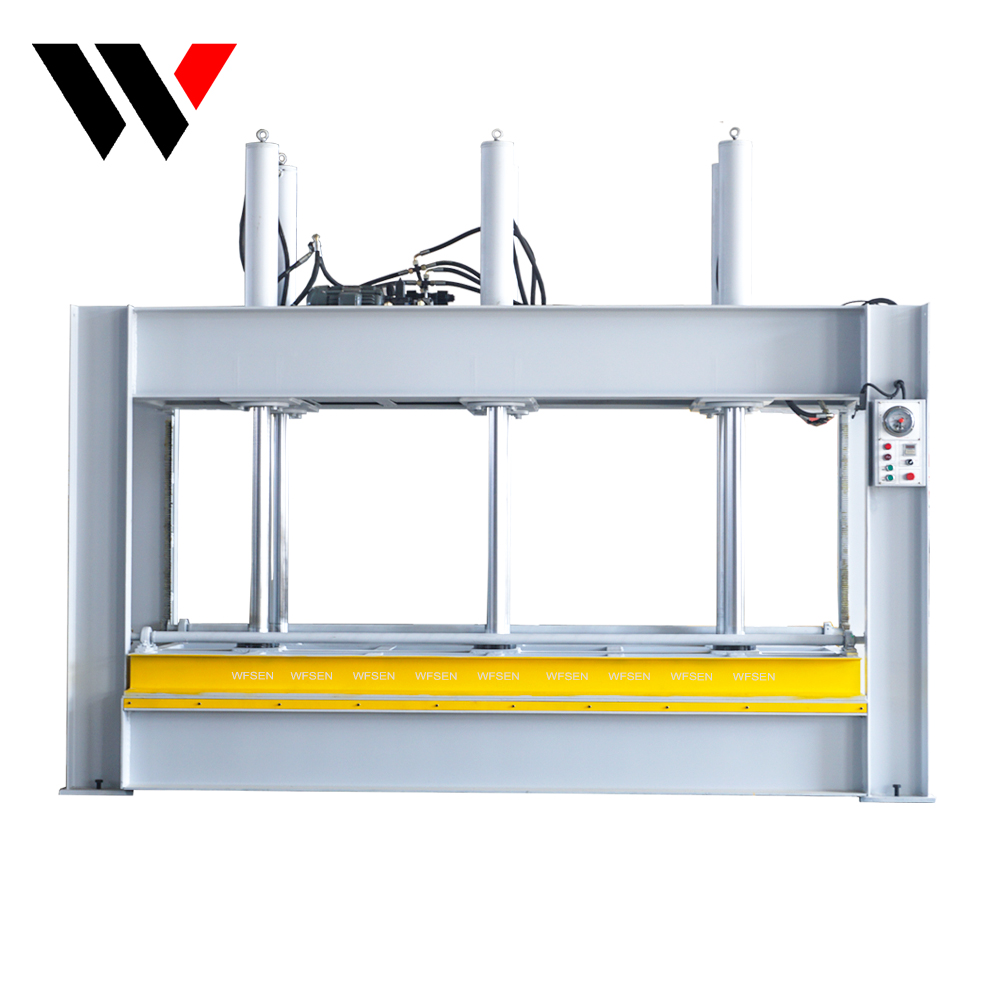
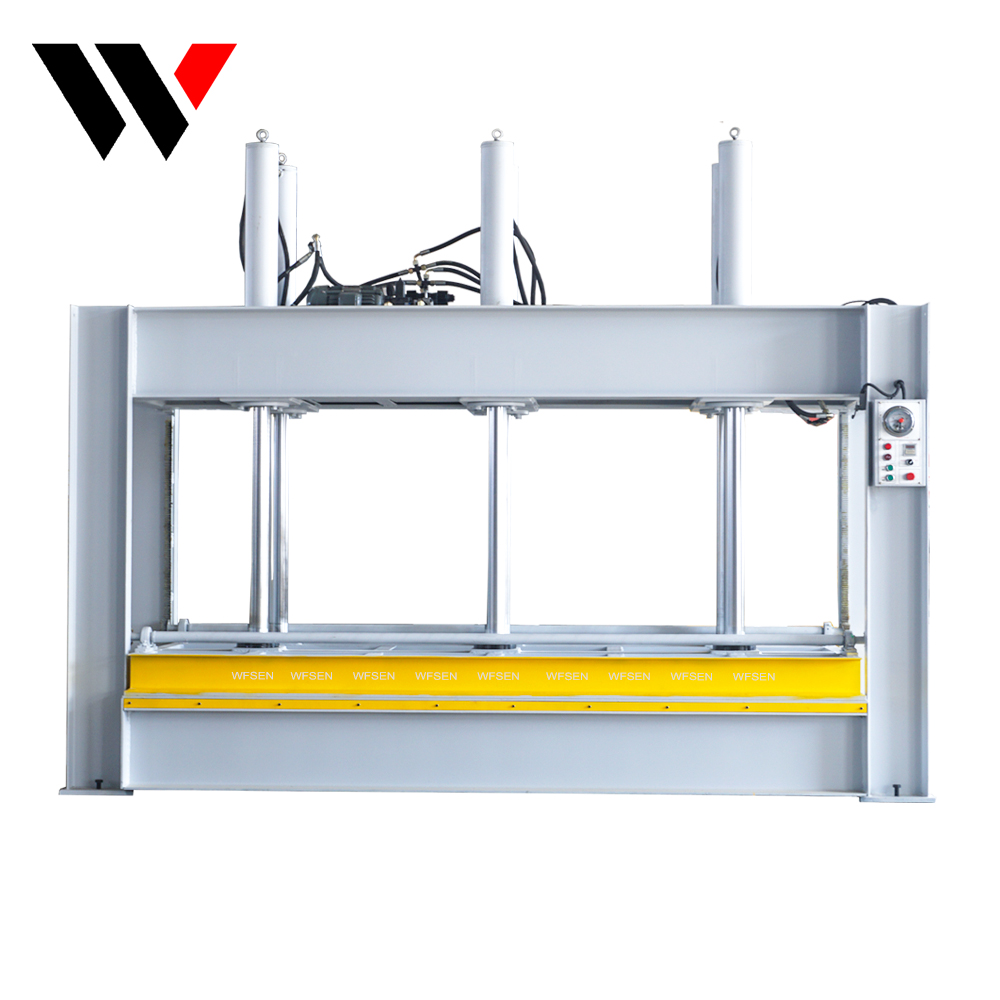
A cold press machine is the simplest machine in a panel line to describe, and one of the easiest to buy wrong. It does not heat anything. It holds a glued assembly flat under pressure while the adhesive cures at room temperature, and three decisions set the flatness of everything that comes out of it: tonnage, platen size and daylight opening. Get those three right and the press runs for twenty years without attention. Get them wrong and every panel you press is either under-pressed or too big for the machine.
Cold pressing is pressure plus dwell time at ambient temperature. There is no heating platen and no steam or oil circuit in the press: the adhesive cures by its own chemical reaction while the platens hold the assembly flat and closed. It is the right machine for plywood assembly, for laminating door skins onto door blanks, and for board-on-board build-ups where the adhesive system is designed to cure cold.
Because there is no heat to compensate for anything, the machine's whole job is to apply even pressure across the full platen and to keep it there for the full cure. That is why the frame, the columns and the guided platens matter more than the number printed on the pressure gauge.
If your process needs heat to cure the glue, or you are pressing melamine papers that have to be bonded hot, this machine is the wrong choice and a hot press machine is the right one. Everything below applies to room-temperature curing only.
Tonnage and platen size have to be chosen together. The same 50 ton press spreads that force over a 1250 × 1000 mm platen or over a 3000 × 1300 mm platen, and those are two very different pressures per square metre of panel. Buying tonnage alone, without the platen size next to it, is how workshops end up with a press that is strong enough on paper and weak in the middle of the board.
In the WFSEN range the pressure steps run 50 ton, 100 ton, 120 ton and 200 ton, on platens from 1250 × 1000 mm up to 3200 × 1300 mm. The practical rule is to size the press for the largest assembly you intend to press, not the average one, because the oversized job is the one that decides whether the panel is scrap. Tell us the board footprint and the adhesive you use, and our engineers will tell you which step in that range holds pressure across the whole assembly.
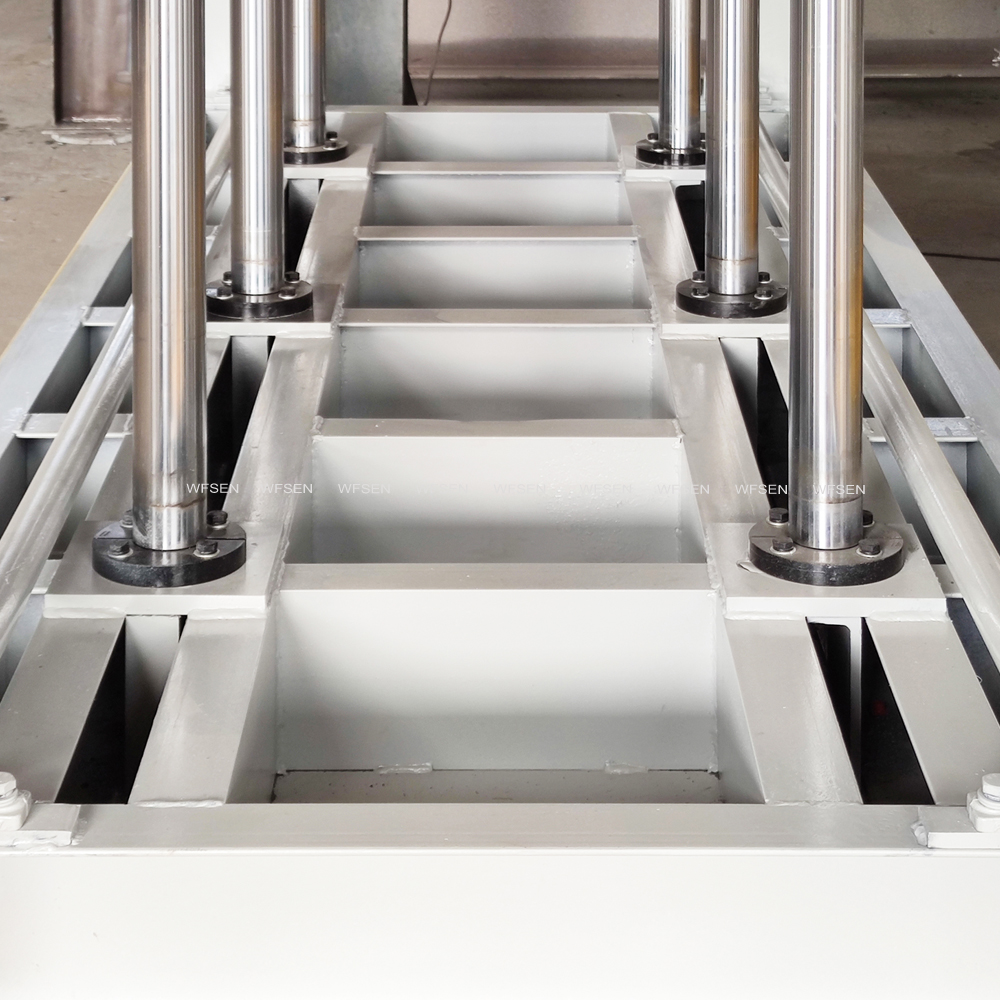
The platen is the working area: whatever fits inside it can be pressed, and whatever hangs over the edge cannot be held flat. The daylight opening is the clear height between platens, which decides how thick a stack — board, glue line, caul plate and spacers — you can load in one cycle.
Throughout this range the opening runs 900–1000 mm, which covers single-panel pressing as well as stacked loads with caul plates. Four platens sizes cover most production: 1250 × 1000 mm, 2500 × 1250 mm, 3000 × 1300 mm and 3050 × 1300 mm. Door blanks and standard cabinet panels usually sit in the middle two; long plywood panels need the 3050 × 1300 mm platen.
Three layouts are available on the same hydraulic base, and the choice is about how the press fits your line rather than about pressure.
Output per shift is set by how fast the platens close, how long the glue needs, and how long loading and unloading takes. Only the first is a machine specification.
The hydraulic unit on this range is 4 kW, with working speed either continuously variable or fixed at 200 mm/min depending on model, and cylinders sized to the tonnage — Ø125 mm × 2 on the 50 ton press, Ø100 mm × 6 on the 100 ton roller-feed model, and 125 mm × 6 on the 120 ton press. Motors are available for 220 V, 380 V and 415 V supplies, which matters when the machine is going into a workshop whose mains you do not control.
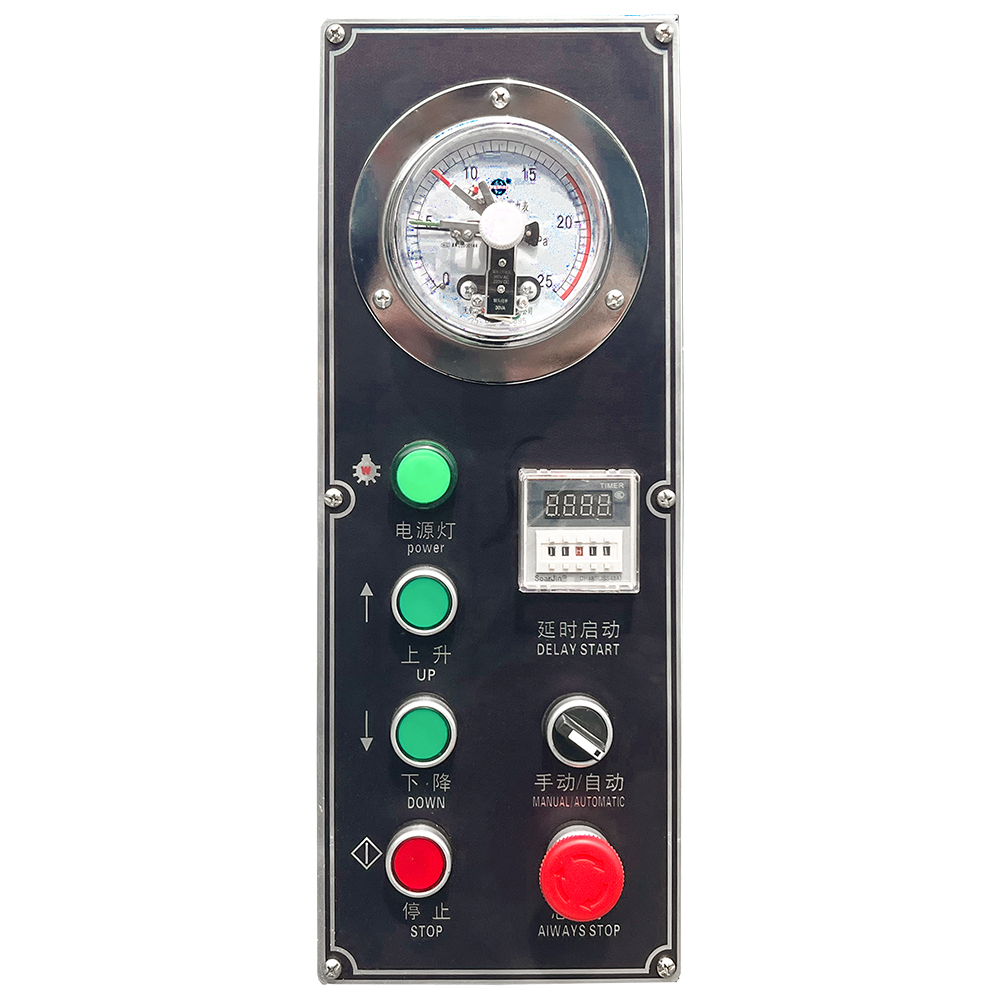
The control panel stays deliberately simple: pressure gauge, up, down, stop, an emergency stop, a delay start timer for setting dwell time, and a manual/automatic selector. Operators can be trained on it in an afternoon.
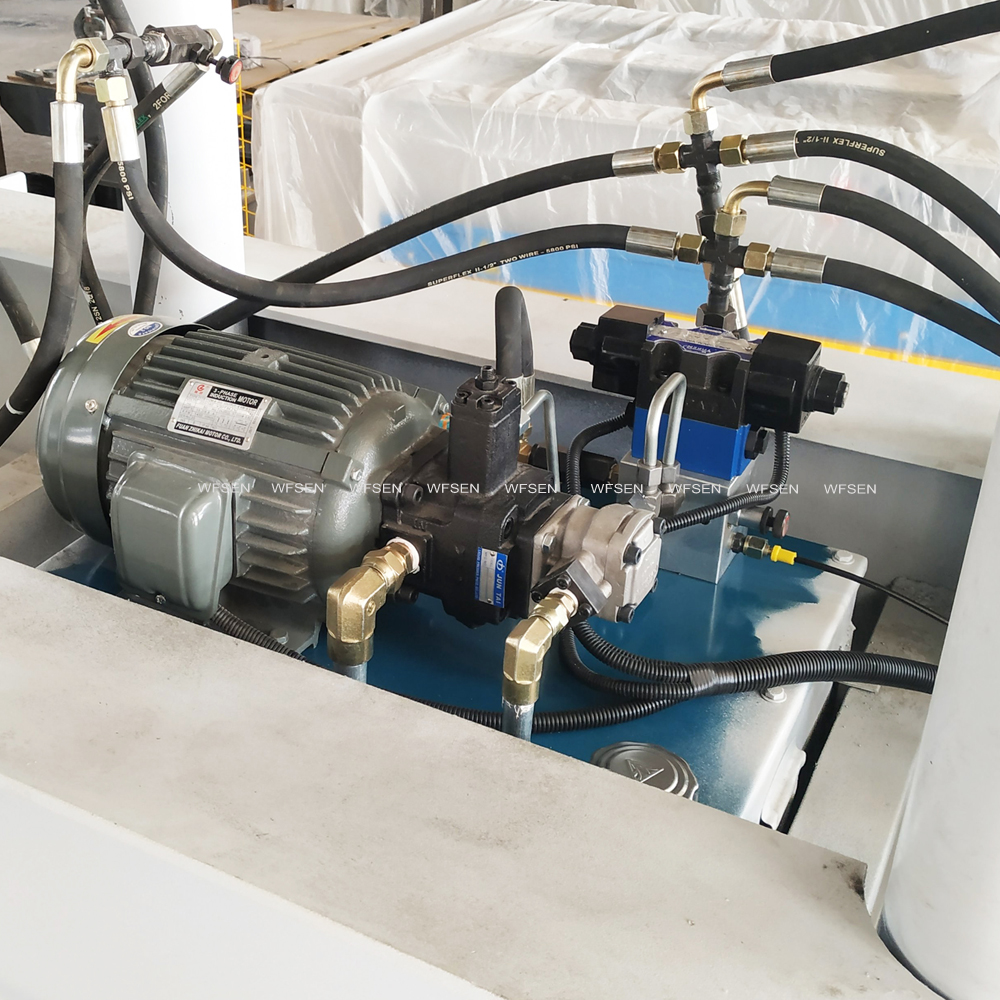
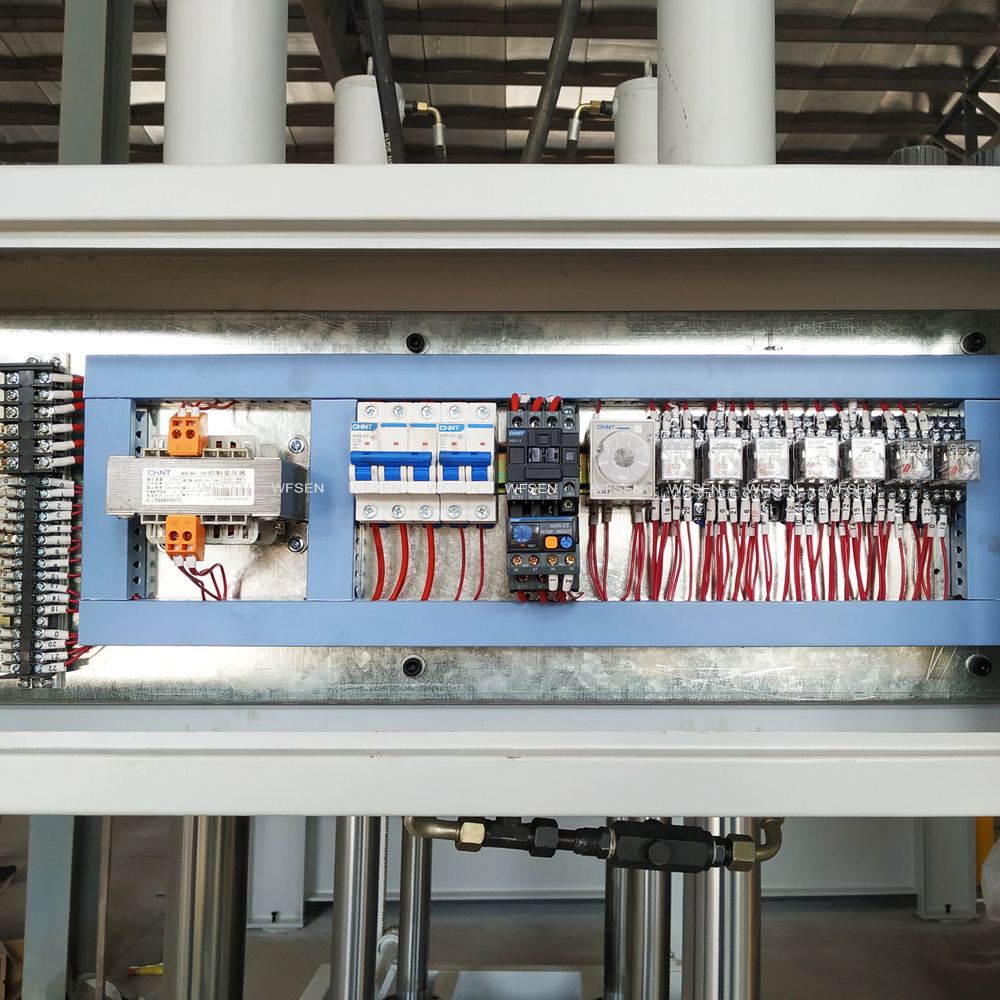
Behind the panel, the electrical cabinet uses standard components and labelled terminal blocks, which is what your local maintenance technician will be looking at in year five rather than the catalogue photo.
The boundary is the adhesive, not the panel. Cold-curing systems — the ones specified to reach full bond strength at workshop temperature — belong on a cold press. Where the process depends on a heated platen to melt or cross-link the glue, or where you are pressing decorative papers that must be bonded hot, the press has to be a hot press, and no amount of extra tonnage on a cold press will substitute for the heat.
Many workshops run both: a hot press for the laminating work and a cold press for assembly, because it costs less to buy and less to run and takes over the jobs that never needed heat in the first place. The cold press machine range and the hot press range are built on the same factory floor, so the two can be specified together.
Every figure below is the published specification of the model it sits under. Because the pressure has to be read together with the platen size, the four models are shown side by side.
| Model | Cold press 50T | Cold press 100T (3 feeding rollers) |
| Max. pressure | 50 ton | 100 T |
| Platen size | 3000 × 1300 mm | 3050 × 1300 mm |
| Platen opening | 900–1000 mm | 900–1000 mm |
| Oil cylinder | 125 mm × 2 pcs | Ø100 mm × 6 pcs |
| Hydraulic power | 4 kW | 4 kW |
| Working speed | — | Continuously variable |
| Voltage | — | 220 V / 380 V / 415 V |
| Overall size | 3000 × 1300 × 2300 mm | 3600 × 1500 × 2200 mm |
| Weight | 1900 kg | 3500 kg |
| Model | MC120T | 3 stages cold press |
| Max. pressure | 120 T | 50 ton |
| Platen size | 2500 × 1250 mm | 1250 × 1000 mm × 3 pcs |
| Platen opening | Max. 1000 mm | 900–1000 mm |
| Oil cylinder | 125 mm × 6 pcs | Ø125 mm × 2 × 3 pcs |
| Hydraulic power | 4 kW (total) | 4 kW |
| Working speed | 200 mm/min | Continuously variable |
| Voltage | 220 V / 380 V / 415 V | — |
| Overall size | 3000 × 1300 × 2800 mm | 4100 × 1300 × 1900 mm |
| Weight | 3000 kg | 3000 kg |
| Feed cylinder | — | Ø40 × 50 mm × 6 pcs |
Other models in the same range, for reference: 120 T on a 3100 × 1300 mm platen, 200 T on 3200 × 1300 mm, 120 T on 1500 × 1300 mm, and a 200 T three-stage build on 2500 × 400 mm platens. If your board does not match any row above, send us the size — this range is built to order, so the useful question is which combination you need, not which one is in stock.
Individual models: 50T cold press with a 3000 × 1300 mm platen, the 120T cold press (MC120T), and the full cold press machine range.
The press only performs if what goes into it is right. In practice the order is: adhesive mixed and applied evenly, usually on a glue spreader so the film weight is identical panel to panel; the assembly stacked squarely inside the platen; the load pressed and held for the full cure; then the panels stacked flat while the bond reaches full strength. Uneven glue shows up as a press that "does not close", and a cure interrupted too early shows up a week later as a raised edge.
In a plywood production line the press sits between the glue spreader and the finishing stages, and its platen size is what sets the panel size the whole line can run — which is why it is worth sizing this machine before the machines around it.
What size cold press do I need for a 2500 × 1250 mm board?
The MC120T is built on exactly that platen — 2500 × 1250 mm, 120 T, with a maximum opening of 1000 mm.
How many pressing cycles can I run per day?
That is set by your cure time and your loading crew, not by the machine alone. The MC120T closes at 200 mm/min and the other models run continuously variable, so the hydraulic side is rarely the limit — the dwell time the adhesive needs usually is.
Can one cold press serve several pressing stations?
That is what the three-stage build does: three 1250 × 1000 mm platens in one frame on one hydraulic unit, so three loads cure in the same cycle.
Do I need a hot press as well?
Only if your adhesive or your decorative material needs heat to bond. For cold-curing adhesives the press is the cheaper machine to buy and to run — see the note above on where the boundary sits.
WFSEN has been building woodworking machinery in Qingdao since 2008, on a 16,000 m² site, and this range is built to order rather than picked from stock. Send the following and you will get a configuration, not a catalogue page: the board size you press most often, the largest assembly you ever press, and the adhesive you use. Contact our engineers with those three numbers.