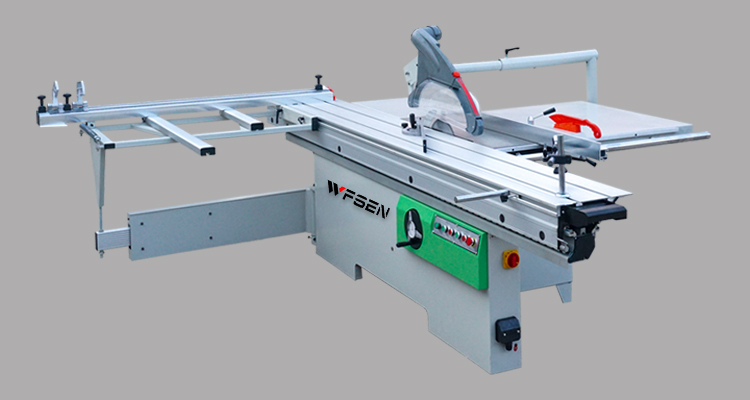
Short answer: on a sliding table saw four published figures decide what you can cut: the maximum cutting length (2800 / 3000 / 3200 / 3600 / 3800 mm across the build options of the MJ6232TD), the maximum cutting width (1250 mm), the height of cut at 90° (90 mm) and the height of cut at 45° (60 mm). A scoring saw running at 7000–8000 rpm cuts a shallow groove in the underside ahead of the main blade, which is what keeps two-sided decorative boards chip-free. Every other number on the sheet only describes how the machine delivers those four.
This page reads the published figures: what each one measures, which fields are alternative build options rather than one machine, and what they mean when you break down panels. The machines are listed on the saw machine page.
A specification sheet splits into two groups. The first describes the cutting envelope: how long, how wide and how thick a panel the machine takes. The second describes the hardware that produces it — blade diameters, spindle diameters, spindle speeds, motor power, sliding table width, overall size and weight.
The distinction that catches people out is that some fields hold several values at once. Where a field reads 2800 / 3000 / 3200 / 3600 / 3800 mm, it is not one machine with a variable setting; it is five build options of the same model.
Maximum cutting length is measured along the travel of the sliding table, so it is the longest straight cut the machine makes in one pass: 2800 / 3000 / 3200 / 3600 / 3800 mm on the MJ6232TD, depending on the build option. It is the most important number on the page for anyone cutting long boards: a cut longer than the stroke has to be made in two passes, and a two-pass rip has to be dressed afterwards.
The same field explains why the machine is quoted in several sizes: the table and its support rails are built to the stroke, so a longer cutting length is a decision about floor length. The published overall sizes run from 2850 × 3150 × 900 mm to 3850 × 3150 × 900 mm across the same options: the first figure grows with the stroke, the other two do not.
The machine carries two blades on separate spindles. The main saw does the cutting: a 300 mm blade on a 30 mm spindle, driven by a 5.5 kW motor. The scoring saw runs ahead of it: a 120 mm blade on a 20 mm spindle, driven by a 1.1 kW motor, set to cut a shallow groove in the underside just before the main blade passes through.
The reason for the second blade is the exit face. When a single blade leaves a melamine-faced or laminate-faced board it lifts the decorative layer on the underside, and the chip-out shows in the finished edge. The scoring saw cuts that underside first, so the main blade exits through a pre-cut line instead of through intact laminate. That is what separates a machine that cuts two-sided decorative panels from one that cuts one good face only.
The three figures go together. Blade diameter sets the maximum depth of cut, spindle diameter sets the bore of blade you can fit, and spindle speed sets the cutting speed at the rim. The MJ6232TD publishes a 300 mm main saw blade on a 30 mm main spindle, and a 120 mm scoring saw blade on a 20 mm scoring spindle.
The main saw spindle is published at 4500–6000 rpm and the scoring saw spindle at 7000–8000 rpm: the small blade turns much faster, which gives it a similar rim speed despite being less than half the diameter. Both are published as ranges, so both are adjustable.
The MJ6232TD publishes a tilting saw blade of 45 degree and gives the height of cut twice: 90 mm at 90° and 60 mm at 45°. Upright, the machine cuts a 90 mm stack; tilted to 45°, it cuts 60 mm, because tilting reduces the depth the blade reaches below the table.
That gap is the practical limit on bevel work. For mitres, chamfers and bevelled components the governing figure is the 45° one, not the 90° one.
The sliding table width is published at 380 mm: the width of the moving carriage that carries the panel past the blade. The maximum cutting width is published at 1250 mm: the widest rip the machine takes with the panel registered against the fence.
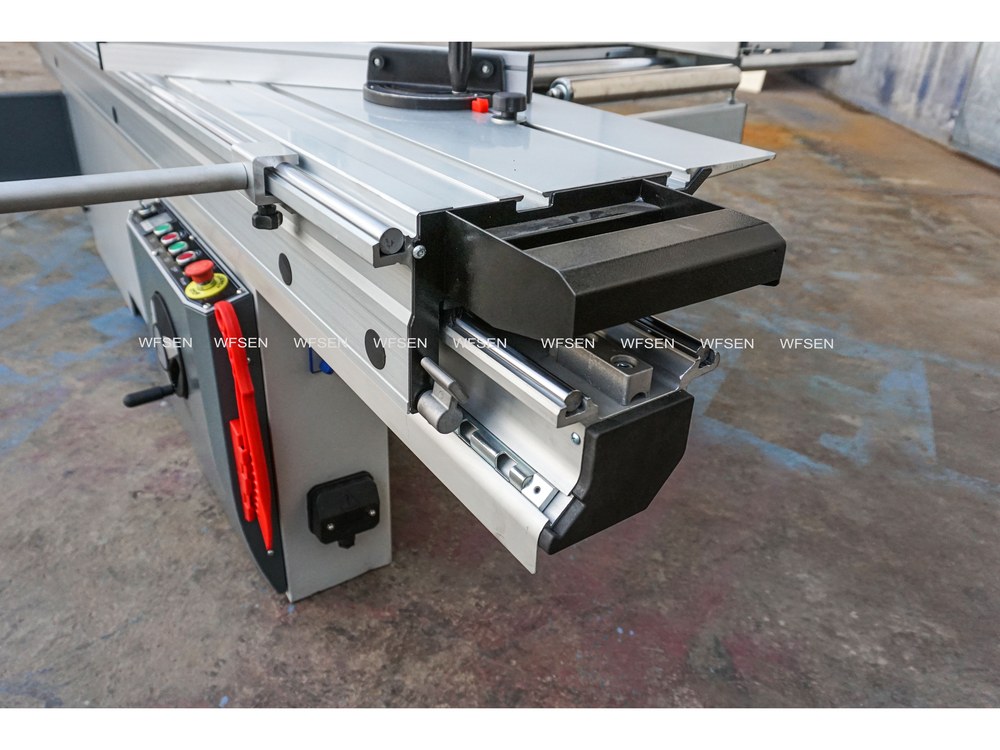
The full published specification for the model is set out below.
| MJ6232TD parameter | Published value |
|---|---|
| Overall size | 2850 / 3050 / 3250 / 3650 / 3850 × 3150 × 900 mm |
| Gross weight | 800–1200 kg |
| Max cutting length | 2800 / 3000 / 3200 / 3600 / 3800 mm |
| Max cutting width | 1250 mm |
| Height of cut at 90° | 90 mm |
| Height of cut at 45° | 60 mm |
| Sliding table width | 380 mm |
| Tilting saw blade | 45 degree |
| Main saw blade diameter | 300 mm |
| Scoring saw blade diameter | 120 mm |
| Main saw spindle speed | 4500–6000 rpm |
| Scoring saw spindle speed | 7000–8000 rpm |
| Main spindle diameter | 30 mm |
| Scoring spindle diameter | 20 mm |
| Main motor | 5.5 kW |
| Scoring motor | 1.1 kW |
The MJ6232TD product page also carries a separate comparison across the MJ6232TD, TE, TF, TG and TS variants, which is not reproduced here; the values above are for the build options of the machine itself.
A sliding table saw is the machine you push a panel through. The others hold the panel and bring the saw head to it — a distinction worked through in the comparison of beam saws, vertical panel saws and table saws.
| Machine | Published cutting envelope | Published thickness | Published main motor |
|---|---|---|---|
| MJ6232TD sliding table saw | Cutting length 2800–3800 mm; cutting width 1250 mm | 90 mm at 90°; 60 mm at 45° | 5.5 kW |
| MJF4116 full auto vertical panel saw | Cutting size 4100 × 1600 mm | 60 mm | 7 kW |
| MJ4116 vertical panel saw | Cutting size 4100 × 1600 mm | 60 mm | 4 kW |
| MJ2800 CNC beam saw | Max cutting width 2800 mm | 60 mm | 7.5 kW |
| MJ2700 / 3300 CNC beam saw | Saw length 2700 / 3300 mm | Saw thickness 75 / 100 / 120 mm | 7.5 / 11 / 18 kW |
| MJR1325 reciprocating saw | Working width 1300 mm; working length 2500 mm | 40 mm | 2.2 kW |
The envelopes are not measured the same way, and that is the point: the sliding table saw publishes two independent limits, a length along the stroke and a width across the table, while the vertical panel saws publish one cutting size of 4100 × 1600 mm and the CNC beam saws publish a saw length instead of a panel length.
Translated out of the table, the specification becomes a short list. The cutting length is the longest single rip or cross-cut and decides whether long components come off in one pass. The cutting width is the widest panel you can register against the fence. The 90 mm figure is the thickest stack you can cut square and the 60 mm figure the thickest you can cut with the blade tilted.
Two of these numbers also decide what happens to offcuts. A shorter cutting length still cuts the same widths, so a long narrow strip is more demanding than a short wide panel — the reverse of what most buyers assume.
The MJ6232TD publishes its two motors separately — 5.5 kW main saw and 1.1 kW scoring saw — and a gross weight of 800–1200 kg across the build options, with the overall size varying from 2850 × 3150 × 900 mm to 3850 × 3150 × 900 mm. On a sliding table saw the table and its rails run across the machine rather than along it, so the 3150 mm width is the figure to measure a doorway and a floor plan against.
For a smaller workshop there is a different machine in the same range: the MJF103 table saw and edge bander, with a sliding table size of 1200 × 1000 mm, a main saw blade power of 3 kW, a scoring saw blade power of 2 kW and a folding size of 1100 × 600 × 35 mm. It combines two operations in one movable package, and its edge banding side is covered on our edge banding machine page.
What is the maximum cutting length of a sliding table saw?
It depends on the build option. The MJ6232TD is published at 2800 / 3000 / 3200 / 3600 / 3800 mm — five build options rather than one adjustable machine.
What is a scoring saw for?
It cuts a shallow groove in the underside of a faced board ahead of the main blade, so the main blade exits through a pre-cut line instead of intact laminate. On the MJ6232TD it is a 120 mm blade on a 20 mm spindle, 1.1 kW, at 7000–8000 rpm.
How thick a panel will it cut?
The published heights of cut are 90 mm at 90° and 60 mm at 45°; the lower figure governs whenever the blade is tilted.
What is the difference between sliding table width and cutting width?
Sliding table width is the width of the moving carriage, 380 mm on this model. Maximum cutting width is the widest rip, published at 1250 mm.
What motor power does it need?
The MJ6232TD publishes a 5.5 kW main motor and a 1.1 kW scoring motor as separate figures; read them as two loads on independent spindles.
Can a sliding table saw replace a beam saw?
They cut differently rather than better or worse: the sliding table saw moves the panel past a fixed blade, while the CNC beam saws publish a saw length of 2700 / 3300 mm with carriage speeds for automatic cutting. Volume and automation decide between them.
Three habits cover most of it. Count the values in each field: a field with five numbers is five build options, and comparing option five of one model against option one of another is where most comparisons go wrong. Pair every cut figure with the angle it applies at, because a height of cut means nothing without the blade position. And check whether a figure is a size or a limit — table width and cutting width are different kinds of number.
The full saw range with published specifications is on our saw machine page. If your breakdown work is routed rather than sawn, that is a different family, covered on our CNC router page. Cutting is the first operation in a panel line; the drilling machines that follow it are a separate specification again. Send us the panel sizes, thickness and facing you cut and we will tell you which build option covers them — reach us through our contact page.