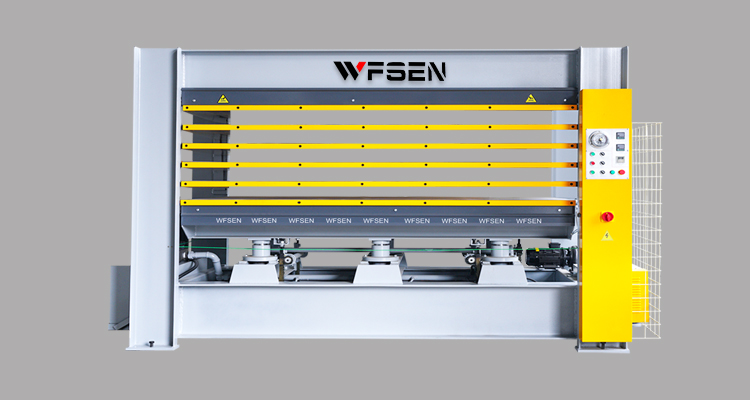
Short answer: a hot press machine for wood bonds a stack of glued panels into one board by holding that stack under pressure between heated platens until the adhesive cures. In the WFSEN range the published figures run from 100 ton of total pressure on a single-layer machine to 300 ton on a six-layer machine, with a thermal oil furnace from 24 kW to 98 kW and between 1 and 6 working layers. Pressure closes the glue line; heat sets it.
This page covers the working principle and the structure: what happens during one cycle, what each part does, and what the layer, opening, tonnage and temperature figures on a specification sheet really mean. Matching a tonnage and plate size to your own product is a separate question, answered in our guide to how to choose a hot press machine for plywood and panel production.
A hot press is the stage where loose material becomes a single board. Panels are stacked with adhesive between them, the stack is loaded between heated platens, the platens close and clamp it while the plates stay hot, and the stack is held there until the resin has gelled and cured. Pressure then releases, the platens open, and the board comes out flat, bonded and ready for trimming or sanding.
Three variables decide the result: pressure, temperature and time. A specification sheet describes the first two. The third, the time the stack stays closed, is set by the adhesive you use rather than by the machine, which is why no cure time is published.
The press is also one stage of a line: adhesive is applied in front of it on a machine such as a glue spreader, and a curing or stacking stage often follows. The sequence is set out on our plywood pressing line page.
Each part has one job. The frame carries the load and keeps the plates parallel, the platens transfer pressure and heat to the panel faces, the cylinders generate the force through the hydraulic pump and motor, and the thermal oil furnace and hot oil pump hold the plates hot through the cycle.
Platen size is the working surface and decides the largest panel a machine will take. The published platens are 3300 × 1300 × 42 mm on the five-layer 160 ton press, 2500 × 1300 × 42 mm on the three-layer 120 ton and the single-layer 100 ton presses, 3000 × 1300 × 42 mm on the two-layer 120 ton press, and 1600 × 1200 × 42 mm on the six-layer 300 ton press. Every platen we publish is 42 mm thick — that mass is what keeps temperature even across the face when a cold stack is loaded.
The cylinder sets differ by model: 6 × 100 mm on the three-layer 120 ton and single-layer 100 ton presses, 8 × 100 mm on the five-layer 160 ton press, 8 × Ø85 × 300 mm on the two-layer 120 ton press, and 4 × ø200 mm plus one 120 mm promote cylinder on the six-layer 300 ton press, which also publishes a cylinder distance of 600 mm.
Read the range across and the trade-off is visible: tonnage, layer count and plate size move together, and plate size moves against layer count.
| Model | Total pressure | Working layers | Platen / plate size | Overall dimension |
|---|---|---|---|---|
| HT-160 × 5 layer | 160 ton | 5 | 3300 × 1300 × 42 mm | 4500 × 1700 × 2300 mm |
| HT-120 × 3 layer | 120 ton | 3 | 2500 × 1300 × 42 mm | 3700 × 1700 × 2000 mm |
| HT-120 × 2 layer | 120 ton | 2 | 3000 × 1300 × 42 mm | 4200 × 1700 × 2000 mm |
| HT-100 × 1 layer | 100 ton | 1 | 2500 × 1300 × 42 mm | 3600 × 1700 × 2000 mm |
| HT-300 × 6 layer | 300 ton | 6 | 1600 × 1200 × 42 mm | not published |
Two notes so nothing looks more complete than the source. The six-layer 300 ton machine publishes a plate size but not an overall dimension, so that cell says not published. Only one model publishes a weight — the two-layer 120 ton press at 7000 kg — and where a page writes the force as pressure rather than total pressure, both mean the rated force.
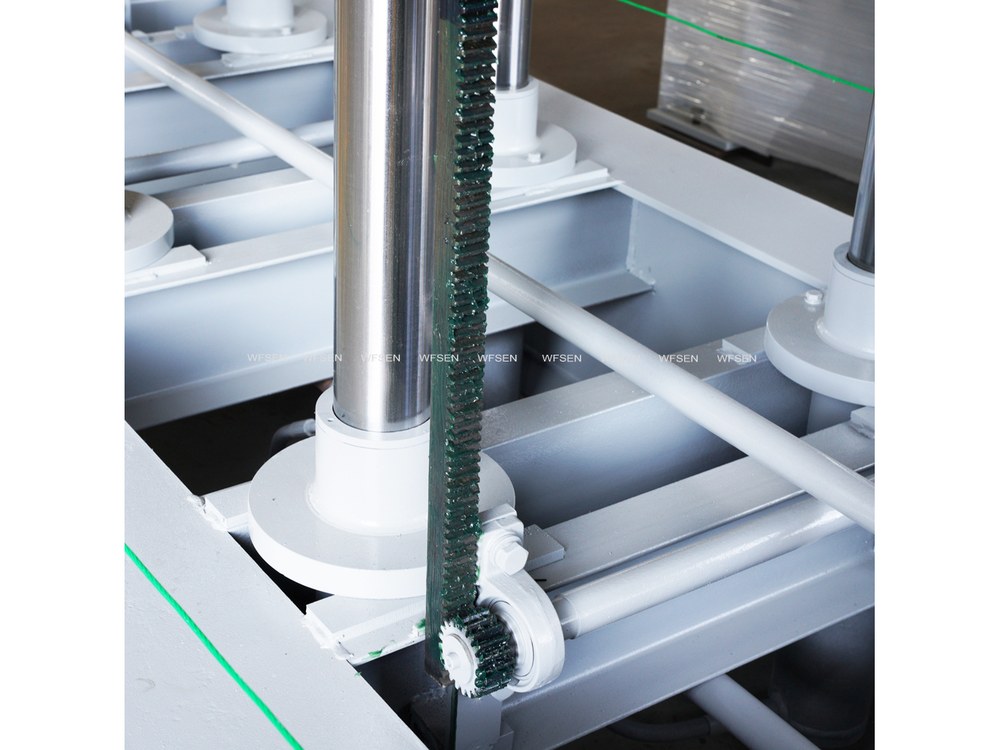
Tonnage is the total force the cylinder set pushes up through the plate, published here at 100, 120, 160 and 300 ton. It is made hydraulically: a motor drives the pump, the pump pushes oil into the cylinders, and the cylinders raise the bottom platen against the fixed upper plate.
Read tonnage with plate size: the same tonnage over a smaller plate is a higher pressure on the panel, and over a larger plate a lower one. A 300 ton rating on a 1600 × 1200 mm plate and a 160 ton rating on a 3300 × 1300 mm plate are not describing the same thing, even though both are simply called "tonnage" on a quotation — so compare the pair of numbers.
Cylinder arrangement belongs to the same story. More cylinders, or a larger bore, across the same plate does not change the rated total, but it changes how evenly that total is spread — which keeps a large, thin panel flat.
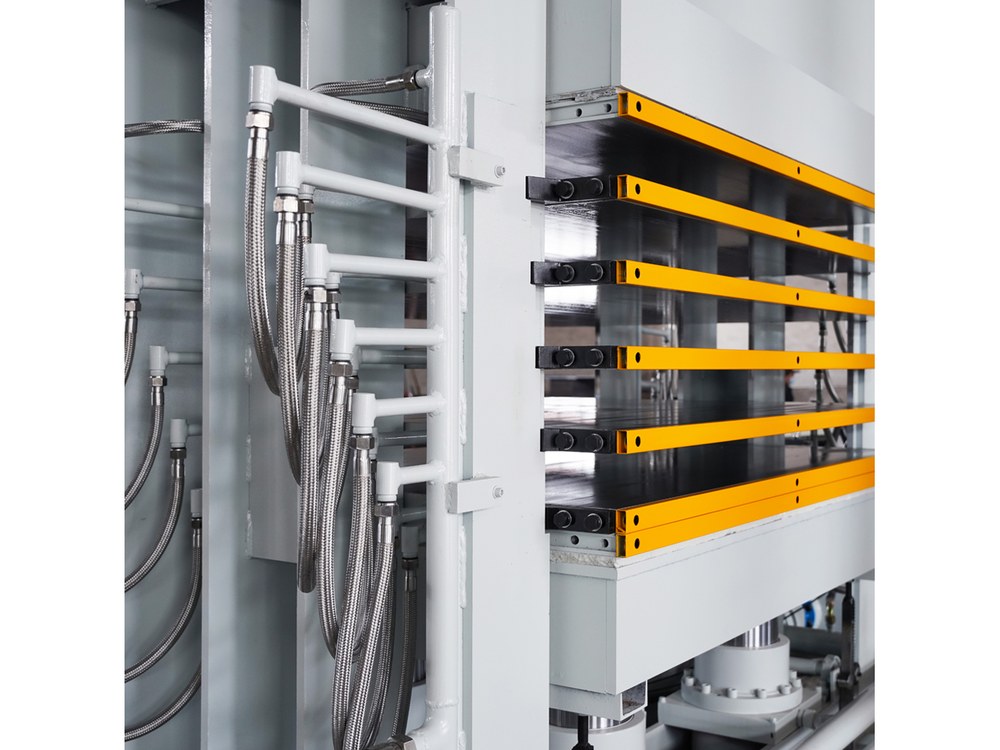
Heat reaches the panel through the platens, and every machine in this range is heated by thermal oil. The furnace heats the oil, the hot oil pump circulates it through the platens, and the oil returns to be reheated. Furnace power is published at 24 kW, 36 kW, 39 kW, 63 kW and 98 kW, and the hot oil pump at 1.5 kW, 2.2 kW or 3.7 kW depending on the model.
Thermal oil is used because it delivers a high plate temperature at low circuit pressure, without the boiler and water treatment a steam system needs. The hydraulic motor clamps the stack and the furnace holds the plates hot while it is clamped, so a larger plate area and more layers need a larger furnace.
Only one page in the range publishes a maximum temperature: 180 °C on the six-layer 300 ton machine. The other four do not publish one, so we do not quote one; the set point comes from your adhesive data sheet.
A layer is one panel position in the stack: the single-layer machine presses one panel per cycle and the six-layer machine six. Layers are the throughput figure: output per shift is the layer count multiplied by the cycles completed.
Opening and spacing are the clearance figures that go with it. The two-layer 120 ton press publishes an opening of 150 mm. The six-layer 300 ton press publishes a plate-between distance of 100 mm and a cylinder distance of 600 mm. Those numbers set how much room the stack has between the plates, and therefore the thickest assembled stack a machine will accept. Where no opening is published, confirm the figure with us.
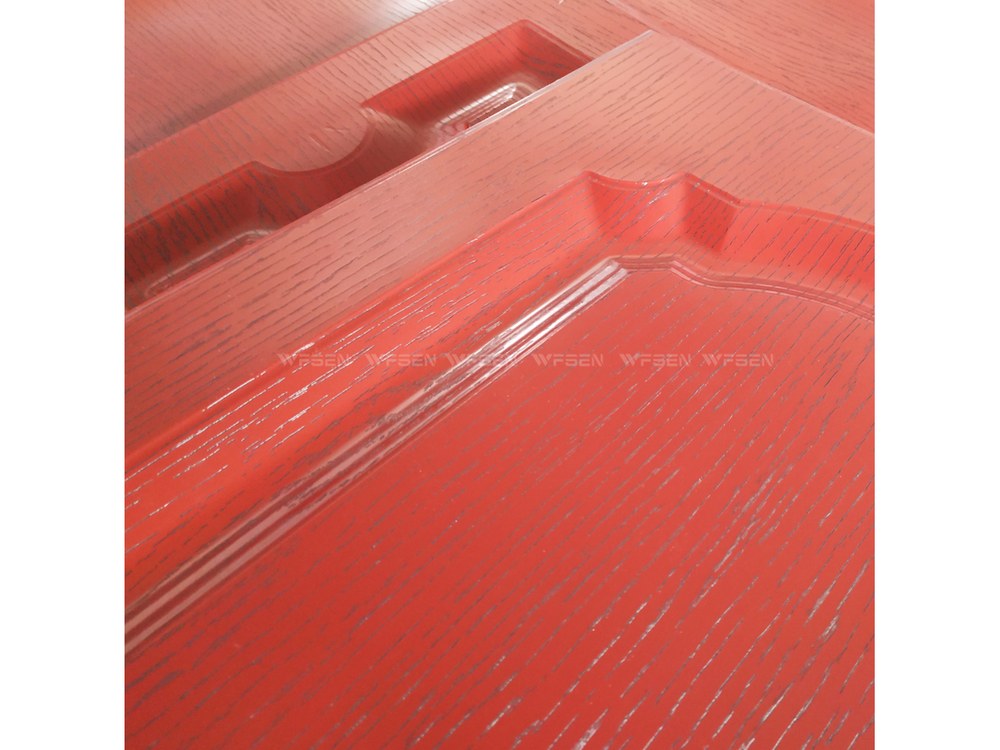
The job is always the same — hold a glued stack flat while the adhesive cures — and the products follow from that. Plywood and blockboard are pressed with adhesive between veneer or core layers. Veneered MDF and particleboard are pressed with a decorative face glued down — the melamine hot press duty, where the plate surface finish transfers to the panel — and decorative laminates are pressed the same way.
Three models publish a minimum panel width of ≥60 mm, the smallest strip the press is rated to hold. Bond quality comes from pressure being even, temperature being even and the cure being complete.
Each machine publishes three electrical loads separately, and the largest is not the one most buyers expect. The hydraulic motor is near-constant across the range; the furnace is what scales.
| Model | Hydraulic motor | Hot oil pump | Thermal oil furnace |
|---|---|---|---|
| HT-160 × 5 layer | 5.5 kW | 3.7 kW | 98 kW |
| HT-120 × 3 layer | 5.5 kW | 3.7 kW | 39 kW |
| HT-120 × 2 layer | 5.5 kW | 1.5 kW | 36 kW |
| HT-100 × 1 layer | 5.5 kW | 1.5 kW | 24 kW |
| HT-300 × 6 layer | 7.5 kW | 2.2 kW | 63 kW |
Four of the five machines use the same 5.5 kW hydraulic motor, and only the six-layer 300 ton press steps up to 7.5 kW. The furnace spans 24 kW to 98 kW — several times any hydraulic load. That is the figure to give your electrician, and the reason press heating is planned into the building supply.
A cold press holds a glued stack flat at room temperature and lets the adhesive cure on its own, which suits flat bonding and heat-sensitive faces. A hot press adds heat so the adhesive cures in minutes rather than hours, which is what makes a high-output line possible. Many plants run both, with the flat-bonding duty covered by our plywood cold press machine.
How does a hot press work?
A glued stack is loaded between heated platens. The cylinders clamp it at the rated tonnage while the thermal oil circuit keeps the plates hot, and the stack stays clamped until the adhesive cures. The platens then open and the board is removed flat.
What is a thermal oil hot press?
A press whose platens are heated by hot oil instead of steam or electric elements. A furnace heats the oil, a hot oil pump circulates it through the platens and back, and the plate temperature is held through the cycle.
What does the tonnage mean?
It is the total clamping force of the cylinder set — 100 ton, 120 ton, 160 ton or 300 ton here — and it only means something alongside the platen size, because pressure is force divided by plate area.
How many layers does a hot press have?
One, two, three, five or six here, and the layer count is the throughput figure. The six-layer 300 ton machine presses six panels per cycle on a 1600 × 1200 × 42 mm plate with a plate-between distance of 100 mm.
What temperature does it run at?
The only maximum published in this range is 180 °C, on the six-layer 300 ton machine; the other four do not publish one. The set point comes from the adhesive data sheet.
How much power does a hot press need?
The largest single load is the furnace, published at 24 kW, 36 kW, 39 kW, 63 kW and 98 kW, plus a 5.5 kW or 7.5 kW hydraulic motor and a 1.5 kW, 2.2 kW or 3.7 kW pump.
The full range is on our hot press machine page. Which tonnage, plate size and layer count suit your board and output is covered in how to choose a hot press machine for plywood and panel production. To have a model matched to your panel size and adhesive, reach us through our contact page.