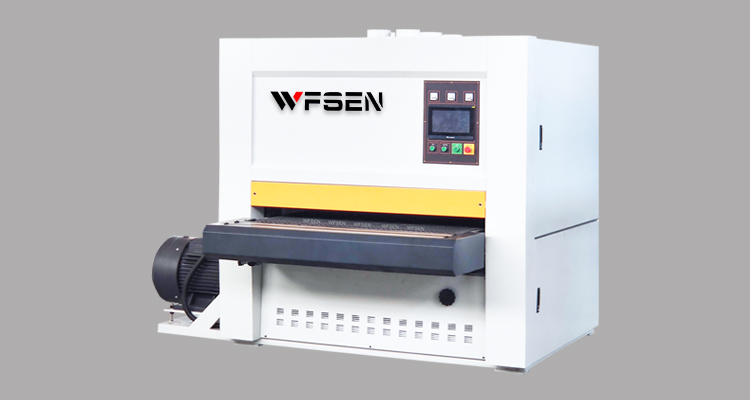
Short answer: the industrial sanders used in panel production fall into five families — wide belt, planer sander, primer sander, double-sided, and edge or profile. They are told apart by three things: how many heads the machine carries, whether it also planes, and whether it sands one face or both in the same pass. Across our range the panel machines run from 1,600 kg to 5,000 kg and cover a working thickness of 2.5–110 mm at a feed speed of 5–30 m/min. The brush and metal family is a separate group with its own figures, and it is the one that goes thinnest.
This page sets out what each family is for and how to read the specification figures that separate them. Every number below is taken from the individual machine pages, and where a page does not publish a value it is marked not published rather than estimated.
| Family | Reference model | Weight | Working width | Thickness | Feed speed |
|---|---|---|---|---|---|
| Wide belt | R-R-RP1300 | 2,000–4,100 kg | 1,000 / 1,300 mm | 3–110 mm | 6–30 m/min |
| Planer sander | B-R-RP1000 / 1300 | 3,600 / 4,500 kg | 1,000 / 1,300 mm | 3–110 mm | 6–30 m/min |
| Primer sander | R-R1000 | 2,200 / 3,200 kg | 1,000 / 1,300 mm | 2.5–110 mm | 6–30 m/min |
| Double-sided | R/R-R/R | 4,000 / 4,500 kg | 630 / 1,000 mm | 3–110 mm | 6–30 m/min |
| Edge and profile | 1S1C1P1P | 1,600 kg | 100–1,800 mm | 5–80 mm | 5–30 m/min |
The wide belt sander is the machine most workshops mean when they say sander. A panel is carried under one or more abrasive belts on rollers, and each head does one job: the first head calibrates, and later heads remove the scratch pattern left by the head before. The R-R-RP1300 is published with up to three belt heads plus a feeding motor, a lifting motor and a dust collector:
| Unit on the R-R-RP1300 | Published motor power |
|---|---|
| First motor | 15 / 22 / 37 kW |
| Second motor | 11 / 15 / 22 kW |
| Third motor | 11 / 22 kW |
| Feeding motor | 1.5 / 4 / 4.5 kW |
| Lifting motor | 0.37 / 0.55 kW |
| Dust collector | 5.5 / 7.5 kW |
The rollers are published at 190 / 240 mm for the first head, 190 / 210 / 240 mm for the second and 190 / 210 mm for the third, and the abrasive belt size is 1020 × 2020 mm or 1320 × 2020 mm. Note what that means for the workshop: a 37 kW first motor plus a 7.5 kW dust collector is a three-phase installation with extraction sized to match, not a machine that plugs in next to a bench.
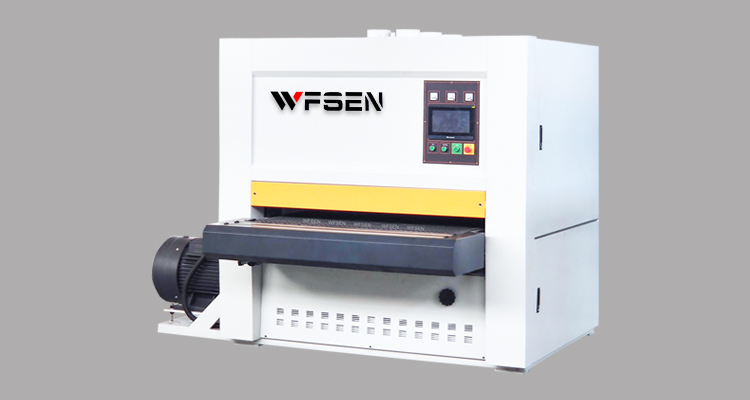
A planer sander puts a planing head in front of the belt heads on the same bed. The planer takes the panel to thickness with knives, and the belts then remove the knife marks and finish the surface. On the B-R-RP1000 / 1300 the published motor list is a planer motor at 15 / 22 kW, a first belt motor at 15 / 30 kW, a second belt motor at 11 / 22 kW, a feeding motor at 3 / 4 kW and a lifting motor at 0.37 / 0.55 kW.
The machine is heavier than the equivalent wide belt sander — 3,600 kg against 4,500 kg depending on width, in outline sizes from 2,500 × 2,050 × 1,750 mm to 3,000 × 2,150 × 2,150 mm — and that weight sits behind the planing head, which has to hold a panel against a cutter. If your incoming panels vary in thickness, this is the family that removes the variation before the belt ever touches the surface.
After a panel is primed or sealed, it has to be sanded again before the top coat, and that pass is gentle: the aim is to flatten the coating without cutting through it. The R-R1000 is built for it. Its published working thickness starts at 2.5 mm — thinner than the 3 mm floor of the other families — its feed speed is 6–30 m/min, and its dust volume is published at 8,000 or 9,600 m³/h depending on the 1,000 mm or 1,300 mm width.
Two details matter more than the headline figures. First, the belt speed on this model is published as frequency controlled, which is what allows the same machine to sand a sealer coat without burning through it. Second, this is the only family in the range whose page publishes the dust volume itself rather than a dust collector motor power, which is a useful reminder that primer dust is fine and loads a filter quickly — extraction is the constraint on this process rather than head power.
A double-sided sander has an upper and a lower unit on the same bed, so a panel is sanded on both faces in a single pass. The published unit motors on the R/R-R/R are 11 + 7.5 kW or 15 + 11 kW, with two feeding motors at 2.2 kW each and a lifting motor at 0.75 kW. Working widths are published at 630 mm or 1,000 mm, and the machine is listed in three configurations — R/R, R-R/R-R and R-P/R-P — with upper and lower unit rollers at 190 + 240 mm.
This is the family for boards where both faces are visible — door skins, furniture panels finished on both sides, and any part that will be seen from the front and the back. Running one face at a time through a single-sided machine means two passes and two chances to lose the thickness reference; the double-sided machine takes both faces off the same setting.
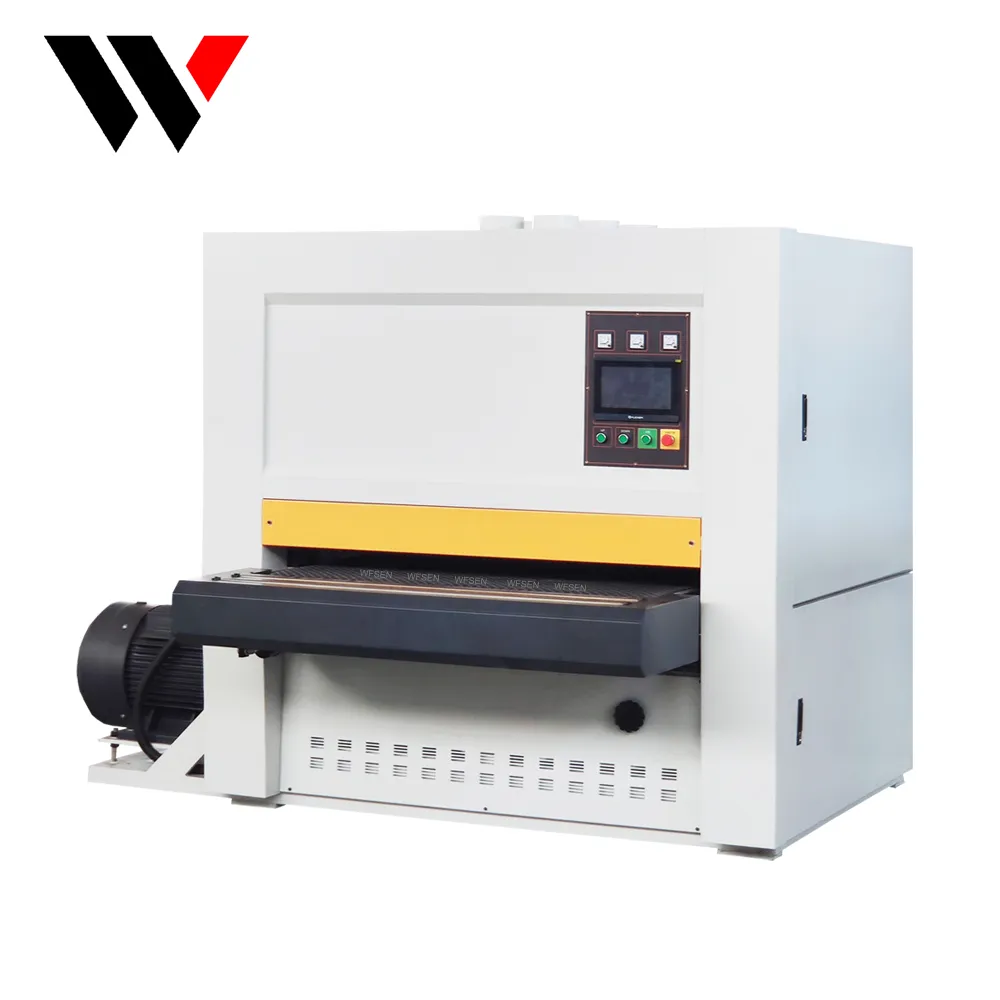
Panels have edges, and edges are sanded on a different machine because the work is narrow and long rather than wide and flat. The 1S1C1P1P edge sanding machine is published with a working width of 100–1,800 mm against a working thickness of 5–80 mm and a feed speed of 5–30 m/min controlled by frequency, which is a very different shape of machine from the wide belt units: 4,200 × 1,100 × 1,500 mm and 1,600 kg.
Its published motor list explains what it does in sequence: a feeding motor at 2.2 kW, a belt sanding motor at 2.2 kW, a swing belt sanding motor at 0.12 kW, a corner motor at 1.1 kW, a belt polishing motor at 1.5 kW and a brush polishing motor at 1.5 kW. Sanding, then the corner, then belt and brush polishing — the same finish-by-stages logic as the wide belt family, applied to a profile instead of a face. The polishing machines that take over at the end of either line are specified separately.
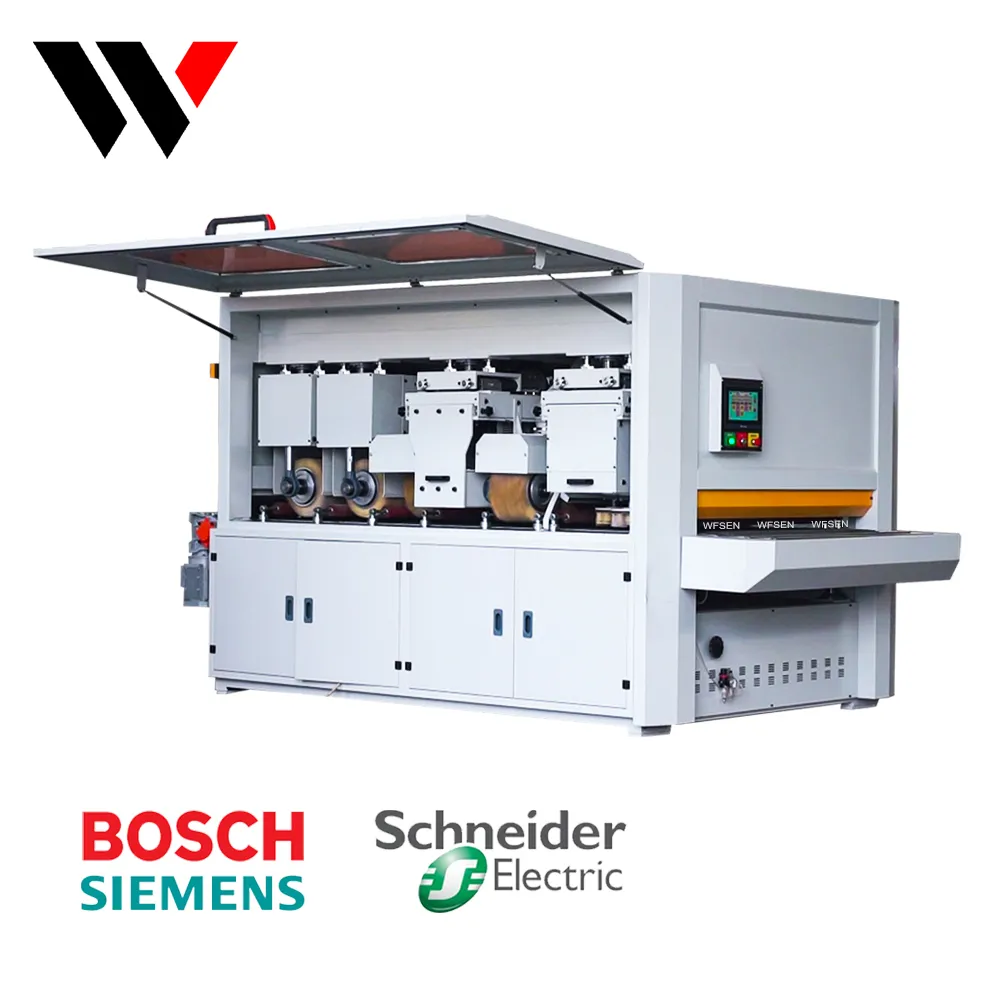
The last family uses brushes rather than belts, and it is bought for a surface effect rather than for dimensional work. On the W-R1100 the published motors are four brush roller motors at 2.2 kW each, a brush roller lift motor at 0.37 kW, a table lift motor at 0.37 kW, a feeding motor at 3 kW and a vacuum adsorption unit at 15 kW. The brush roller is published at Ø300 × L400 mm running at 8–20 r/s, with a polishing angle of R0.1–0.5 mm.
Working thickness on this family runs from 0.2 mm to 70 mm, far thinner than the panel families, and the minimum working piece is published at 50 × 50 mm. That combination — thin stock, small parts, a 15 kW vacuum table to hold them down and a feed speed of only 0.5–6 m/min — describes a deburring and surface-finishing machine: brushed metal, sharp edges removed, small laser-cut parts. The sister model W1100 is the same machine at 2,400 × 1,800 × 2,200 mm and 2,000 kg with magnetic iron adsorption published at 820–920 mm instead of a vacuum table.
How many types of sanding machine are there?
For panel work, five families cover almost everything: wide belt for faces, planer sander where thickness varies, primer sander for coated panels, double-sided where both faces show, and edge or profile machines for narrow work. Brush sanders are a separate family for surface finishing rather than dimensional work.
What is the difference between a wide belt sander and a planer sander?
A wide belt sander only sands. A planer sander carries a planing head in front of the belt heads on the same bed, so it takes a panel to thickness with knives and then removes the knife marks. The planer sander is heavier as a result — 3,600–4,500 kg in this range — because the planing head has to hold the panel against a cutter.
What is a primer sanding machine for?
Sanding a primed or sealed panel before the top coat without cutting through the coating. The R-R1000 is published with a working thickness from 2.5 mm, frequency-controlled belt speed and a dust volume of 8,000–9,600 m³/h.
Can one machine sand both sides of a panel?
Yes — a double-sided sander with an upper and a lower unit sands both faces in one pass. The R/R-R/R is published at 630 mm or 1,000 mm working width with unit motors of 11 + 7.5 kW or 15 + 11 kW.
What is the thinnest material a sander will take?
The brush and metal family goes down to 0.2 mm with a minimum working piece of 50 × 50 mm; the panel families start at 3 mm, and the primer sander at 2.5 mm.
How much dust extraction does a sander need?
Size it from the machine's own published figure rather than from the shop's existing ducting — the same rule that applies when you size a cyclone dust collector. The primer sander publishes 8,000–9,600 m³/h and the wide belt machine carries a 5.5–7.5 kW dust collector, which is the scale of extraction the machine was designed around.
Four facts decide which family you need: the widest panel you sand, the shortest part you sand, the thinnest and thickest stock, and whether the panel is bare, coated or metal. Send us those and we will tell you which machine in the range covers the work — and which two of the five families you can rule out.
The full range is on our sanding machine page, and you can send your panel specification directly to us here. Sanding rarely stands alone: the polishing machines that follow it, and the plywood pressing line that feeds it, are specified on the same basis. Most panels reach a sander from a cutting and edge banding sequence, and the finish you can sand to depends on how clean those two left the edge.