Screw compressors took over the industrial market for good reasons, and the advice to buy one is usually correct. It is not always correct. A workshop that needs 8 bar for a nailer, a blow gun and a clamping cylinder a few times an hour does not benefit from a rotary screw running unloaded for most of the day.
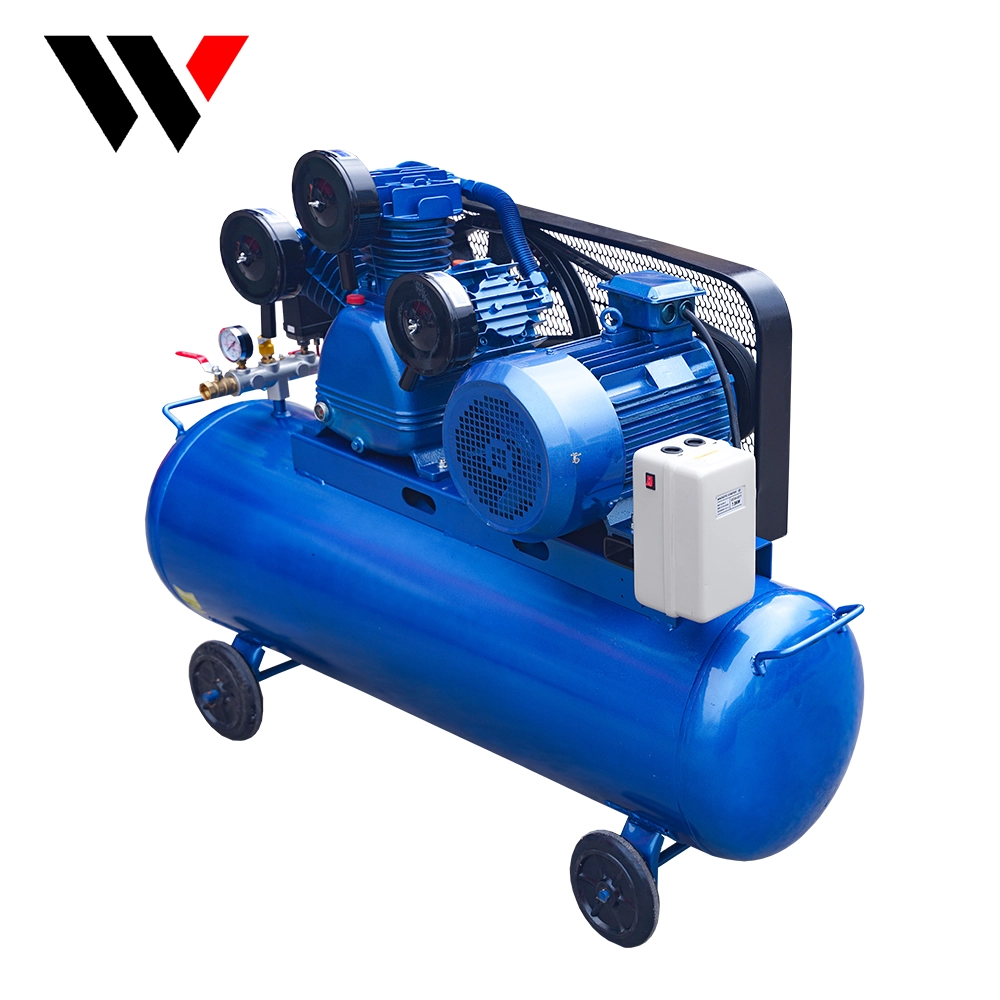
The 7.5 kW piston unit is built for that shop. The published figures are a 230 L tank, 0.8 MPa of air pressure, a flow of 1.0 m³, a 7.5 kW motor and an overall size of 1550 by 500 by 1100 mm. It is belt driven, it is on wheels with a handle, and the motor is described as all copper.
Those numbers describe a mobile, intermittent-duty machine. What follows is what each of them actually constrains.
Eight bar is the default workshop pressure. It runs nailers, staplers, blow guns, most pneumatic clamps, spray guns and the pulse valves on a cartridge dust collector.
It does not run a wide belt sander's air tensioning system if that system is specified higher, and it does not run certain blast cabinets or air-over-hydraulic presses. Those are 10 to 12 bar applications and no amount of tank volume substitutes for pressure. If your machine's plate says 10 bar, this compressor is the wrong machine whatever the flow.
Eight bar is also a working figure, not a shut-off figure. A piston compressor cuts out at its set pressure and cuts back in below it, so the pressure at the tool is lower than the pressure in the tank by the pressure drop across the regulator and the hose. A 10 m hose at high flow can lose a bar on its own. Size the hose for the tool, not for the compressor outlet.
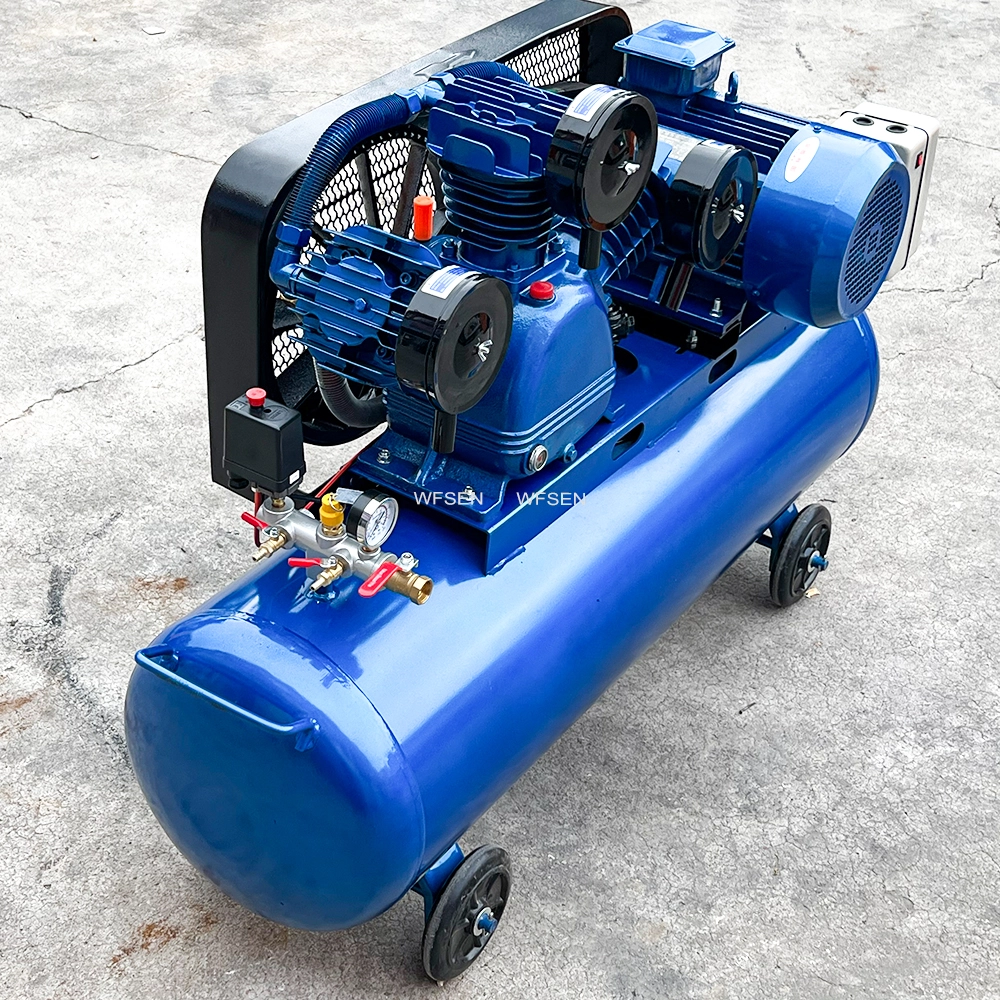
The tank does two jobs and buyers usually only count one of them.
The first is buffering. A nailer fires in a fraction of a second and draws a burst far above the compressor's steady delivery. The tank supplies that burst, and the pump refills afterwards. A 230 L receiver handles a burst that a 50 L receiver cannot, which is why a small direct-drive unit and this machine feel completely different with the same tool.
The second is cooling and moisture separation. Air leaving the pump is hot, and hot air holds water as vapour. In a 230 L tank the air slows down, cools and drops its condensate, which then sits at the bottom and has to be drained. A bigger receiver removes more water before it reaches the tool than a smaller one does.
A rough way to read the capacity: at 0.8 MPa, a 230 L receiver holds roughly two cubic metres of free air, which is about two minutes of this pump's delivery. That is the buffer, and it is the reason a 230 L unit at 7.5 kW feels like a bigger machine than its motor suggests.
The flow figure is published as 1.0 m³ without a time unit in the table, while the tank is listed separately at 230 L. Read as delivery per minute, 1.0 m³/min is about 35 cfm, which is a sensible figure for a 7.5 kW piston pump. Confirm the unit on the quotation if your tool list is close to the limit.
A belt-driven pump runs slower than a direct-drive one because the pulley ratio trades motor speed for pump speed. Slower pump speed means less noise, less heat per stroke and longer pump life.
It also means the pump is a serviceable assembly rather than a sealed unit. Belts are a consumable and a belt that is tensioned correctly lasts years; a belt that squeals on start is too loose and one that whines is too tight. Both are five-minute adjustments, and both are ignored until the belt fails.
The trade is bulk. Belt drive needs more length and more mass, which is why this machine measures 1550 mm long for a 7.5 kW motor. It is a machine that sits against a wall, not one that tucks under a bench.
The wheels and handle are not a gimmick. A piston unit is the compressor you move to the job, and a 1550 mm machine on castors can be pushed to the assembly bay where the nailers are working instead of running 30 m of hose across a walkway.
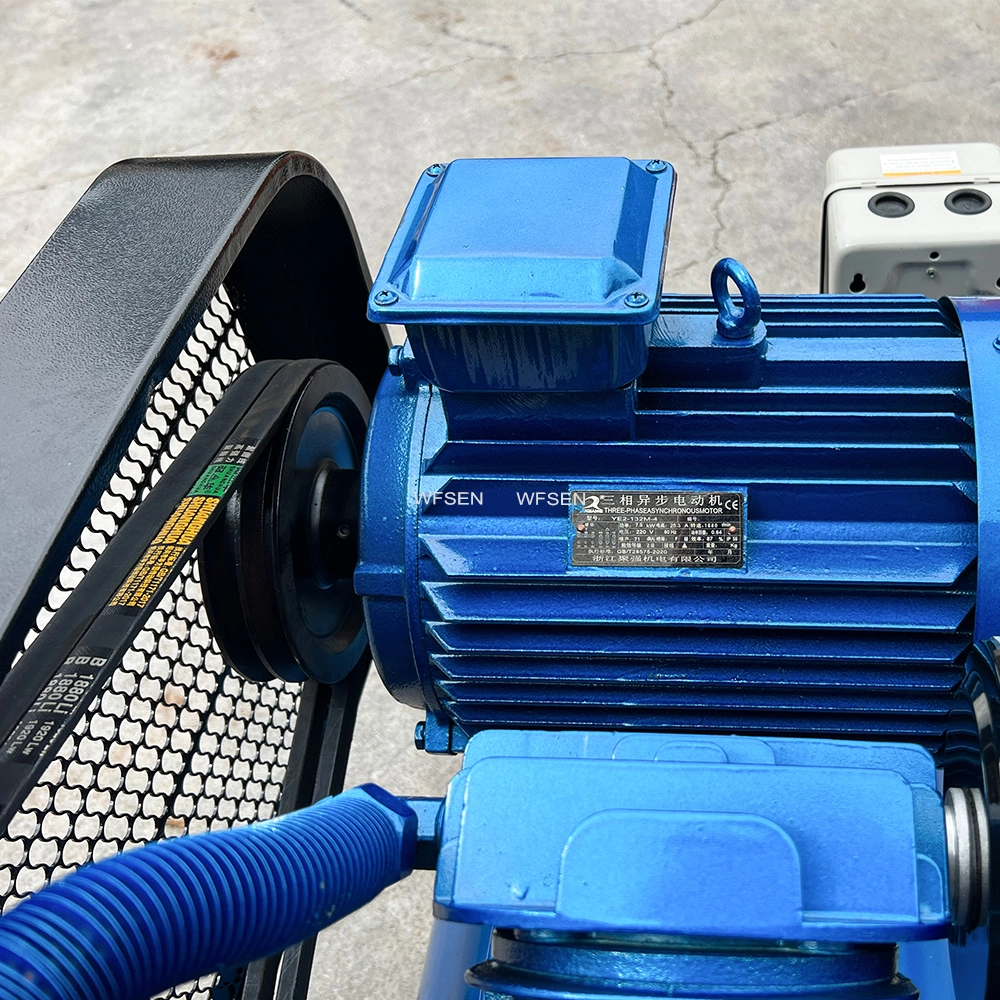
The motor is described as all copper, which is a claim about the windings rather than about the copper content of the whole machine. Copper windings run cooler than aluminium for the same current, and a cooler winding lasts longer in a machine that starts and stops repeatedly.
It matters here because of duty cycle. A piston compressor is an intermittent machine: it runs until the tank is full, stops, and waits. Every start is a thermal and electrical event, and a compressor that short-cycles because the tank is too small for the demand does that hundreds of times a day. Copper windings and a 230 L receiver are the two things that make short cycling less likely, and they work together.
Every compressor produces condensate, and every workshop that skips the drain pays for it in tools.
Water in a nailer rusts the piston and the o-rings. Water in a spray gun ruins a finish in a way that looks like a paint fault. Water in a pulse valve on a dust collector makes the pulse fire weakly and the filter blinds early.
Drain the tank at the end of the shift. Not weekly: daily. Fit a separator and a filter regulator at the outlet if the air feeds a spray gun or a pulse system, and drain those too. If the compressor runs hard in humid weather, a refrigerated dryer is cheaper than the rework it prevents.
The tank drain is at the lowest point, which is why the machine needs to sit level. A compressor on an uneven floor keeps water at one end and drains incompletely.
The mistake is to add up the consumption of every tool in the shop. The correct method is to add up the tools that run at the same time.
Two nailers and a blow gun is a light load for this machine. One edge bander with pneumatic clamping, a spray gun and a pulse-jet collector starting together is a different question, because a pulse valve draws a large volume for a very short time and the collector may fire several valves in sequence.
Ask each machine supplier for the air consumption at the stated pressure, add the simultaneous load, and compare it with 1.0 m³/min. If the answer is within about two thirds of the delivery, this machine is comfortable. If it is at or above the delivery, the pump will run continuously and you are in screw compressor territory.
Two pieces of equipment catch people out. An edge banding machine with pneumatic clamping draws in bursts that overlap with a nailer, and a pulse dust collector fires its solenoid valves on a timer, so a collector and a tool can demand air at the same instant without anyone planning it. Leave headroom for both.
Our screw air compressor guide covers the 15 kW rotary route and the 0.6 MPa specification that suits a woodworking shop running sanders and edge banders together. The two articles answer different questions: that one is about continuous demand, this one is about intermittent demand.
Three signals, and they usually arrive together.
The pump runs continuously and the tank never reaches cut-out. That means demand has caught up with delivery and the receiver is no longer buffering anything.
The shop runs air for a full shift rather than in bursts. A screw compressor is efficient when it runs loaded for long periods; a piston unit is efficient when it runs briefly and rests.
The compressor has moved into the production area and the noise has become a problem. A piston unit is audibly working; a rotary screw in an enclosure is not.
None of those signals is about pressure. If your problem is that tools are starving at 8 bar, the answer is a bigger receiver or a shorter hose, not a different compressor type.
The machine is 1550 by 500 by 1100 mm, so it fits along a wall, and it needs clear air around the pump for cooling. Boxing it into a cupboard is the fastest way to overheat a piston compressor.
Power is a 7.5 kW motor, which on a single-phase supply is not a realistic load. Check the supply against the motor plate before delivery, and check that the circuit is dedicated rather than shared with a machine that starts at the same time. A compressor and a dust collector starting together on one circuit is a trip that will be blamed on the compressor.
The outlet should feed a filter regulator and then a hard line or a hose reel, not a loose hose lying on the floor. A hose that gets driven over is a hose that fails at the worst moment, and a compressed air hose that whips is a genuine hazard.
If the compressor will sit in a workshop where the temperature drops below freezing, drain it thoroughly at the end of every shift. Ice in a receiver or a trap is not a maintenance inconvenience, it is a burst risk.
A 7.5 kW piston compressor on a 230 L receiver at 0.8 MPa is the right machine for a joinery or assembly shop that uses air in bursts: nailers, staplers, blow guns, a clamping cylinder, the occasional pulse valve. It is mobile, it is serviceable, and the receiver is large enough that the pump is not starting every few minutes.
It is the wrong machine for continuous demand, for pressures above 8 bar, and for a shop where the compressor will sit beside a workstation. Those cases belong to a rotary screw, and pretending otherwise is how people end up with a pump that never stops.
Full figures are on the 7.5 kW piston air compressor page. The rotary alternative is on the 15 kW screw compressor page, and both sit in the workshop equipment range with the pulse dust collectors that depend on a stable air supply.
Send the tool list with consumption figures at 8 bar and we will tell you whether this machine holds the load or whether you need the rotary route.