Two dust collectors with the same airflow are not the same collector. What separates them is the filter medium, and the medium decides how fine the exhaust is, how the unit is cleaned, how much floor space it takes and what it costs to run for a year.
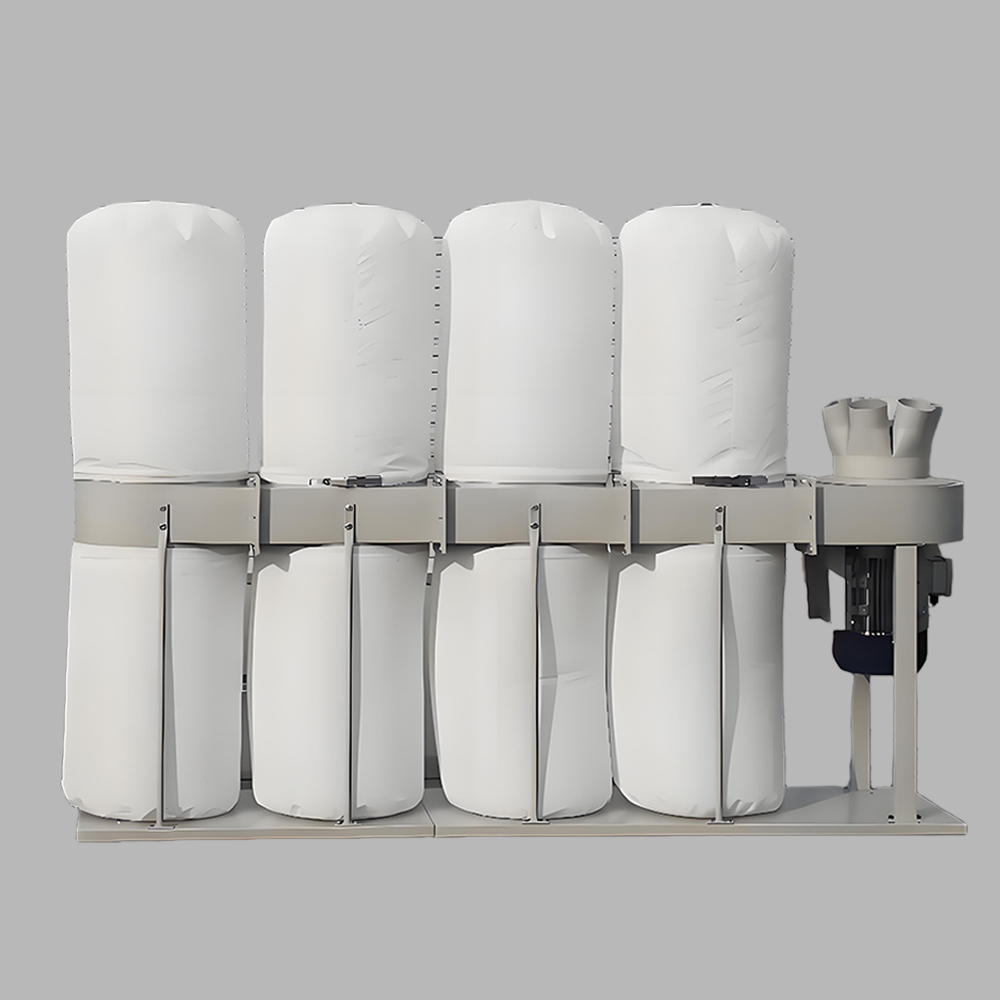
Our range has both answers. A cartridge unit with automatic pulse cleaning lists a 96 m² filter area, 14,000 m³/h of fan exhaust airflow and 32 cartridges of 150 by 1000 mm. A bag-type series, the MF9022 through MF9075, lists a wind capacity of 2,350, 3,150 and 8,500 m³/h across the range, power from 2.2 to 7.5 kW, a spindle speed of 2,900 r/min and cloth bags of 480 mm diameter in one, two or four per unit.
The choice between them is not about which is better. It is about which failure mode you can live with.
Air enters a housing, passes through fabric, and leaves. Dust stays on the outside of the fabric, and the fabric is shaken or reversed to drop it into a bin.
The MF series follows that pattern. Cloth bags of 480 mm diameter, one to four per unit, at a spindle speed of 2,900 r/min and a wind speed of 35 to 40 m per second. The published weights tell the size story: 50, 70 and 170 kg across the range, against a 7.5 kW top motor.
A bag collector is simple, cheap to buy, and forgiving. It has few moving parts, the bag is a low-cost consumable, and a workshop can service it without a technician. What it does not do is filter fine dust well after the fabric has loaded, and it does not clean itself.
That last point is the one that matters on a sander. Fine dust is the fraction that stays airborne and the fraction that a bag passes once the weave is loaded. A bag that is shaken by hand once a week is a bag that runs most of the week at reduced airflow.
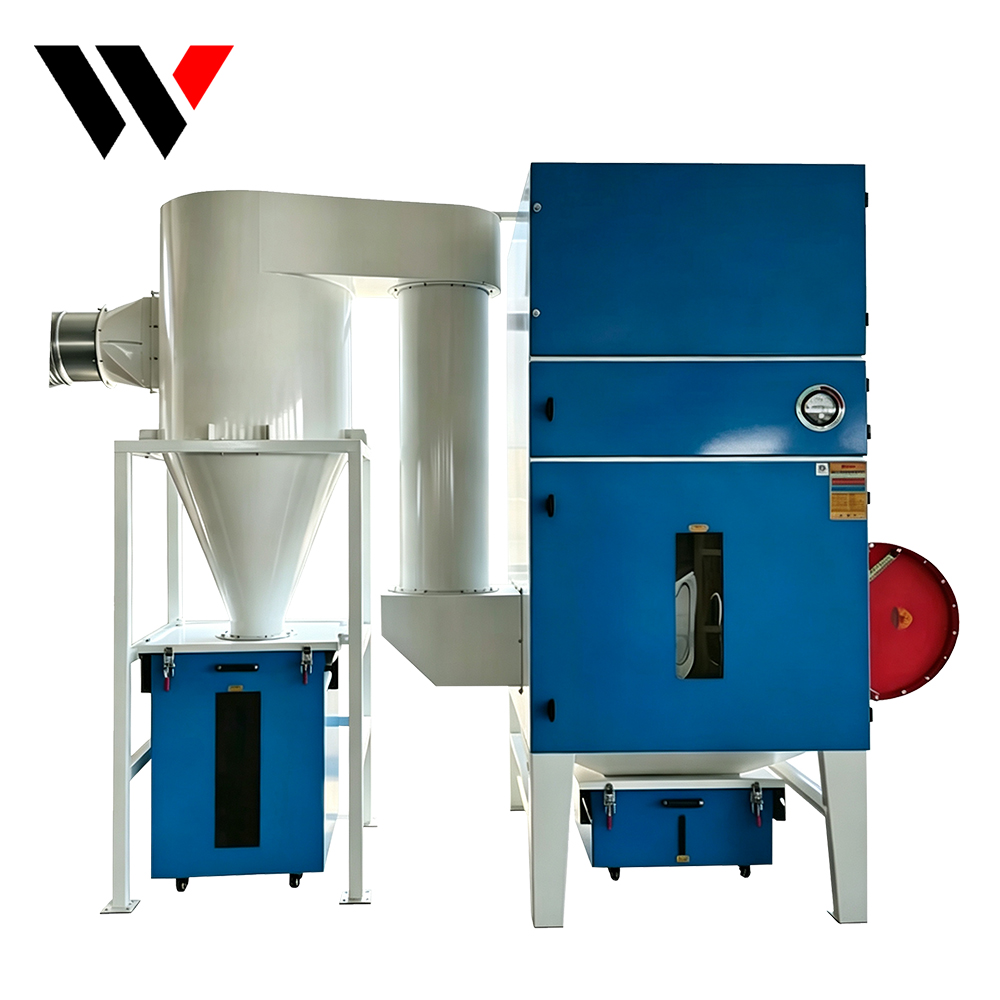
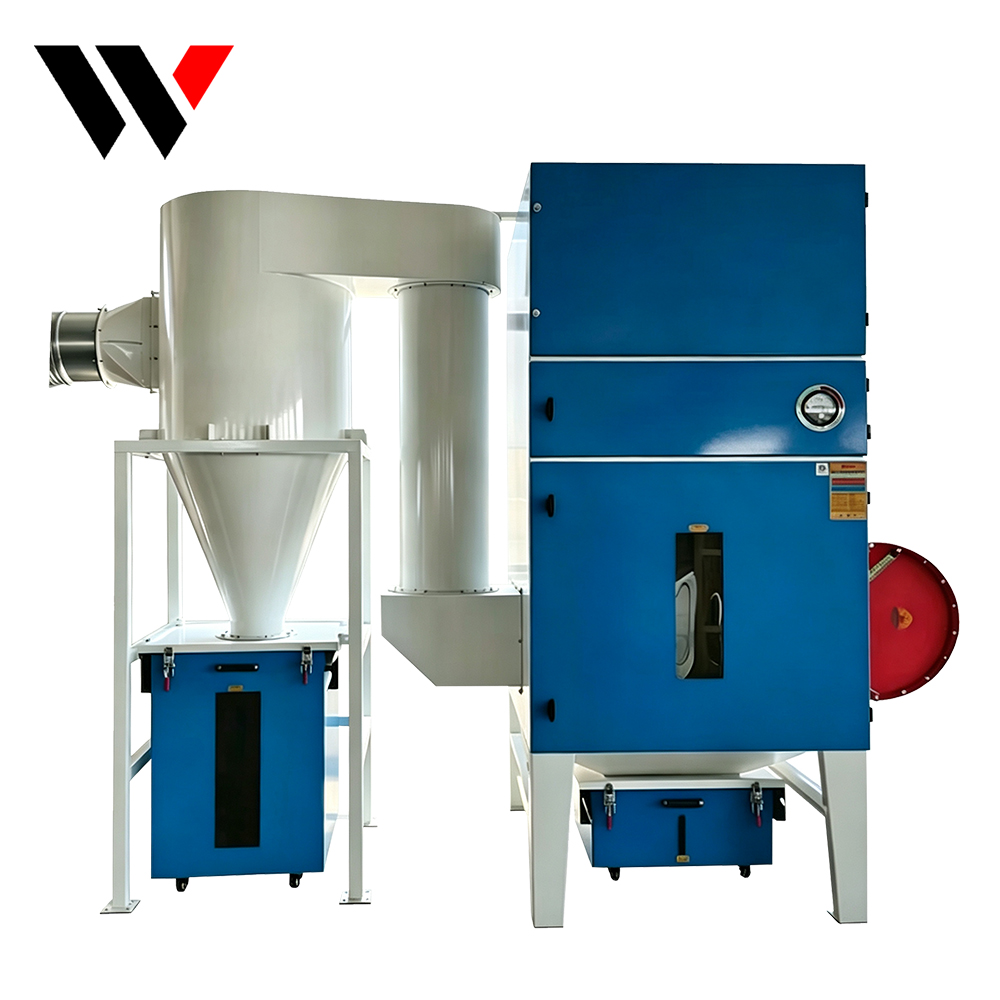
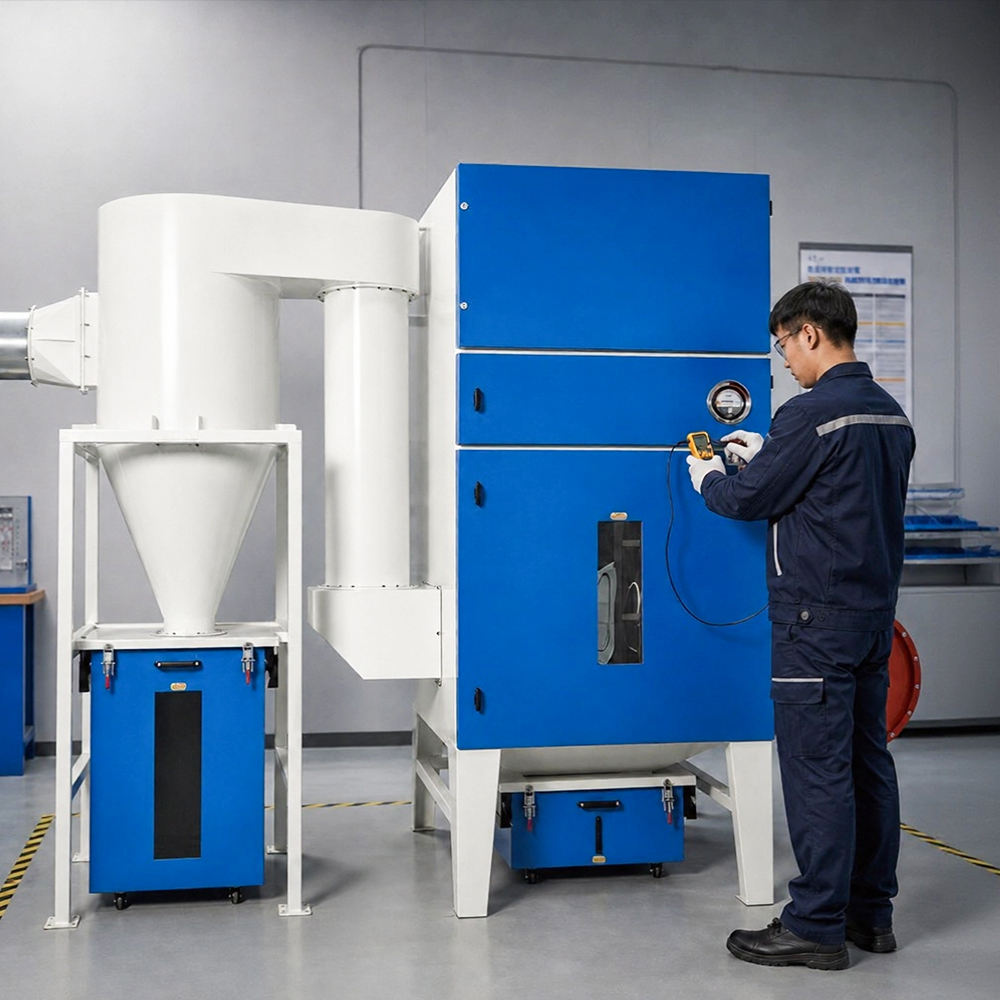
A cartridge collector passes air through pleated media rather than a flat bag. Pleating puts a large surface into a small housing, which is why 32 cartridges of 150 by 1000 mm come to 96 m² of filter area in a unit that measures 2630 by 2460 by 3600 mm.
Cleaning is by compressed air. A solenoid valve fires a short pulse down the inside of each cartridge on a timer, the pleats flex, and the dust cake falls into the bin below. The bin on this unit is 735 by 570 by 1140 mm.
Pulse cleaning is the reason a cartridge unit holds airflow through a shift instead of decaying. The filter is being cleaned while the machine runs, so the resistance stays close to the design figure rather than climbing until somebody notices the extraction has gone soft.
The published fan airflow is 14,000 m³/h and the fan motor is listed at 7.5 kW. One note on the naming: the model is sold as a 15 kW pulse dust collector, while the parameter table lists the fan motor at 7.5 kW. We quote the table. If the motor rating is critical to your electrical plan, confirm it against the quotation rather than the page heading.
The number that decides how a collector behaves is the ratio of airflow to filter area, usually expressed as the air-to-cloth ratio.
14,000 m³/h through 96 m² is about 146 m³ per hour per square metre of media. That is a gentle figure, and gentle is what keeps a cartridge from blinding. Run the same airflow through a much smaller filter area and the dust is driven into the pleats instead of settling on them, the pulse cannot dislodge it, and the filter is finished long before its time.
This is why comparing collectors on motor power alone is misleading. A 7.5 kW fan on 96 m² and a 7.5 kW fan on half that area are different machines with the same badge.
| Specification | Pulse cartridge unit | MF bag series |
|---|---|---|
| Filter area | 96 m² | not published |
| Airflow | 14,000 m³/h | 2,350 / 3,150 / 8,500 m³/h |
| Filter elements | 32 cartridges, 150 x 1000 mm | cloth bags 480 mm dia., 1 / 2 / 4 |
| Motor power | 7.5 kW fan motor | 2.2 / 3 / 4 / 5.5 / 7.5 kW |
| Cleaning | automatic impulse control | manual |
| Noise | 70 dB | not published |
| Overall size | 2630 x 2460 x 3600 mm | not published |
| Weight | not published | 50 / 70 / 170 kg |
The bag table collapses five models into three airflow figures and three weights, so pair the model you want with the figure rather than assuming the top of each list goes together.
Dust is not one material. A planer produces chip, a saw produces sawdust, and a sander produces fines that behave like a different substance altogether.
Chip and sawdust are heavy and settle. A bag collector handles them well because the load is high and the particle is large, and a large particle is easy to intercept. This is why a bag unit on a planer or a table saw is a reasonable engineering choice rather than a compromise.
Fines are light and stay airborne. They are also the fraction that matters for air quality and for fire risk. A cartridge with 96 m² of pleated media intercepts them; a loaded bag passes them. If the machine upstream is a wide belt sander, a stroke sander or a polishing head, the filter medium is the specification that decides whether the workshop air is acceptable.
A mixed shop often needs both, and not because one is better. A bag unit at the planer handles the volume cheaply, and a cartridge unit at the sander handles the fines. Trying to do both jobs with one collector usually means the fines win. The sanding machine range note sets out which heads produce which fraction of dust.
Impulse control on the cartridge unit is listed as automatic. That means the cleaning cycle runs on a timer while the machine works, without an operator deciding when.
The alternative is a schedule: somebody shakes the bags on Friday. In a two-person shop that schedule survives. In a shop where the person who knows about the bags is on holiday, it does not, and the symptom is not a dramatic failure. It is a slow loss of suction that gets blamed on the ducting.
A cartridge that is pulsed regularly also lasts longer, because the dust cake stays thin and the pressure drop stays low. The saving is in cartridges not bought, not in electricity.
The pulse needs clean, dry compressed air at a stable pressure. If the shop compressor is a piston unit running at 0.8 MPa and cycling hard, check that the pulse valve has its own regulated supply. A pulse that fires weakly is worse than no pulse, because it disturbs the cake without removing it. Our piston air compressor note covers the receiver and duty cycle side of that pairing, and the screw compressor guide covers the continuous-demand case.
The cartridge unit is 3600 mm tall. That is a height decision before it is anything else: it will not go under a mezzanine, and it needs access above for cartridge replacement.
The 2630 by 2460 mm footprint is larger than most buyers expect from a collector, because a cyclone pre-separator is part of the assembly. The pre-separator takes the heavy load before the cartridges see it, which is what keeps the pleats from filling with chip.
The dust bin at 735 by 570 by 1140 mm is the other number to plan around. It has to be pulled out, emptied and pushed back, so it needs clear floor in front of it. A collector installed with the bin facing a wall is a collector that will be emptied by removing the ducting.
On the bag side, weights of 50 to 170 kg mean the smaller units can be moved by two people and the larger one cannot. Plan the position before delivery, not after.
Seventy decibels is published for the cartridge unit. That is roughly the level of a busy office or a vacuum cleaner at a metre, and it is low enough to stand next to without hearing protection for a short period.
Noise matters because a collector that is unpleasant to run is a collector that gets switched off between jobs. Switching it off between jobs is what allows fine dust to settle on surfaces and then be disturbed later. A quiet unit gets left running, and a unit left running is the one that actually controls the air.
The bag series does not publish a noise figure. Ask for it if the collector will sit beside a workstation rather than in a plant room.
The cartridge unit lists an explosion-proof distribution box, and that is not a marketing line. Wood dust in the right concentration is an explosion hazard, and the electrical enclosure on a collector sits in the middle of the hazard zone.
Two related details are not on the sheet and should be asked about: whether the unit has an explosion vent, and whether the inlet has a spark trap if the ducting serves a sander or a machine that can produce a hot particle. Neither is a substitute for a proper assessment, and neither is expensive compared with the alternative.
Grounding is the third. A collector and its ducting need to be bonded, because a static discharge in a duct carrying fines is a credible ignition source.
Sizing starts at the hood, not at the collector. Each machine has a connection diameter and a required air volume, and the duct run adds resistance between the hood and the fan.
Add the requirements of every machine that will run at the same time, not every machine in the shop. A shop with a planer, a saw and a sander rarely runs all three at once, and sizing for the sum produces a collector that is oversized for most of the day and noisy for all of it.
Our cyclone dust collector sizing guide works through the airflow calculation and the duct layout in detail, and it is the right starting point before choosing between the two filter types described here.
Choose the bag series when the machines produce chip and sawdust, when the collector sits beside one or two machines, when the budget is tight, and when somebody in the shop will genuinely service it. The 2,350 and 3,150 m³/h units at 50 and 70 kg suit a small workshop; the 8,500 m³/h unit at 170 kg is a different installation and deserves a duct layout.
Choose the pulse cartridge unit when a sander or a polishing head is in the line, when the collector serves several machines through ducting, when the shop cannot guarantee a cleaning routine, and when the installation has 3.6 m of height and a clear face for the bin.
Both are on the site: the pulse dust collector page carries the cartridge figures, and the MF9030 bag collector page covers the five-model range. Both sit in the workshop equipment range.
If you send the machine list with connection diameters and the duct layout, the choice stops being a preference and becomes an arithmetic answer.