The MJA and the MJB carry the same 3928 series number, cut the same kind of work, and are quoted at almost the same price band. Buyers who compare them on a spreadsheet see two rows that look interchangeable. They are not.
The differences are in the wheel, the blade, the feed rate and the frame. Each one decides something different about how the saw behaves after two years of daily use, which is the only horizon that matters when a machine is expected to run for a decade.
This is a specification comparison, not a recommendation. Where a number is published on one page and not the other, it is marked as such rather than filled in.
The MJA runs a 711 mm saw wheel. The MJB runs a 650 mm wheel with a 65 mm rim. That 61 mm difference is the single most consequential number in the comparison, because the wheel sets how much the blade bends per revolution.
A blade on a larger wheel wraps a gentler arc. Every time the band passes around the wheel it is flexed and straightened, and that cycle is what eventually cracks a blade at the weld or at a hard spot. A bigger wheel means fewer and shallower flex cycles for the same metres of cut. It also means more blade in contact with the wheel, which spreads the drive load and reduces slip on heavy cuts.
The MJB answers the same problem from a different direction. Its wheel is smaller but the rim is 65 mm wide, which is a heavy-duty rim dimension: more bearing surface, more resistance to the blade wandering sideways under load. On a 650 mm wheel with a narrow rim, a deep cut in dense hardwood will make the band track toward the low side. The wider rim is how that is held.
So the two designs are not one better and one worse. One buys blade life through geometry; the other buys tracking stability through contact area.
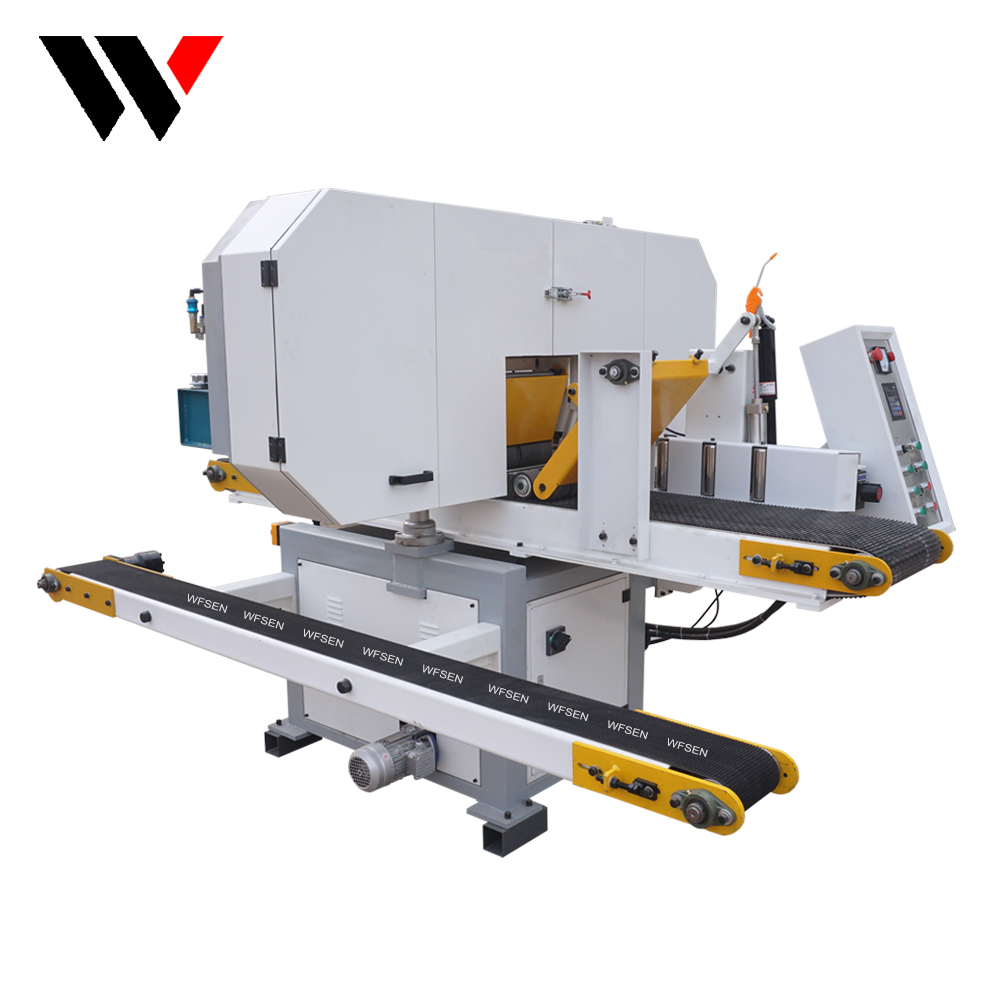
The MJA takes a 4572 mm blade on the 300 and 400 models and a 5172 mm blade on the 650. The MJB takes 4330, 4885 and 5435 mm across its three widths, published as saw length rather than blade size.
Read those numbers as a stock list. If your shop already keeps a welded blade length in the rack, a machine that cannot take it means a new SKU, a new minimum order and a second set of spares. That is a real annual cost and it is easy to miss at quotation stage.
Note also that the largest MJB uses a longer blade than the largest MJA, 5435 against 5172, even though its wheel is smaller. That follows from the wider rim and the frame geometry: more blade is outside the cut. When you price blades per metre, the heavy machine costs slightly more to run on consumables, and that is the trade for the rim.
The MJA page publishes the full blade section as 4572/4572/5172 by 27 by 0.9 mm, which is a 27 mm width on a 0.9 mm body. Order that specification, not a generic band, and check the tooth pitch against the material before the first cut.
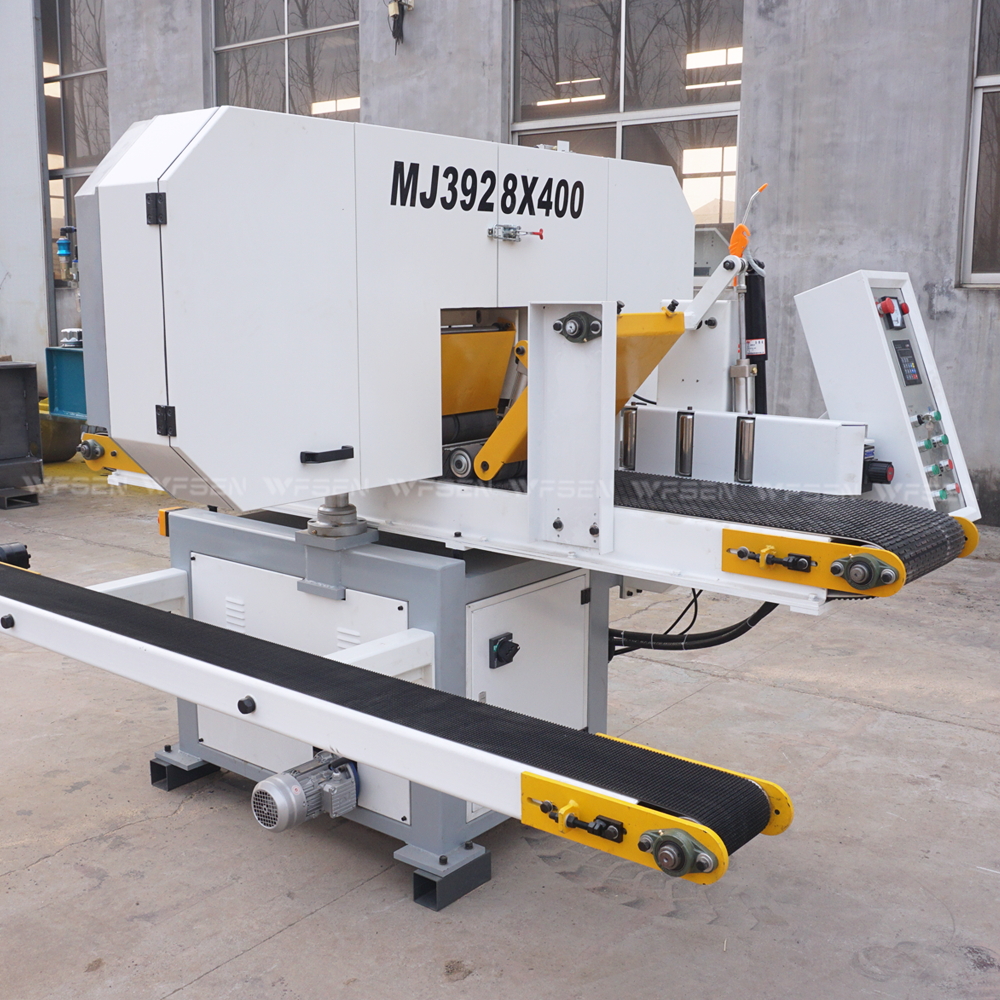
The MJA feeds at 0 to 20 m/min. The MJB feeds at 0 to 14 m/min. Both figures are the top of a variable range, so the practical difference is not the maximum but what happens near it.
A 20 m/min band saw is a production machine for softwood, panel stacks and repeat ripping where the finish is not the constraint. Run it flat out on dense oak and the blade will deflect, the cut will drift and the operator will back the dial off anyway. The extra range is useful when the material allows it, and neutral when it does not.
A 14 m/min ceiling tells you what the designers expected. The MJB is aimed at the cut that is deep, dense and slow: heavy sections, European hardwood, resaw work where the surface has to come off the saw close to finished size. Slower feed on a rigid frame produces a straighter cut with less blade load, and the 65 mm rim is there to keep that cut straight.
If a shop's work is 80 percent softwood and panel, the MJA's range is the better match. If it is 80 percent dense hardwood above 100 mm, the MJA will spend its life at half speed and the MJB will be running where it was designed to run.
The MJA page publishes cutting thickness 3 to 200 mm and, separately, maximum working thickness 300 mm. Those are two different figures on the same page, and they are not interchangeable: one describes the range of cut the machine is set up for, the other the largest workpiece the frame will accept.
The MJB publishes working thickness 2 to 200 mm and a cutting length of at least 300 mm. Its lower bound is 2 mm rather than 3 mm, which matters for veneer and thin stock, and its 300 mm figure refers to length rather than thickness.
This is exactly the kind of place where a buyer gets caught. Two pages, similar-looking tables, and the labels do not line up one to one. Before ordering, ask for the figure in writing with its unit and its meaning, and match it against the tallest and thinnest piece you actually cut. A machine that is 1 mm short on the upper bound is a machine that cannot do the job, however good the rest of the specification looks.
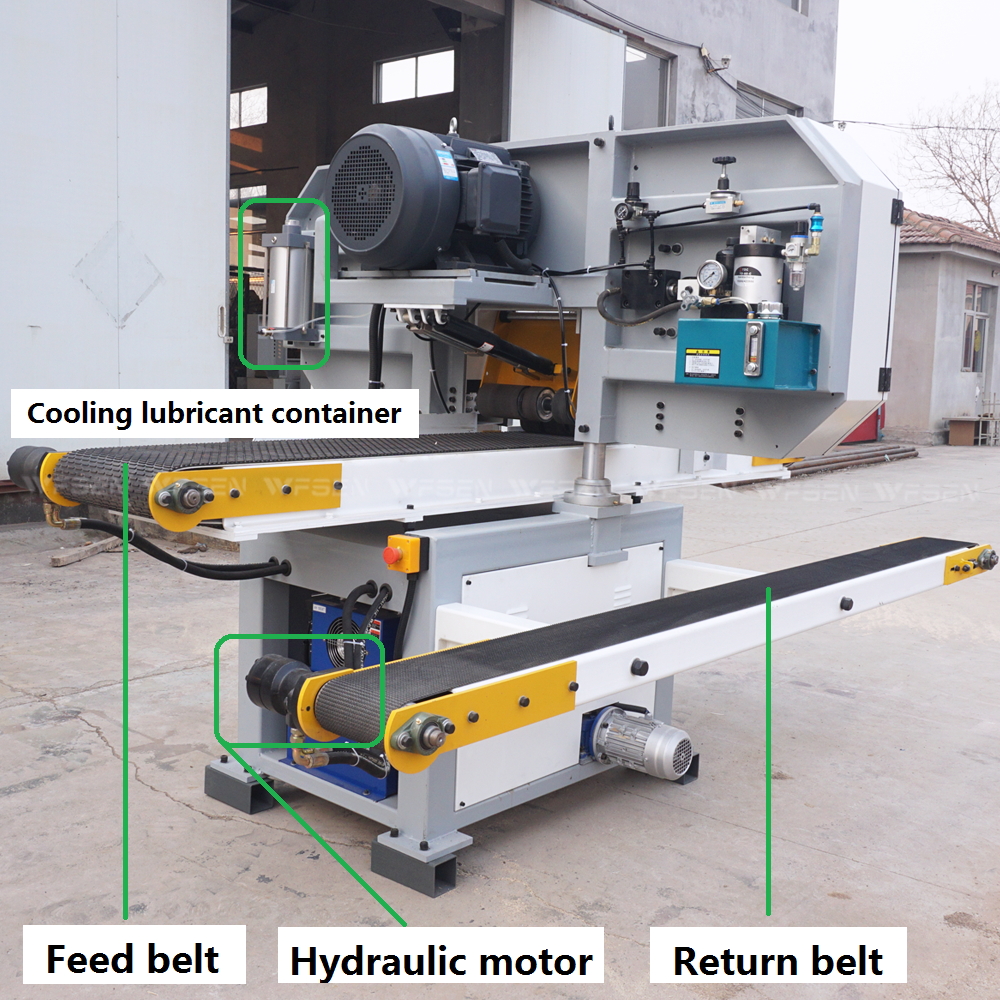
The MJA covers 300, 400 and 650 mm maximum working width. The MJB covers 400, 500 and 650 mm. The smallest MJA is the only one that goes below 400 mm, and the only width class the two ranges do not share is that 300 mm entry model.
A narrow machine is not a compromise for a shop that cuts narrow work, because the frame is smaller, the blade is shorter and the whole installation takes less floor. The MJA 300 is the machine for a shop that resaws 250 mm stock all day and never sees a wide slab.
At the other end the two 650 models compete directly, and the footprint numbers decide it. The MJA 650 is published at 2700 by 2400 by 2000 mm. The MJB 650 is published at 2600 by 2550 by 1950 mm. One is longer and narrower, the other shorter and deeper, and the height difference of 50 mm is the least interesting of the three.
Measure the aisle, not the machine. A saw 2550 mm deep needs clearance behind it for unloading and for blade changes, and a 2700 mm length needs room at both ends for long stock. Most installations that fail do so at the infeed, not at the machine.
Total power across the ranges sits in the same band: 16.68, 20.18 and 23.68 kW for the MJA; 16.47, 20.37 and 20.37 kW for the MJB. Anyone comparing only this row will conclude the machines are equivalent, and on the electrical supply they nearly are.
These totals aggregate the saw motor, the feed motor, the hydraulic pump and the conveyor. A machine that puts more of its budget into feed and hydraulics will clamp harder and feed more consistently; one that puts it into the saw motor will hold speed in a deep cut. The published tables give the total, not the split, so ask for the breakdown if the cut is near the machine's limit.
What the totals do tell you is the supply requirement. A 23.68 kW machine is not a 16 A single-phase installation, and the difference between the smallest and largest model in either range is roughly 7 kW, which is often the difference between an existing supply and a new one.
The MJA weighs 1800, 1900 and 2000 kg across its three widths. The MJB weighs 1700, 1900 and 2050 kg. At the middle width they are identical, which is a useful reminder that weight alone is not the discriminator here.
What matters is where the mass sits. A band saw that vibrates will produce a cut that wanders, and vibration shows up in the second year, after the machine has settled, not on the day of commissioning. A heavier base and a wider rim both fight that, which is why a 1700 kg machine with a 65 mm rim can out-cut a 1800 kg machine with a narrower one on dense stock.
Practically: pour a level slab, bolt the frame down, and check the wheel balance at installation. Those three steps do more for cut quality than the choice between these two models will.
The MJA page publishes an air pressure range of 0.5 to 0.8 MPa. That is the clamping circuit, and it is the part of a band saw that fails quietly. A clamp that holds at 0.8 MPa and slips at 0.55 will produce a cut that is straight in the morning and tapered after lunch, and the operator will blame the blade.
If your shop air runs a piston compressor cycling between wide limits, put a regulator and a gauge at the machine rather than trusting the line. The piston compressor note covers how much the delivery pressure moves under load, which is the number that decides whether the clamp holds.
The MJB page does not publish an air pressure figure. That is a gap to close at quotation, not a detail to assume.
Take the MJA when the work is mixed and the material is forgiving: softwood, panel stacks, general ripping, a shop that wants one saw to cover 300 to 650 mm and values the faster feed. The 711 mm wheel is the reason to pick it, and the 300 mm entry model is the reason a narrow-work shop should not pay for width it will never use.
Take the MJB when the work is dense, deep and repetitive, and the cut has to come off the saw close to size: European hardwood, heavy sections, resaw lines where a drifting blade costs a whole board. The 65 mm rim and the 14 m/min ceiling are the reasons, and the 2 mm lower thickness bound helps if thin stock is in the mix.
Neither machine replaces a vertical panel saw for sheet goods or a reciprocating saw for honeycomb and composite. If the shop cuts all three, the band saw is the solid-timber machine and the other two cover sheet and sandwich panel.
Five questions, in this order. What is the maximum working thickness in millimetres, and is that the same figure as the cutting thickness range? Which blade length and section does the model take, and is it in stock locally? What is the split between saw motor, feed motor and hydraulics? What clamping pressure does the machine need, and what tolerance does the clamp hold at the low end of that range? And what is the footprint including the infeed and outfeed clearance the maker recommends?
Answers to those five settle the choice between an MJA and an MJB faster than any brochure. The full range, including the smaller vertical band saw and the table saws, is listed under saw machines.
If you are sizing a resaw line rather than a single saw, send the section sizes and the daily metres. The choice between 650 mm and 500 mm is usually decided by the tallest piece in the order book, not by the average.