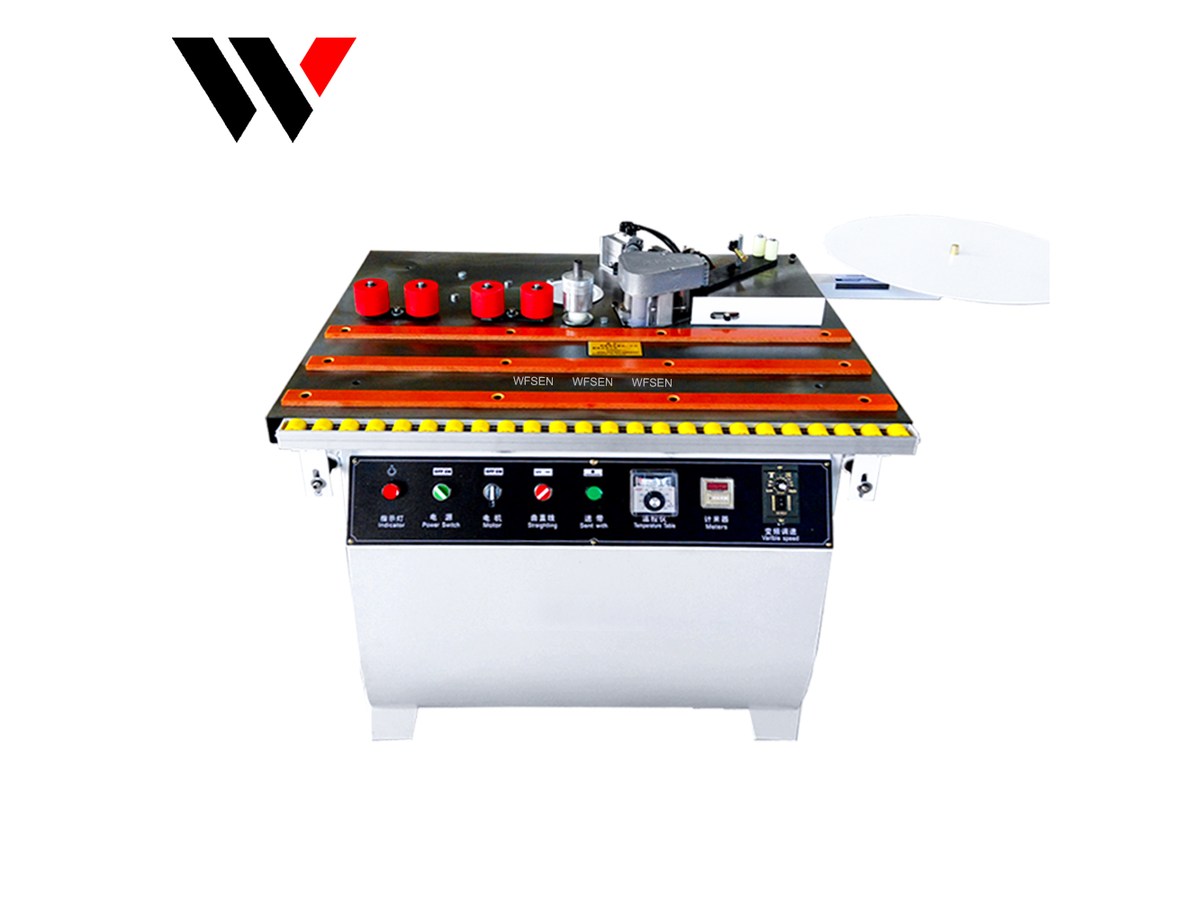
Short answer: a manual edge banding machine is the right machine when the edge is not a straight line, when the tape is thick, or when the batch is one panel rather than one hundred. The manual and curve models in our range publish an edge tape band of 0.15–5 mm — wider than any automatic machine we build — a minimum working radius of 20 mm, a feed speed of 0–14 m/min, and a weight of 180 kg. What you give up is labour: the operator presents each panel and finishes the edge.
This page is about the manual band specifically. If you are still deciding between classes, start with portable, manual, automatic and curve edge banding machines.
A straight-line automatic machine feeds a rectangular panel past fixed stations and expects that panel to stay square and straight. A manual machine does not have that expectation. The operator moves the work past the glue and pressure rollers, so the machine can band a curve, a shaped door panel, a radius shelf, a tapered part, or a single panel that is not worth setting up a line for.
That is the whole design argument. Everything else about a manual machine — the lighter frame, the lower installed power, the hand-held finishing — follows from the fact that the work is guided rather than transported.
| Model | Work | Weight | Outline size | Edge tape | Min. radius |
|---|---|---|---|---|---|
| MF260B | Manual, straight line | 180 kg | 1,100 × 900 × 1,000 mm | 0.15–5 mm | 20 mm |
| MF260T | Manual, straight line | 180 kg | 1,100 × 900 × 1,000 mm | 0.15–5 mm | 20 mm |
| MF260D | Curve | 180 kg | 1,100 × 900 × 1,000 mm | 0.15–5 mm | 20 mm |
| MF260M | Folding-arm curve | 180 kg | 1,200 × 900 × 1,000 mm | 0.5–2 mm | not published |
| MF60S | Semi-automatic | 200 kg | 1,600 × 800 × 1,100 (unit not published) | 0.3–3 mm | not published |
Four of the five sit at 180 kg and the semi-automatic at 200 kg. The MF60S is listed alongside the manual band because it is the half-step between hand-fed and automatic work: it carries a powered trimming motor of 1.6 kW and a polishing motor of 0.44 kW, where the manual models publish a single 0.25 kW motor and leave the trimming and polishing to the operator.
The 180 kg manual models publish an edge tape band of 0.15–5 mm. The full automatic machines publish 0.4–3 mm. The difference is mechanical rather than commercial: a hand-guided feed can present thick solid edging to the glue and rollers at whatever angle and pressure the operator chooses, while an automatic feeder has to grip the tape and carry it at a fixed speed and depth.
So if your edge is 2 mm or 3 mm solid wood — where the edge is part of the design rather than a cover strip — the cheaper, lighter manual machine covers a band the heavy automatic cannot. Weight and price buy throughput, not edge range.
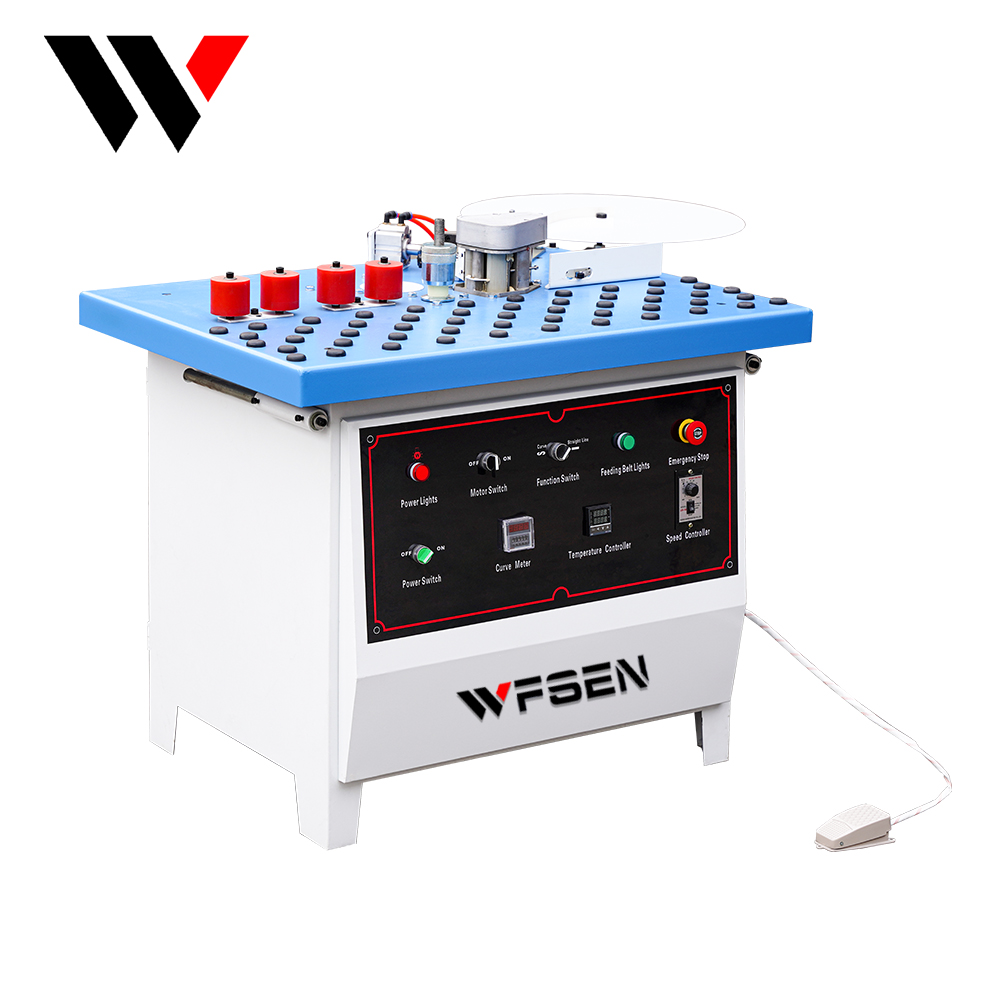
The control panel of a manual or semi-automatic bander is small, and every switch on it maps to one physical thing on the bed. Reading the panel from left to right, the controls are a power indicator, the motor switch, the trimming switch and the polishing switch, a temperature table, an edge speed regulator and a conveyor belt speed regulator.
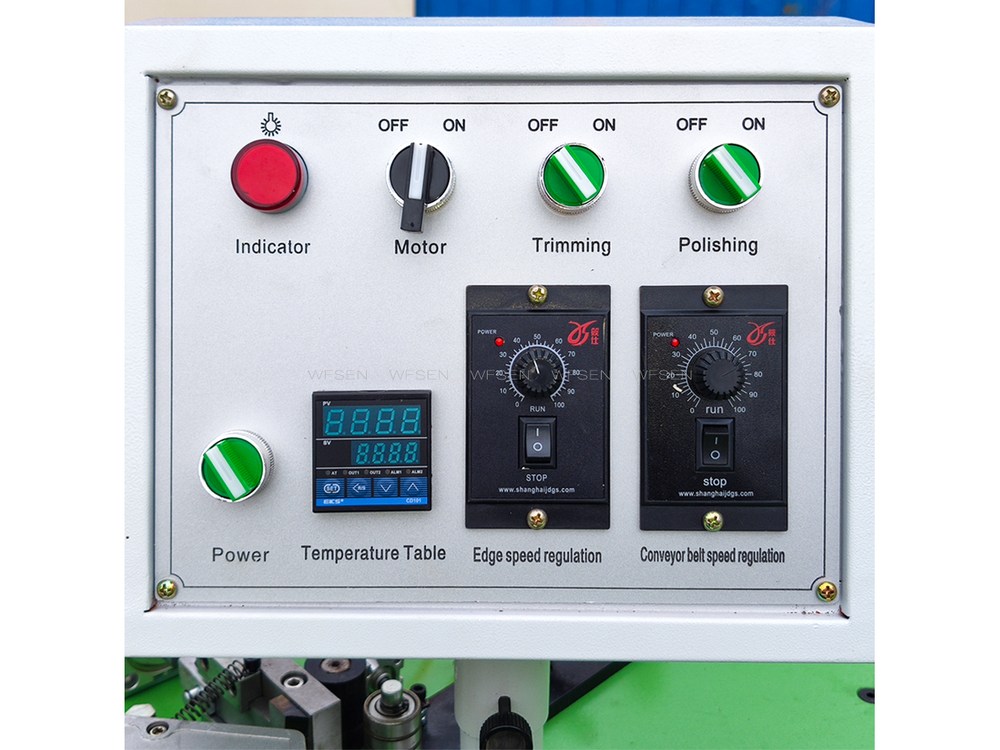
Two of those controls are temperature and two are speed, and that is the whole setup:
The habit worth building is to set temperature and conveyor speed together rather than one at a time. Run the work faster and each point on the edge spends less time in contact with the glue, so the machine has to be hotter. Set one without the other and the first panels of a batch are the ones that fail.
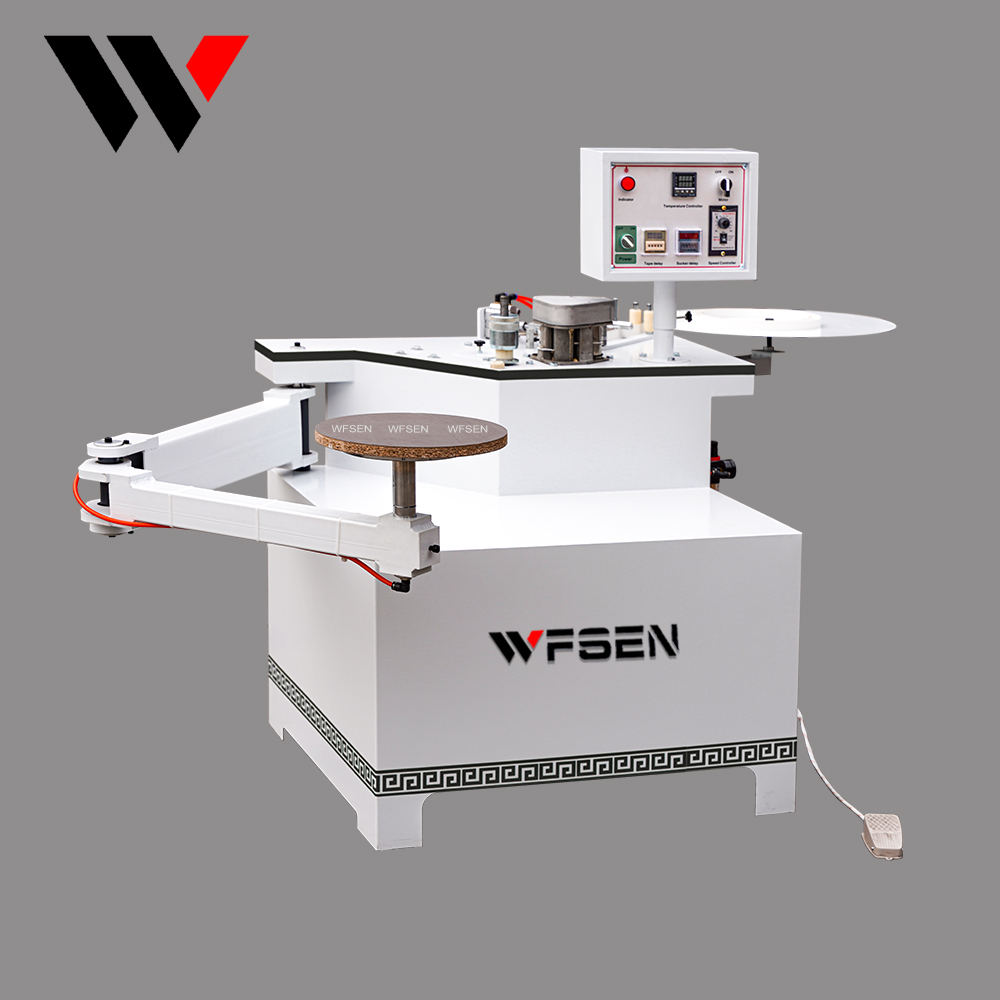
The manual band splits in two, and the split matters more than any other choice in this class. The MF260B and MF260T are manual straight-line machines: the work runs against a fence and the edge has to be straight. The MF260D and MF260M are curve machines, built to follow a radius — the folding-arm model MF260M carries a 1.2 kW heater and a 0.2 kW motor and is listed at 1,200 × 900 × 1,000 mm.
The published minimum working radius is 20 mm. Below that the tape creases on the inside of the curve whatever the machine, because the tape itself has to turn through a tighter arc than its thickness allows. If your design has small radius corners, band the straight runs and finish the corner by hand rather than hunting for a machine with a smaller figure.
Compare the published feed speeds and the gap between classes is the labour cost:
| Class | Published feed speed | Who moves the panel |
|---|---|---|
| Bench mini (MF160B) | 2–6 m/min | Operator |
| Portable (MF170B) | 0–6 m/min | Operator |
| Manual and curve (MF260B/T/D) | 0–14 m/min | Operator |
| Full automatic (MF360B, MF630A) | 13–23 m/min | Machine feed |
On a manual machine the operator is the feed system. That is what makes the curve work possible, and it is also what caps output: a straight-line automatic at 13–23 m/min runs panels through at a rate no hand-fed machine will match. The manual machines publish a single 0.25 kW motor because there is no feed motor, no trimming motor and no polishing motor to publish — the trimming is done with a hand edge trimmer after the panel comes off the bed.
A manual machine wins on three jobs: shaped and curved edges that a straight-line feed cannot follow, thick solid edging outside an automatic feeder's tape range, and one-off panels where setting up a line costs more than banding the part by hand. It also wins on floor space and on the power supply — you are installing a 0.25 kW motor, not a 13.5 kW machine with extraction.
It loses on volume, and it loses on consistency, because two operators will not trim an edge identically. If your work is rectangular panels in batches, the machine you want is a compact straight-line unit — see small edge banding machines — or, above that, a full automatic machine. The cost of the class step up is set out in what drives the price of an edge banding machine.
What is a manual edge banding machine used for?
Banding edges that a straight-line machine cannot reach: curved and shaped panels, thick solid edging, and single parts. The operator guides the work, so the machine follows the edge rather than requiring the edge to be straight.
Can a manual machine band curved edges?
Yes — with a curve or folding-arm model. The MF260D and MF260M are curve machines and publish a minimum working radius of 20 mm. The MF260B and MF260T are straight-line machines and are not rated for radius work.
How thick an edge tape can a manual machine take?
0.15–5 mm on the MF260B, MF260T and MF260D — the widest band published anywhere in our range. The full automatic machines publish 0.4–3 mm. The folding-arm MF260M is listed at 0.5–2 mm.
Does a manual machine trim the edge for me?
No. The manual models publish a single 0.25 kW motor with no trimming or polishing station, so the overhang is finished with a hand edge trimmer. If you want the trimming powered, the semi-automatic MF60S carries a 1.6 kW trimming motor and 0.44 kW polishing motor.
What feed speed does a manual machine run at?
0–14 m/min on the MF260B, MF260T and MF260D, and 0–20 cm/s on the folding-arm MF260M as published. In practice the operator sets the pace, which is why these machines have a speed regulator rather than a fixed transport rate.
What power and air does it need?
A 0.25 kW motor on the manual straight-line and curve models, and 0.5 MPa of compressed air. No extraction is needed for the manual models because they have no powered trimming station; add it if you move up to a machine with a trimming motor.
Three facts decide this one: whether any of your edges are curved and what the smallest radius is, the thickness of the edging you buy, and how many parts you band in a shift. Send us those and we will tell you whether a manual machine covers the work, or whether the volume has reached the point where a straight-line machine is the cheaper answer.
The manual and curve models are on our edge banding machine page, and you can send your edge specification directly to us here.