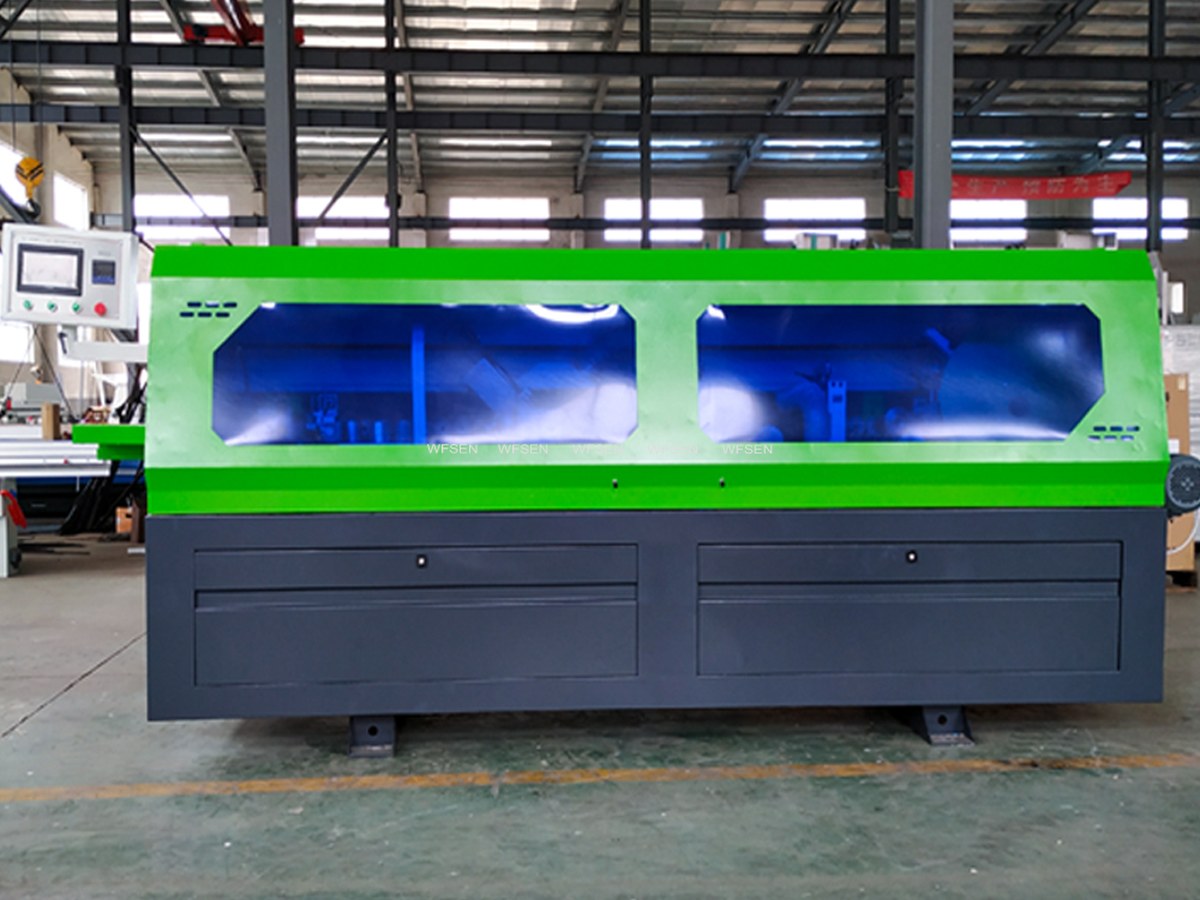
"Full automatic" is the most over-used phrase in edge banding machine listings. On a real production machine it means one specific thing: the panel goes in at one end and comes out finished at the other, without an operator touching a single station. Everything between those two points — gluing, end trimming, rough trimming, fine trimming, scraping, buffing — happens in sequence, at feed speed, automatically.
What separates one full automatic edge banding machine from another is how many stations sit along that line, and therefore what the machine can do to the edge. This guide covers the two automatic models we build, the six-station MF360B and the eight-station MF630A, and what the extra stations actually change.
An automatic edge bander is a line of independent units mounted along one bed, with a chain or belt feed running the panel past each of them in turn. The panel enters with a raw, exposed core edge. By the time it leaves, that edge carries a strip of tape or solid edging, the overhang has been cut back at both ends, the tape has been trimmed flush to the top and bottom faces, the corner line has been scraped smooth, and the edge has been polished.
The end trimming and the fine trimming are what make it automatic rather than semi-automatic: they are driven units that follow the panel automatically, not hand-held tools the operator applies afterwards. That is the practical dividing line. A semi-automatic machine glues and feeds; the operator still touches up the ends and the edges by hand.
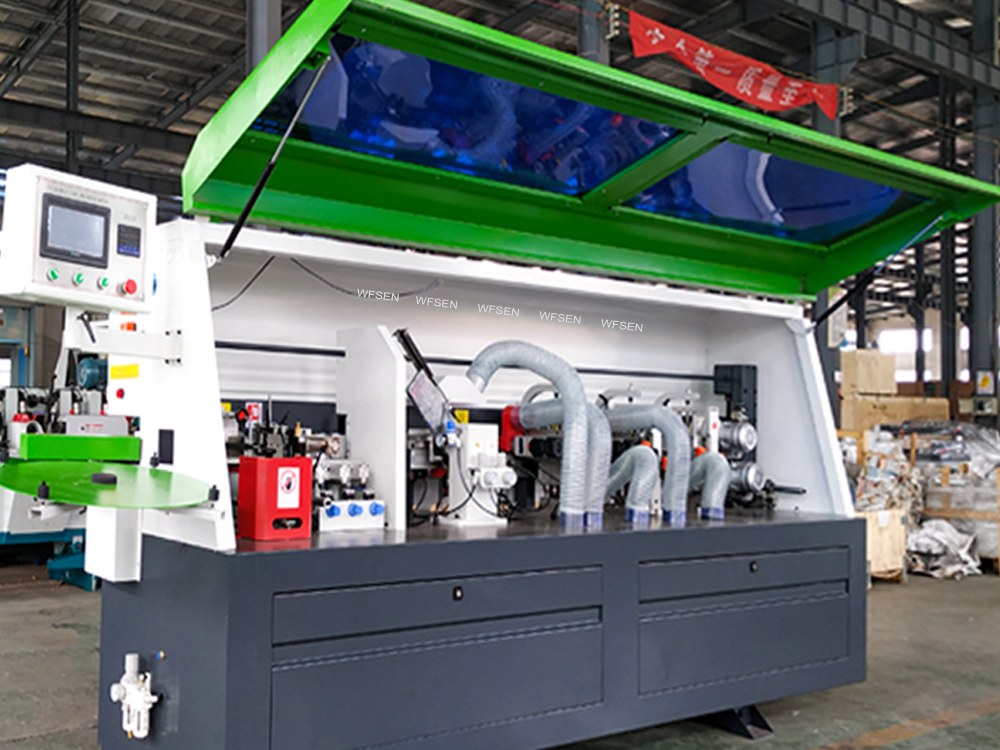
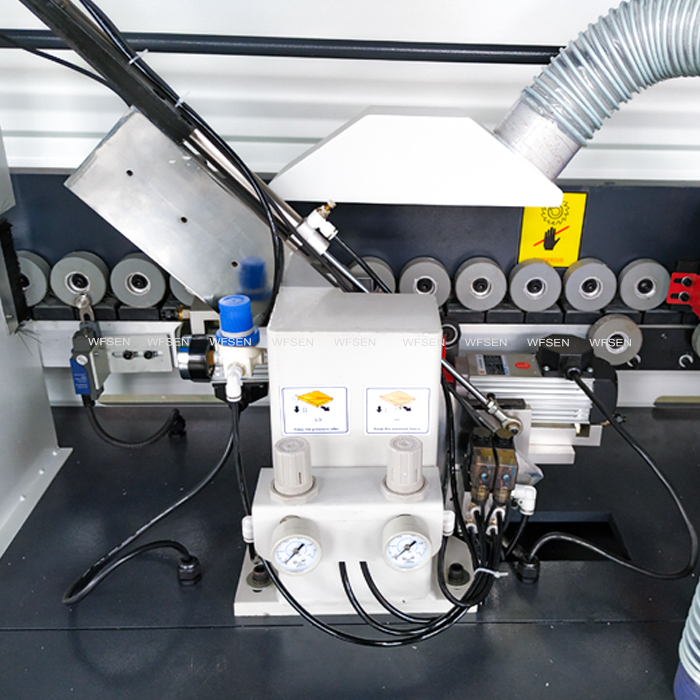
The photograph above is the MF360B with its hood open. Reading left to right along the bed is the whole machine: the control pendant, then the gluing station, then the trimming and scraping group, all driven from a common feed.
Both models are full automatic, both are straight-line machines, and both run at the same feed speed. The difference is the station count:
The MF630A adds pre-milling at the front and corner rounding near the end. Those two additions are the entire reason the machine is longer, heavier and more powerful — and they are also the two questions worth asking yourself before you choose between them.
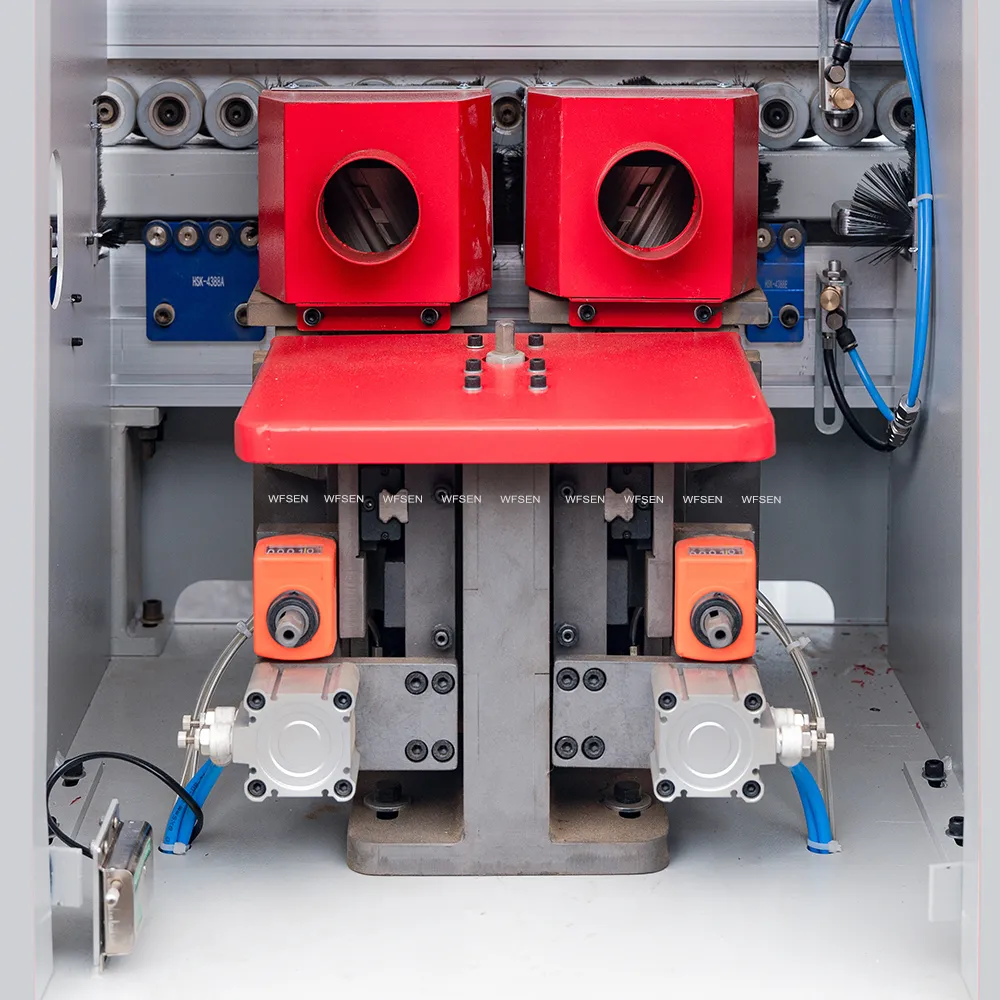
Pre-milling is not a trimming operation — it is a preparation operation. The unit mills a thin shaving off the raw panel edge before the glue is applied, so the surface the tape bonds to is fresh, square and free of the chipping that saw blades and scoring units leave behind. It matters most in three situations:
Corner rounding does what the name says: it shapes the two leading corners of the edge band so the tape does not end in a sharp point. On a straight kitchen cabinet door or any panel where people see and touch the corner, a rounded corner is the difference between a finished product and something that reads as unfinished. On plain shelving and carcass work, it is not needed.
This is the part most buyers get wrong, and it is worth stating plainly: the two machines have exactly the same workpiece range.
So you do not move up to the MF630A to handle thicker panels or to run the line faster. The workpiece envelope and the cycle time are the same. You move up for the finish the extra stations produce. If your panels are 18 mm and your tape is 1 mm, both machines will take the job — only one of them will deliver a rounded corner, and only one will deliver a pre-milled edge.
When you compare quotations, the station list is the specification. Two machines with the same tonnage-free description can differ by four units and a large amount of money. Work through the list in the order the panel meets it:
If you are still deciding whether an automatic machine is the right class at all, the difference against the smaller classes is set out in our overview of portable, manual, automatic and curve edge banding machines.
The gluing station is the one part of an automatic bander that is genuinely adhesive-specific, and it is worth settling before you order the machine rather than after.
EVA hot melt is the default. It applies from a heated pot and roller, bonds quickly, and is the right choice for interior furniture and panels that will not see moisture or heat. It is also forgiving: the machine can sit idle and restart cleanly.
PUR is a reactive adhesive and behaves differently — it needs a controlled application, it cures rather than simply cooling, and it tolerates moisture and heat far better. If your product goes near a kitchen, a bathroom or an exterior wall, PUR is usually the specification, and it needs the matching glue system on the machine rather than a pot swap.
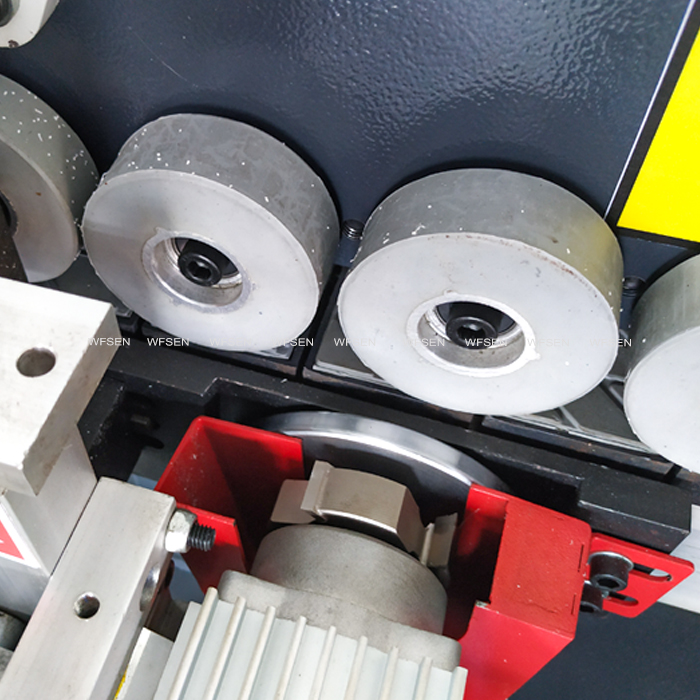
Because the pot, the roller and the heating control are all part of the gluing station, tell the machine supplier which adhesive you run before the order is placed. It is a configuration item, not an accessory.
An automatic bander is not a bench machine, and three site conditions decide whether it works properly on day one.
| Parameter | MF360B full automatic | MF630A full automatic |
|---|---|---|
| Functions | Gluing, end cut, rough trim, fine trim, scrape, buffing | Pre-milling, gluing, end cut, rough trim, fine trim, corner round, scraping, buffing |
| Workpiece thickness | 10–60 mm | 10–60 mm |
| Workpiece width | ≥60 mm | ≥60 mm |
| Workpiece length | ≥100 mm | ≥100 mm |
| Edge height | 15–65 mm | 15–65 mm |
| Edge thickness | 0.4–3 mm | 0.4–3 mm |
| Feed speed | 13–23 m/min | 13–23 m/min |
| Total power | 9 kW | 13.5 kW |
| Air pressure | 0.6 MPa | 0.6 MPa |
| Overall size | 4100 × 1000 × 1600 mm | 6550 × 750 × 1550 mm |
| Weight | 1400 kg | 2200 kg |
Do I need pre-milling if I use standard EVA edge tape?
Not always. Pre-milling is most valuable with pre-glued tape and with laminated or veneered panels, where the decorative face chips at the cut. If you edge plain MDF or particleboard with ordinary EVA tape and your saw leaves a clean edge, the six-station MF360B will do the job.
Can the six-station machine be upgraded to eight later?
No. Pre-milling and corner rounding are separate stations with their own beds, motors and pneumatics. That is why the MF630A is 2450 mm longer and 800 kg heavier — the frame and bed are built for eight stations from the start. Choose the station count when you order.
What is the maximum panel thickness an automatic bander will take?
Both of our automatic models take workpieces from 10 mm to 60 mm thick, with edge tape from 0.4 mm to 3 mm and edge heights from 15 mm to 65 mm. That envelope is the same across the two models; only the finish differs.
How much floor space should I plan for?
The machine itself is 4100 mm or 6550 mm long, but plan for the infeed and outfeed as well. Panels entering at 13–23 m/min need to be supported before and after the bed, and the finished stack has to come off somewhere.
What compressed air supply do these machines need?
0.6 MPa, stable. The trimming units, hold-downs and positioning cylinders are all pneumatic. An unstable supply shows up as inconsistent trimming long before it shows up as a machine fault.
The choice between six stations and eight comes down to four facts about your production: the panel thickness, the tape you buy, whether the customer sees the corner of the finished panel, and how much floor length you actually have. Give us those four and we will tell you which model fits — and if the honest answer is that you do not need pre-milling, we will say so.
Both machines are part of our edge banding machine range. If your work is smaller or shaped rather than straight-line, the manual and curve models and the compact machines for small workshops are covered separately, and the portable class is for site work. Send us your panel and tape specification and we will come back with the station list you need.