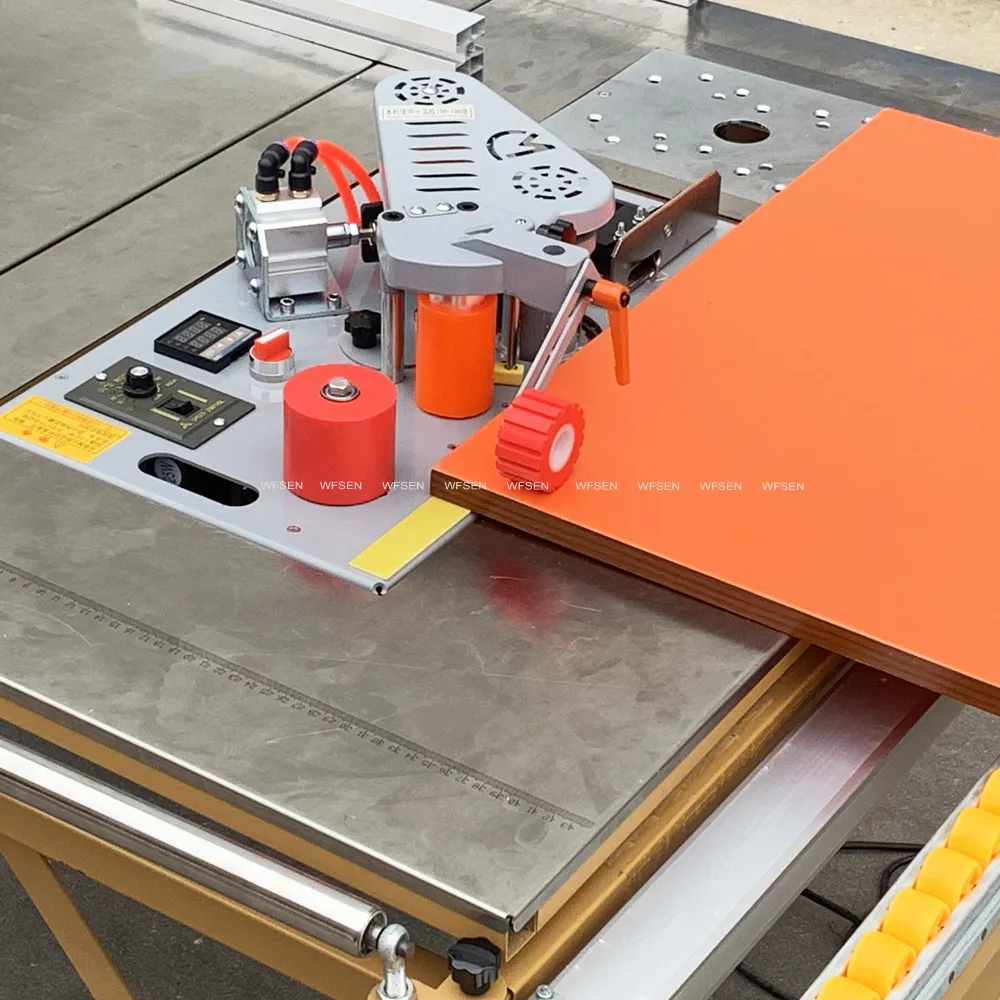
Most edge banding happens in a workshop, on a machine that never moves, next to a panel saw that also never moves. The MJF103 exists for the jobs where that arrangement fails: a fitted wardrobe in a flat on the fourth floor, a shop counter that has to be trimmed to the wall, a run of shelves cut on site because the walls were not square.
It is a table saw, an edge bander and a dust collector that fold into three pieces and travel in a van. Total weight is 85 kg across those pieces, 50 + 20 + 15. Two people carry it. One van holds it with room for panels.
The interesting question is not whether it works. It is whether the work you do is the kind that breaks down when the machine stays in the workshop.
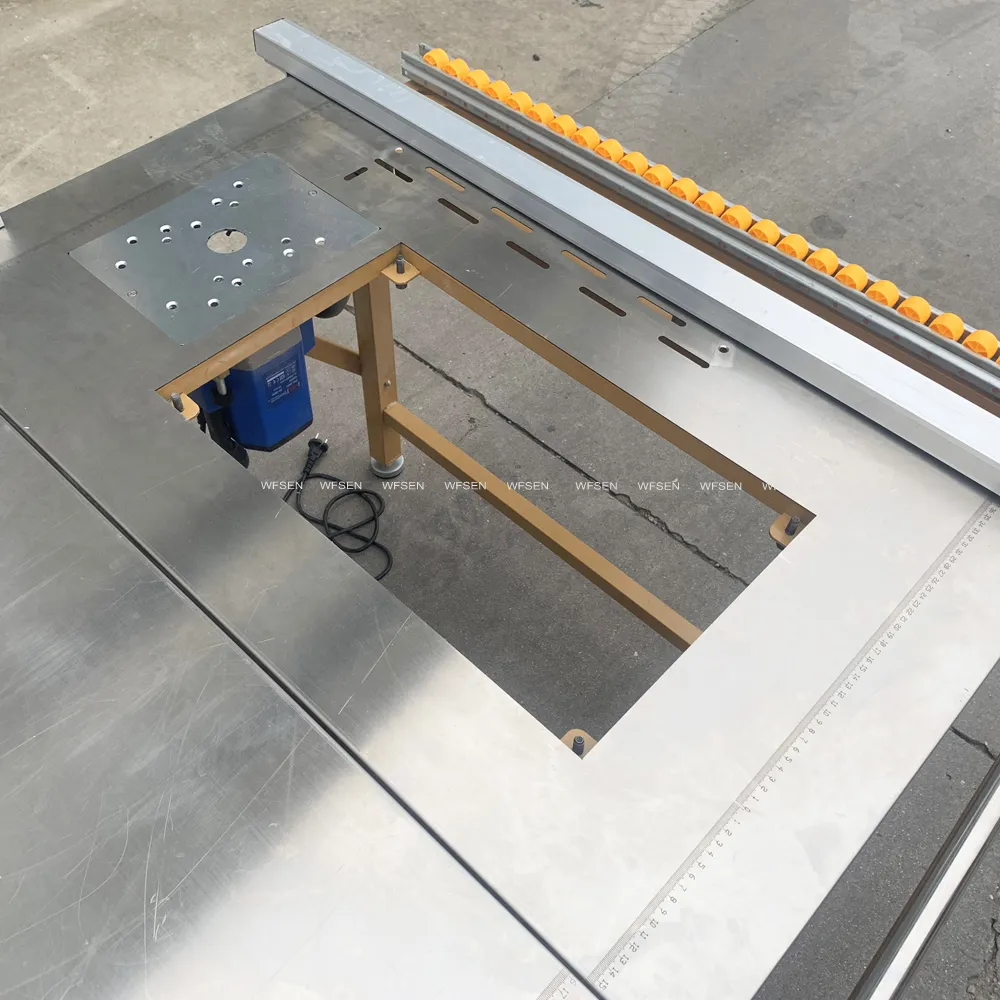
A fixed combination machine of this size would be a workshop tool. The folding frame is what changes the category. It means the saw can be set up where the panel is, rather than the panel being carried to the saw, and for a 2.4 m board in a finished apartment that difference decides the job.
Set-up is the cost. Every fold and unfold is a chance for the fence to lose square, and every site has a different floor. Check it every time. The first job on a new machine is learning how long the set-up really takes, and checking square before the first cut rather than after it.
The main saw blade runs on 3 kW at 3800 r/min. Behind or ahead of it sits a scoring blade on its own 2 kW motor at 1300 r/min. That second blade is the reason this machine can cut melamine-faced board on site without a chipped edge on the underside, which is the failure most portable saws produce and most installers end up hiding with edge tape.
The sliding table measures 1200 x 1000 mm. Read that as the working envelope, not the panel size: it is the carriage your hands and the panel pass over, and it sets how much support you have when a full sheet is being broken down.
For a machine that folds, the scoring blade is the number worth checking first. A saw without one is a site saw. With one, it can finish work. With one, it is a saw that can finish work.
The edge banding unit is rated 1.2 kW and takes tape from 6 to 60 mm wide, with automatic end trimming. Straight edges and curved edges both run on the same station, which is unusual at this size and the main reason installers keep one on the van: a curved counter end or a shaped shelf is exactly the piece that cannot be taken back to the workshop once it is fitted.
Sixty millimetres is the ceiling. Wide, thick or solid-timber lippings are outside it, and so is anything that needs a heavy glue application for a structural bond. This is a finishing bander for furniture edges, not a production line for door blanks.
Tape width matters more than people expect. A 22 mm tape on 18 mm board is the normal case and the machine handles it without drama. Stepping up to 43 mm or 60 mm changes the load on the feed, and the first time you run a wide tape you should do it on scrap.
There is a 1.2 kW dust collector built into the set, and on site it is not a luxury. Cutting and edge trimming in a finished room without extraction means a fine layer of chipboard dust over everything the customer owns, and no amount of sweeping afterwards fixes the surfaces it settles into.
A 1.2 kW unit is a compact collector, so treat the bag as part of the job, not part of the machine. Empty it between rooms, and check it before the last cuts rather than after, because a full bag is worse than no bag: it stops collecting and starts blowing dust back into the room.
Three limits worth stating plainly. Volume: a shop cutting twenty sheets a day needs a panel saw and a fixed bander, because folding a machine fifty times a week is not a business model. Thickness of the edge: 60 mm of tape is the end of the range. Panel size: a 1200 x 1000 mm sliding table with a folding frame does not give a full sheet the support a 3 m carriage does, so full-sheet breakdown still belongs on a proper saw or a beam saw.
None of those are defects. They are the trade. They are the trade for being able to work in a room with a lift that takes nothing longer than 2 m.
Two separate portable machines, a small saw and a small bander, weigh about the same in total and cost a similar amount in space. The combination wins on three things: one power connection, one set-up, and one machine to load. It loses on one thing: if the bander needs attention, the saw goes out of service with it, because they share a frame. One machine. Two jobs.
For an installer who does both operations on most jobs, the shared frame is a fair trade. For a shop that mostly cuts and only occasionally bands, it is not, and two cheap separate units will earn more.
Three kinds of buyer. Fitters who install kitchens and wardrobes and are tired of carrying panels back to a shop for one edge. Small shops with one van and no room for a second machine. And shops that already own a full line but keep a folding set for site callbacks, where sending a two-person crew and a van out for a single shelf is the expensive part of the job.
If you are none of those three, buy a fixed machine, because the folding frame is a cost that only pays back when the work itself moves from place to place and the machine has to follow it.
The specifications, the folding sequence and a short video of it running are on the MJF103 table saw and edge bander page. The machine is small, but the job is not.
Bring your own material. A test on the seller's board proves nothing, because chipboard, MDF and melamine all cut differently and the edge quality you care about is the one on the board you actually use.
Then do four things. Fold and unfold the machine twice and check the fence with a square afterwards. Cut a faced board and look at the underside for chipping with the scoring blade running. Band a curved offcut, not just a straight one. And run the collector through a bin of chips to see how quickly it fills.
If the shop can only show you a straight cut on scrap plywood, ask for the other three.
Add the ratings up and the set draws 7.4 kW: 3 kW main saw, 2 kW scoring saw, 1.2 kW bander, 1.2 kW collector. That total only matters if everything runs at once, which it does not. On site the saw and the collector work together, then the bander and the collector work together.
Ask the question anyway, before the first job. A customer's ring main is not a workshop circuit, and the answer decides whether you can plug in or need to run a supply. It is also the kind of thing that is cheap to check in advance and expensive to discover at nine in the morning.
Three pieces, 50 kg, 20 kg and 15 kg. That is the number that decides whether this machine reaches the job, because 50 kg is one person plus a bad decision or two people and a safe lift. The folding frame is what makes the pieces narrow enough to pass a stairwell and a lift door.
Plan the route before the panels arrive. Measure the door. Lifting a machine into a finished flat and then finding the board will not turn the corner is the failure mode that costs a day, and no specification sheet warns you about it.
The MJF103 sits in a different category from a fixed combination line. If your volume belongs in a workshop, the automatic edge bander MF630A and a CNC beam saw are the machines that pay back on volume. If you are choosing between portable, manual and automatic banders for site work, the edge bander selection guide covers the trade-offs, and the sizes and weights of common banders is the page to read before you commit to a van. The full range sits under edge bander.