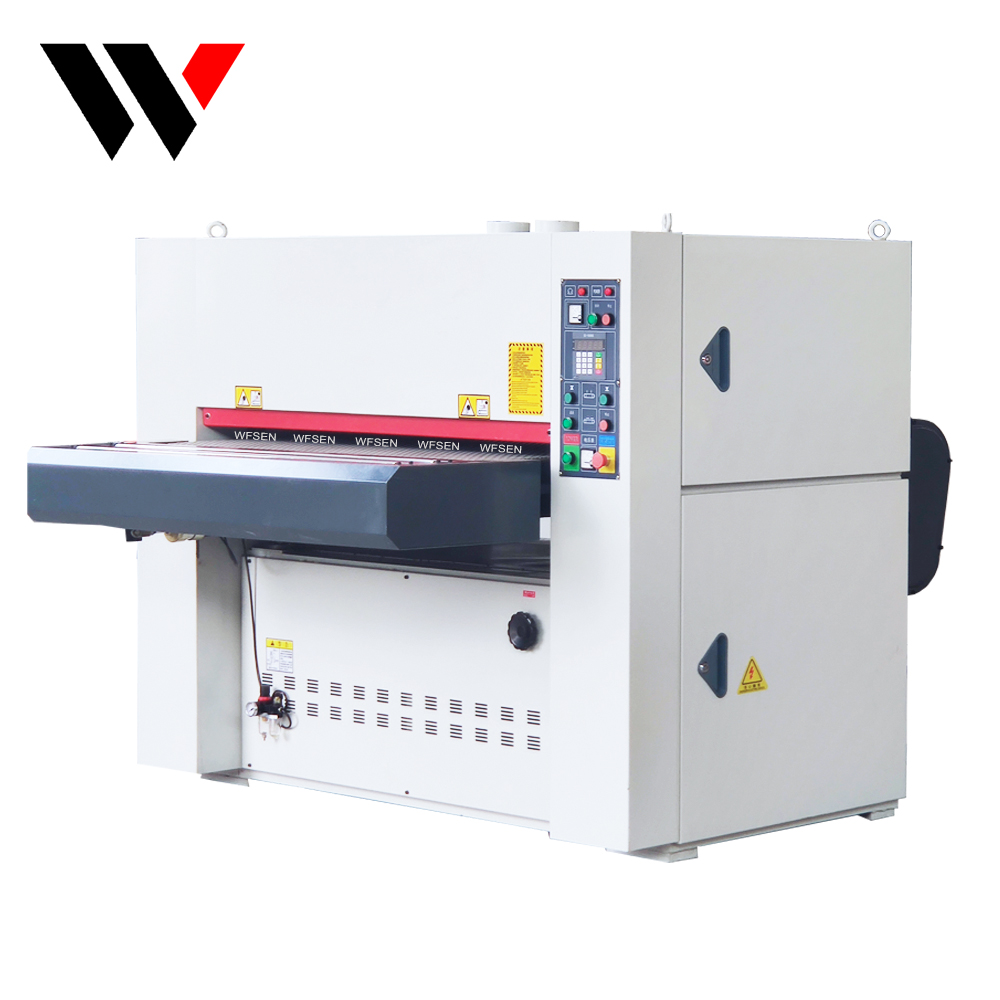
A 1300 mm thickness planer is not a bigger version of a 630 mm one. The work that justifies the width is different: glued panels for tabletops, door blanks, workbench tops, wide cabinet backs, anything where the board arrives already wider than a normal machine can swallow. That is the whole case for width.
The B1300 carries 26 kW, cuts up to 4 mm per pass and feeds from 6 to 30 m/min. Those four numbers, plus the 1800 kg of cast iron and steel holding them together, describe a machine that behaves quite differently from the one most small shops start with.
Start with the limitation, because it decides the whole workflow. A thickness planer copies whatever face is already flat onto the opposite side. It has no long infeed table and no reference surface that removes twist. If the board goes in with a cup, it comes out thinner and still cupped. Twist is not a thicknessing problem.
Every wide panel therefore passes a surfacer first. In our range that is the MB504 surface planer or a wide belt sander if the panel is too big to hand-feed. Only then does the B1300 see it. Shops that buy a wide thicknesser expecting it to flatten a twisted slab end up disappointed, and it is not the machine's fault.
The 1300 mm working width is the number customers actually call about, and it is usually quoted for the wrong reason. A single plank from a sawmill rarely exceeds 400 mm. Measure first. What exceeds 1300 mm is a glued panel, and it is the panel that forces the purchase.
Glue up four boards at 300 mm each and you have 1200 mm. Five boards and you are past the machine. That is why shops making kitchen worktops, conference tables and door cores jump to this size and stay there: their panel width is set by the furniture, not by the timber supply.
Measure the widest panel you actually glue, then add the amount you will glue next year. If that number is 900 mm, a 1300 mm machine is 400 mm of paid-for capacity that does nothing. If it is 1250 mm, anything narrower means ripping panels and re-jointing them, which is slower and shows on the finished face.
Divide the motor rating by the working width and you get 20 W for every millimetre of cut. That figure is the honest way to compare wide planers, because a 26 kW head on a 630 mm machine is a different animal from 26 kW on 1300 mm: the same muscle doing twice the work per pass.
It also means the electrical side needs checking before delivery, not after. 26 kW is a three-phase load, and the cable, breaker and phase capacity have to exist in your building. Ask an electrician to confirm the supply against the motor plate rather than assuming the workshop can take it because another machine runs there. Check it before you order.
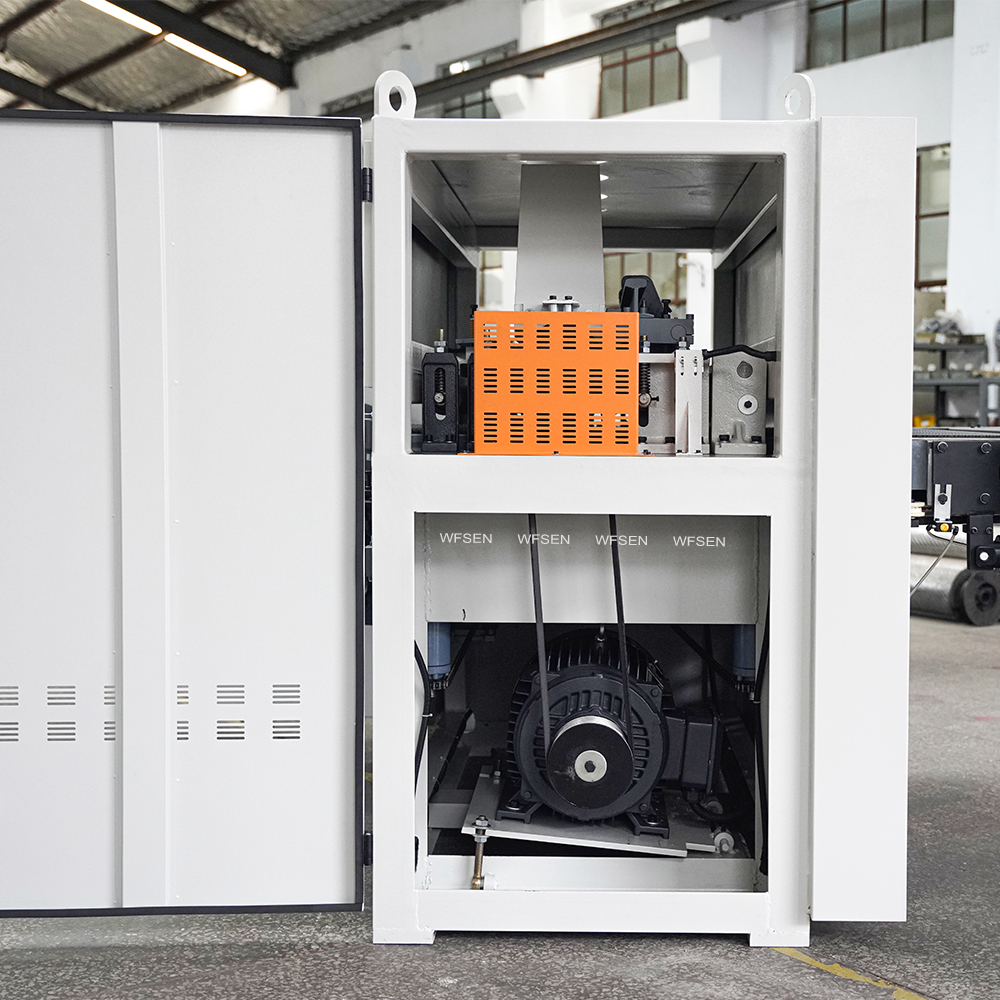
Power is only useful when it turns into depth of cut. In a narrow machine, the motor limits how hard you can push. Across 1300 mm, the same motor shares itself over a wide chip, so the practical limit arrives sooner than the badge suggests. Power is not depth of cut.
Four millimetres is the maximum depth of cut, which is a normal figure for a wide machine and a useful planning number. A 45 mm blank going down to 40 mm takes two passes with a little left for a finishing cut. A panel that arrives cupped takes more, because the first passes only touch the high spots.
Glued panels behave worse than solid stock. Once you machine one face, the balance of moisture across the panel changes and the panel can move. Taking equal amounts from both faces, and letting the panel rest between machining steps, keeps it flatter than hogging one side down in a single heavy pass. Two passes, not one.
This is where a wide thicknesser earns its keep on repeat work. Two light passes across 1200 mm take less time than four passes across a narrow machine plus the ripping and re-gluing that the narrow machine forces.
A 5:1 feed range covers two quite different jobs. At the low end, 6 m/min suits panels with mismatched grain, figured timber, or anything where the cut has to be slow enough to avoid tearing. At 30 m/min the machine is a production tool: uniform stock, light cuts, one operator feeding and one stacking. Six is slow. Thirty is fast.
A shop running 1200 mm panels all day will find the top of the range pays for itself within a season, while a shop running four panels a week spends more time setting the machine than cutting on it, and no feed rate fixes that arithmetic. Feed speed and finish move together. Doubling the feed rate roughly halves the number of knife marks per metre, which sounds good until the marks become visible. The useful setting is the one that gives an acceptable surface at the highest speed your material allows, and finding it takes an afternoon with your own timber, not a specification sheet.
A machine that weighs 1800 kg does not walk across the floor, and it does not need bolting down to stay put. It does need a floor that was poured for it. Check the slab before you commit, especially if the machine goes on an upper level or a mezzanine.
The footprint matters less than the space around it. A 1300 mm wide panel needs support on both sides, or it will tip down as it leaves the rollers and lift as it enters. Roller stands and a long outfeed table are part of the installation, not accessories. Nobody budgets them. Budget the floor space for the panel length, not the machine length. That is the number that surprises buyers.
Snipe, the shallow dip at each end of a board, appears when the last feed roller loses contact and the cutter head keeps cutting. On a wide machine the dip is wider, so the amount you trim off each end goes up. Allow 60 to 100 mm at both ends on a first pass and you will not lose a panel to it.
A 1300 mm cut at 4 mm deep and 30 m/min produces a wide, continuous ribbon of chips. The extraction hood has to take it without the duct choking, and the collector has to have the airflow to carry it. Under-specify the extraction and the machine fills its own hood within minutes. Volume, not pressure.
Size the duct from the hood outlet, keep the run short and the bends few, and check that the collector you already own can handle the volume. Most shops guess here. A shop that runs a narrow planer on a small bag collector usually finds that the same collector is not enough here. Our dust extraction guide covers the sizing method.
Three cases. Shops whose widest panel is under 900 mm, because the extra width never enters a cut. Shops that machine one-offs, because setting up a wide machine for a single board is slower than running it through a narrow one. And shops without extraction capacity, because the machine cannot run properly until that is solved. That last one is more common than the first two, and it is the cheapest to fix.
The fourth case is subtler. If your bottleneck is flattening rather than thicknessing, a wide thicknesser will not fix it. The budget is not the issue. You need a wide surfacer or a wide belt sander, and buying the wrong one of those three is an expensive way to learn the difference.
Ask for the working thickness range in writing for the exact configuration you are buying, and if the answer comes back as a range rather than a number, ask again, because the gap between two published ranges is usually the gap between two machine versions. Published tables for wide planers vary by version, and the range printed in a summary line does not always match the range printed in the table. You want the figure that applies to your order, not the widest one in the catalogue.
Then run your own panel. Nothing else settles it. Take a 1200 mm glued panel with a known cup, machine both faces, and measure across the full width with a straight edge, not just in the middle. Check the two ends for snipe and the surface for tear-out at the feed speed you plan to use, and if the middle of the panel is clean while the last 100 mm is not, the machine is fine and the outfeed support is not. Ten minutes with your own material tells you more than any specification. Ten minutes. Your own panel.
Finally, confirm the supply, the extraction and the floor. Those three decide whether the machine runs on the day it arrives.
If your workflow machines solid stock under 150 mm wide, a four side moulder does more per pass than any thicknesser. If your stock is narrower still and you only need one flat face, the comparison between a thicknesser and a surface planer is the place to start. The full planer range sits under multi planer, and the B1300 page carries the parameters quoted here.