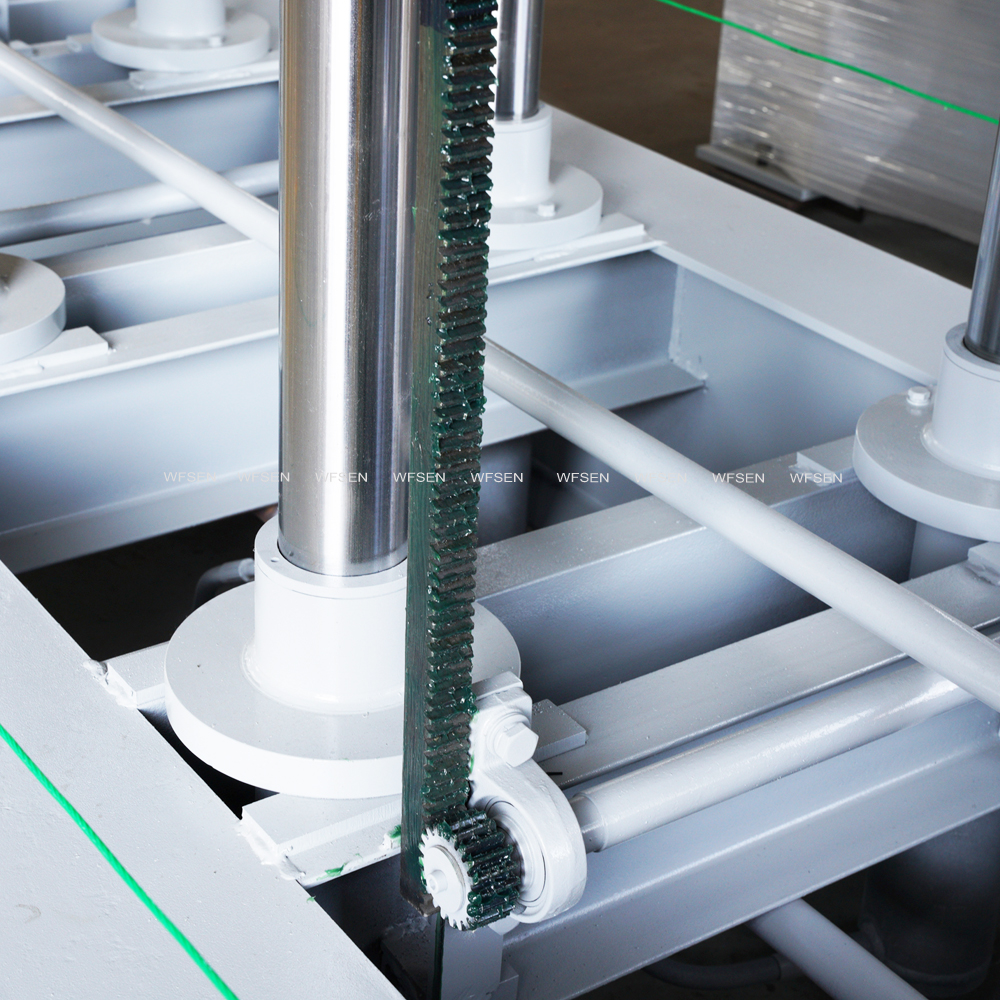
A five-opening hot press is bought for one reason: the same press cycle produces five times the area of a single-opening machine. Everything else about it — the tonnage, the plumbing, the 98 kW thermal oil furnace — exists to make that multiplication possible without the platens going cold or the pressure drifting between the top and bottom opening.
The HT-160 is five openings on platens of 3300 x 1300 mm, 42 mm thick, pressed by eight cylinders of 100 mm at a total of 160 tonnes. PLC and HMI run the sequence; the oil furnace and the hot oil pump do the heating. Overall the machine measures 4500 x 1700 x 2300 mm.
The numbers that decide whether it fits your production are not the headline ones. They are the ones you get by dividing.
One platen covers 3300 x 1300 mm, which is 4.29 square metres. Spread 160 tonnes over that area and you get about 3.7 kg per square centimetre, or roughly 0.37 MPa of platen pressure.
That figure is the useful one, because tonnage alone tells a buyer nothing. A 160 t press with a small platen is a high-pressure machine; 160 t across 4.29 m² is a moderate-pressure machine. Ours is the second kind. It is built for veneering, laminating and light plywood work rather than for compressing dense board at high pressure.
Ask any supplier for tonnage divided by platen area before you compare prices. Two machines with the same tonne rating and different platens are not the same machine at all. Divide it yourself.
A common misunderstanding is that more openings mean a better press. They do not. Not once. Quality comes from flat platens, even temperature and steady pressure. Five openings change one thing. How much material sees that pressure in one cycle: five platens at 4.29 m² each is 21.45 m² per opening of the press.
The trade is in the loading. Five openings have to be loaded and unloaded before the timer starts and after it ends, and every minute spent loading is a minute the platens are open and cooling. That is why the arithmetic of a multi-opening press is never just press time multiplied by five. Five openings are not five times the output.
Eight cylinders of 100 mm push the platen stack up. Eight, rather than four, is about evenness across a 3.3 m platen: a wide platen pressed at its corners bows in the middle, and a laminated panel takes that bow permanently.
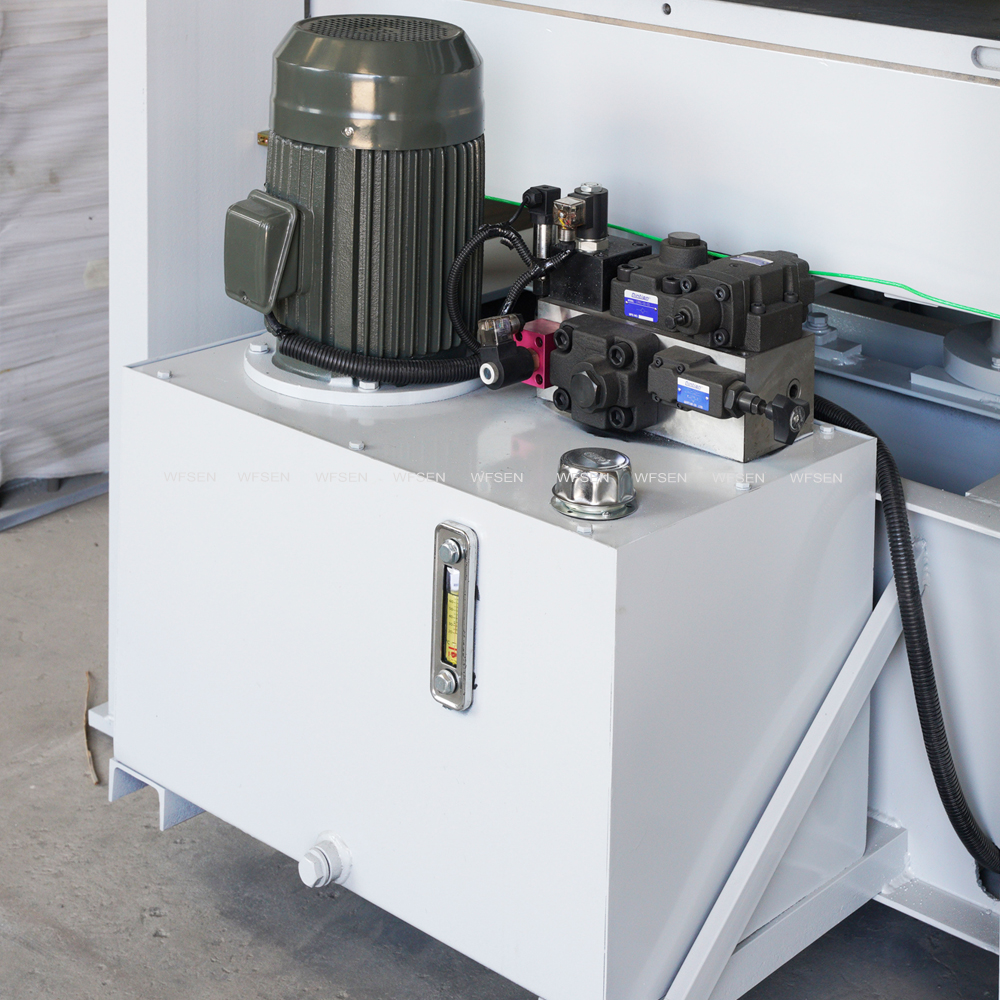
The hydraulic side runs on a 5.5 kW motor. Heat is the cost. That is small next to the 98 kW furnace, and the contrast tells you where the running cost sits: pressing is cheap, heating is not. A shop that budgets for the motor and forgets the furnace has budgeted for the wrong half of the machine.
The thermal oil furnace is rated 98 kW, circulating through the platens on a 3.7 kW hot oil pump. Five platens of 3300 x 1300 x 42 mm hold a lot of heat, and the furnace has to bring the whole stack up and hold it while cold panels keep entering.
Temperature stability is what separates a press that laminates cleanly from one that leaves dull patches. The failure looks like a glue problem and usually is not: it is the platen dropping a few degrees at the far end of the cycle.
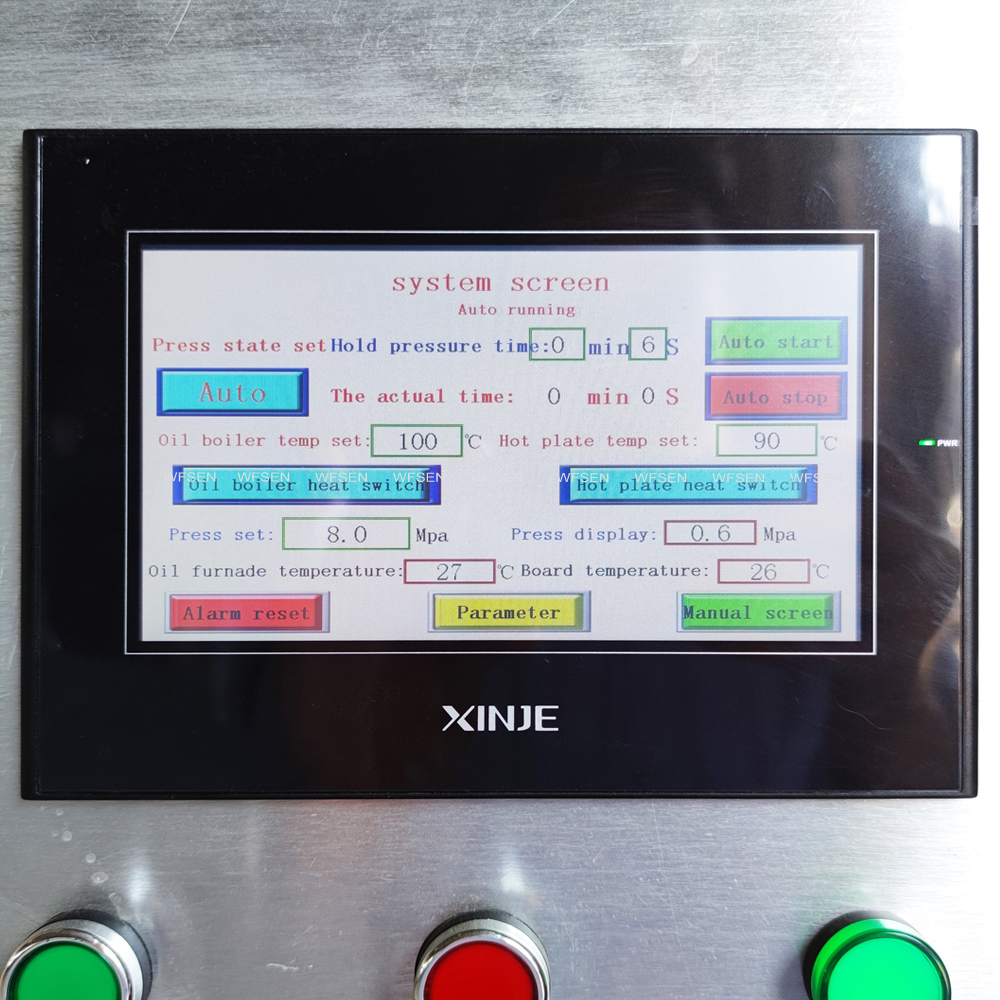
The HMI is where this is managed. On the screen in the photograph, hold pressure time, oil boiler temperature, hot plate temperature and the press set point are all adjustable per recipe, and the actual values sit next to them. That is the part worth learning on day one, because a recipe saved badly is a whole shift of scrap. Start there.
Do the sums with your own numbers, not the catalogue's. Three figures decide daily output: press time per cycle, load and unload time, and the area of one opening.
Take a 10-minute total cycle as an example, which is a press time of a few minutes plus loading and unloading. That is six cycles an hour. Six cycles at 21.45 m² per opening gives 128.7 m² an hour. Over an eight-hour shift with realistic breaks, you are looking at something under 900 m², and the gap between that and the theoretical figure is entirely loading discipline, which is why the difference between 900 and 1,200 square metres a shift is rarely the press and almost always whether the loading racks were bought with the machine and whether the crew loads the top opening while the bottom one is still warm.
Now change one variable. A 15-minute cycle instead of 10 drops you to four cycles an hour, 85.8 m², and roughly 600 m² a shift. Same machine, two thirds of the output, decided by the adhesive and the panel build rather than by the press. One panel.
This is why buyers who compare presses on tonnage alone end up disappointed, and why the question to ask is what cycle time your product actually needs at temperature.
Five openings need five times the loading labour of one. On a 3.3 m platen that means either a loading rack that presents a full stack at once, or two people working fast enough that the bottom platen does not cool while the top is being filled.
Budget for the rack, not just the press. Nobody does. It is the accessory that most often gets left out of the quotation and is the one that decides whether the machine hits its rated output or sits half-loaded, because a crew that has to build a stack opening by opening will always run slower than the press can cycle.
First, what is the platen pressure at the tonnage you are quoting me, in kg per square centimetre? Anyone selling presses should answer that without looking it up. Second, what holds the temperature at the far end of a 3.3 m platen, and how is it measured?
Neither answer is on a specification sheet. Both decide whether the fifth opening produces the same panel as the first.
Three cases. Very thick products, where five openings of a thick build means a platen opening no longer closes comfortably. Small batches with frequent changes, because five openings of one recipe is a lot of material to get wrong at once. And shops without the power supply for a 98 kW furnace, which is a conversation to have with an electrician before the machine is ordered rather than after it lands.
A single-opening press is slower per cycle but far more forgiving of a mixed order book. For a shop running one product all week, five openings wins on labour. That is the whole trade. For a shop running five products a week, it can lose.
Check platen flatness with a straight edge across the full 3.3 m, not just in the middle. Ask for it in writing. Check that all five openings reach temperature and hold it, with a surface probe rather than the screen reading. Check that the pressure holds at the platen over a full cycle, because a slow leak shows up as a thin panel rather than as an alarm.
Then press one panel you already know how to make, and compare it to the one your old machine produces. That comparison is the only acceptance test that matters. Bring your own board.
The HT-160 sits in the middle of a range that starts at a single-opening 100 t machine and runs to six openings at 300 t, so the right choice depends on the order book rather than the budget. The hot press range lists the configurations, the HT-160 five layer 160T page carries the parameters quoted here, and the selection guide covers the upstream questions. If your process is cold pressing or membrane pressing instead, the cold press and vacuum membrane press pages are the ones to read, and the glue spreader decides how much of the cycle time is glue rather than heat.