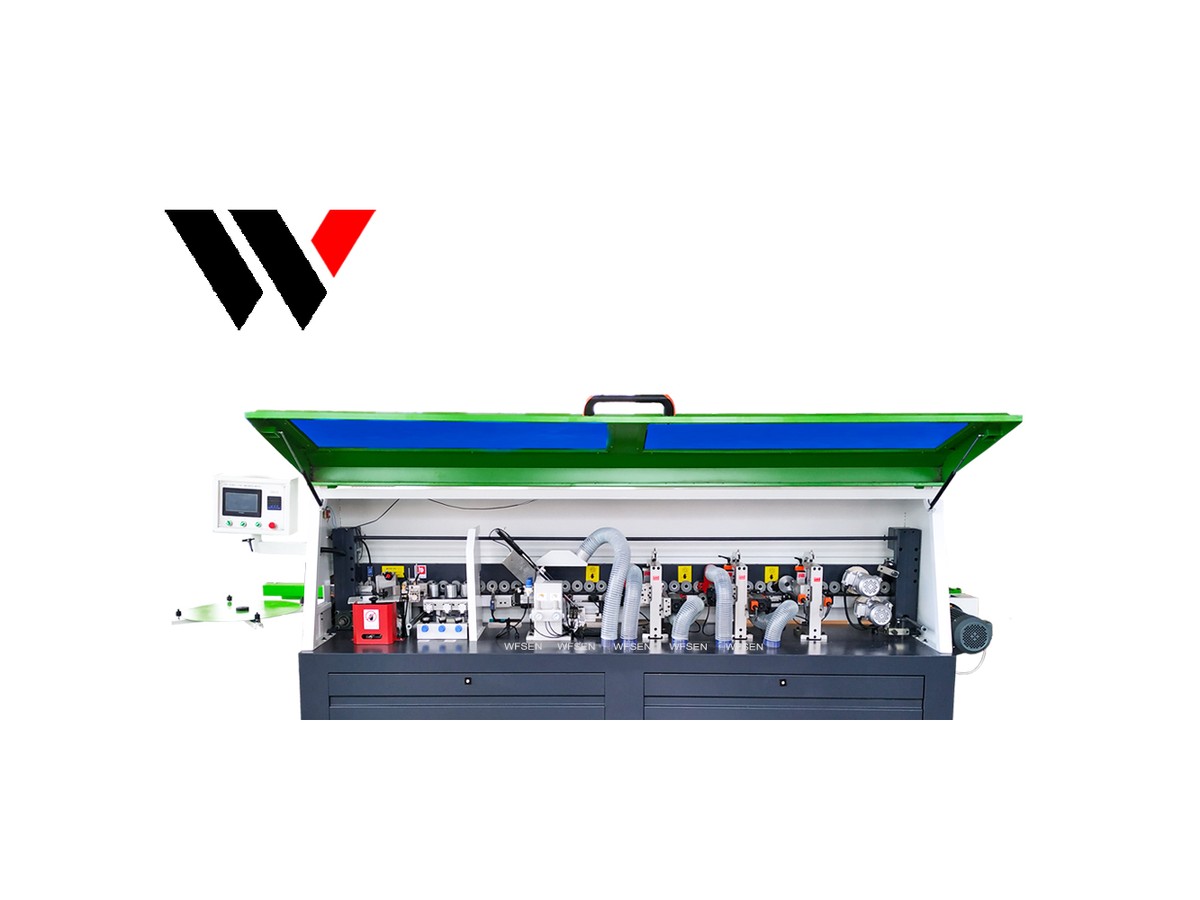
Short answer: across our edge banding range the machines run from 15 kg and 380 × 330 × 380 mm at the bench end to 2,200 kg and 6,550 × 750 × 1,550 mm for the eight-station automatic — roughly 147 times the weight and 17 times the length. Weight and length follow the machine class closely. Width does not, and the heaviest machine in the range is not the widest one.
This page is the reference table for the whole range: published weight, outline size, installed power, feed speed, edge tape range, minimum radius and working air pressure for all eleven models. Every figure is copied from that model's own product page. Where a page does not publish a value, it is marked as not published rather than estimated.
| Model | Class | Weight | Outline size (L × W × H) |
|---|---|---|---|
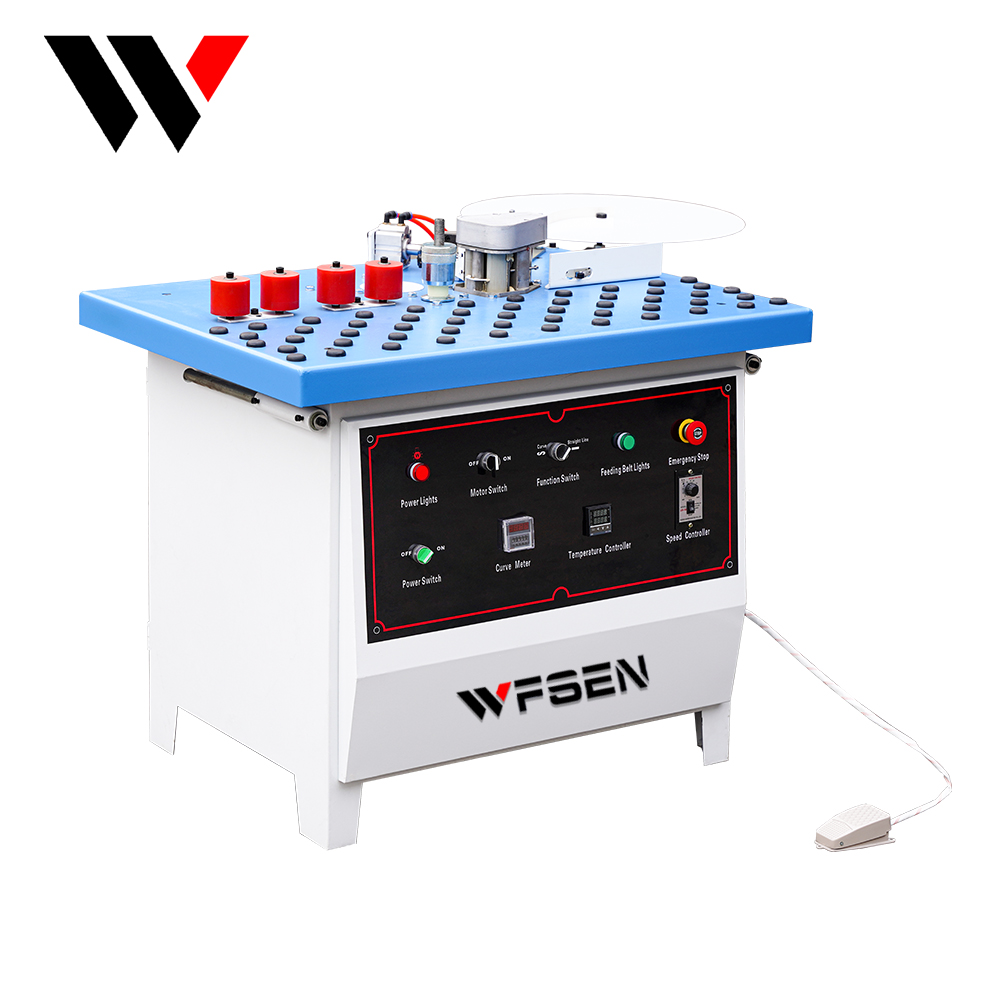
| MF160B | Bench mini | 15 kg | 380 × 330 × 380 mm |
| MF170B | Portable | 30 kg | 500 × 500 × 480 mm |
| MF202 | Compact straight-line | 80 kg | 1,300 × 500 × 500 mm |
| MF260T | Manual | 180 kg | 1,100 × 900 × 1,000 mm |
| MF260B | Manual | 180 kg | 1,100 × 900 × 1,000 mm |
| MF260D | Curve | 180 kg | 1,100 × 900 × 1,000 mm |
| MF260M | Folding-arm curve | 180 kg | 1,200 × 900 × 1,000 mm |
| MF60S | Semi-automatic | 200 kg | 1,600 × 800 × 1,100 mm |
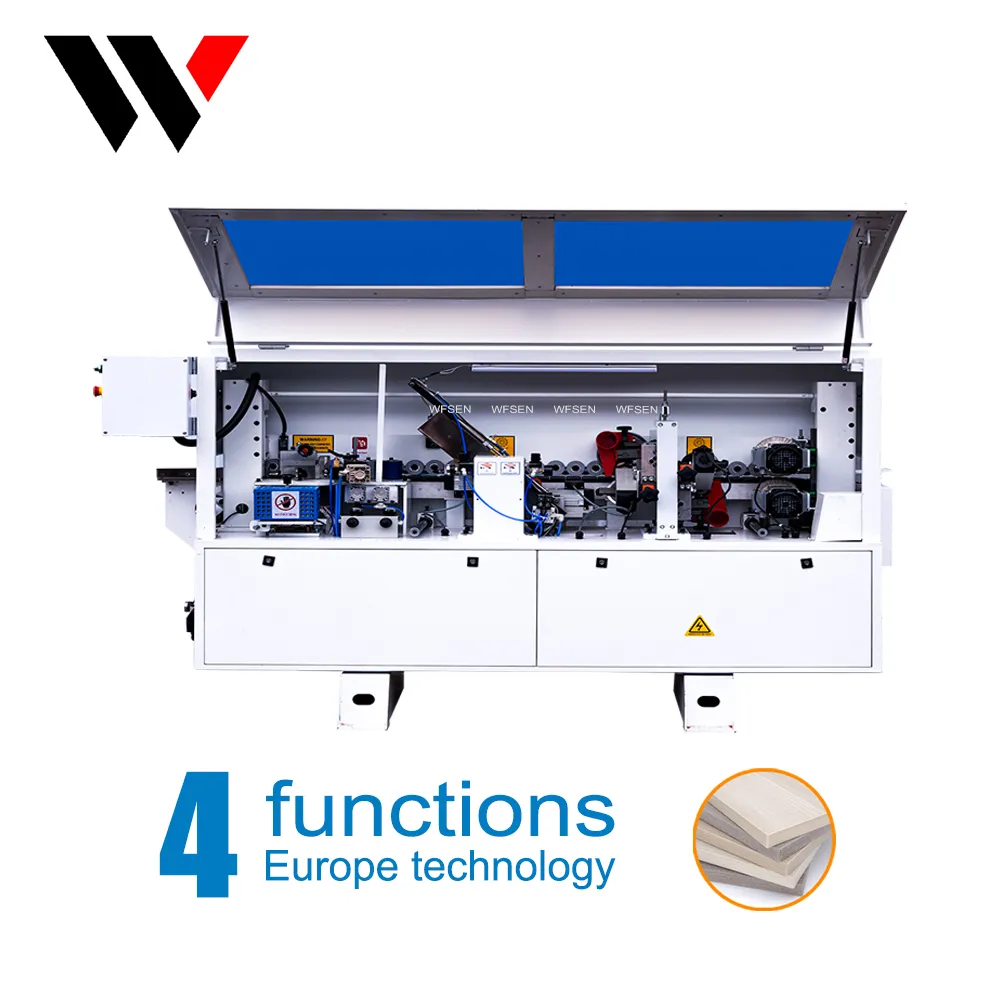
| MF360D | Full automatic | 600 kg | 2,300 × 500 × 1,350 mm |
| MF360B | Full automatic, 6 stations | 1,400 kg | 4,100 × 1,000 × 1,600 mm |
| MF630A | Full automatic, 8 stations | 2,200 kg | 6,550 × 750 × 1,550 mm |
Two notes on the source data, so that nothing here looks more precise than it is. The MF60S product page lists its outline size without a unit, and the MF260T and MF160B pages publish theirs with a trailing "m" — both are millimetre dimensions, and we have reproduced the values as published. Where a page gives no value for a field, the tables below say not published.
Read as a list, the eleven models fall into four natural bands, and the bands are about weight rather than about the features printed on a brochure.
The two most-compared automatic models make the point better than any general rule. The MF360B is 1,400 kg at 4,100 × 1,000 × 1,600 mm. The MF630A is 800 kg heavier and 2,450 mm longer — and yet it is 250 mm narrower and 50 mm lower than the lighter machine.
The stations on these machines sit one behind another along a single bed, which is why the extra stations of the eight-station model show up as length rather than as width. For anyone laying out a workshop this matters more than the weight figure: what you have to find room for on an automatic machine is wall length. Widths across the whole automatic band run from 500 mm to 1,000 mm, so the footprint that actually constrains you is the 2.3 m to 6.55 m of bed.
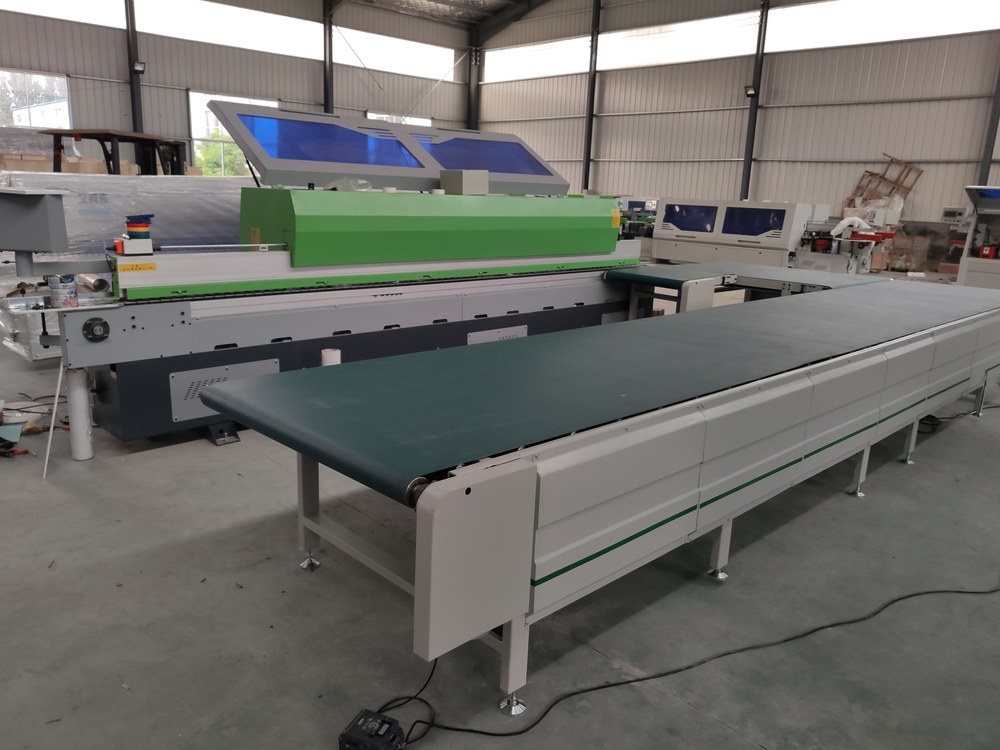
The outline size in the table is the machine only. The panel entering and leaving it needs its own run, and so does the operator working along the feed side. A machine listed at 6,550 mm needs a clear run considerably longer than 6.55 m before you switch it on.
Power is where the range splits most sharply, and where quotations are most often compared unfairly. Five models publish a single total-power figure:
| Model | Total power (as published) |
|---|---|
| MF160B | 800 W |
| MF170B | 1.2 kW |
| MF360D | 6 kW |
| MF360B | 9 kW |
| MF630A | 13.5 kW |
The remaining models publish their motors item by item instead of as one number. The MF202 lists a 2 kW heater, two cutting and scraping motors at 0.8 kW and two polishing motors at 0.37 kW. The MF60S lists a 0.25 kW motor, 0.44 kW polishing, 0.06 kW feeding, 1.6 kW trimming and 1.2 kW heating. The MF260T, MF260B and MF260D each publish a motor power of 0.25 kW, and the MF260M a 1.2 kW heater with a 0.2 kW motor.
The practical consequence: when you compare our automatic machines against another supplier's, check that you are comparing a total-power figure with a total-power figure. An itemised list and a single figure are not the same measurement, and the difference between them can look like a specification advantage when it is only a difference in how the page was filled in.
The manual and curve machines specify 0.5 MPa (MF60S, MF260T, MF260B, MF260D). The automatic machines and the folding-arm curve model specify 0.6 MPa (MF260M, MF360B, MF360D, MF630A). Three models — MF160B, MF170B and MF202 — do not publish a working pressure figure.
Compressed air is not an accessory on any of these machines. Hold-downs, trimming units and positioning cylinders are pneumatic, which means a compressor and a stable supply are part of the installation, not something added later. If your workshop already runs air at 0.5 MPa, that is enough for the manual band; the automatic band wants 0.6 MPa.
| Model | Feed speed | Edge tape range | Min. radius |
|---|---|---|---|
| MF160B | 2–6 m/min | 0.3–3 mm | not published |
| MF170B | 0–6 m/min | 0.4–3 mm | not published |
| MF202 | 0–6 m/min | not published | not published |
| MF260T | 0–14 m/min | 0.15–5 mm | 20 mm |
| MF260B | 0–14 m/min | 0.15–5 mm | 20 mm |
| MF260D | 0–14 m/min | 0.15–5 mm | 20 mm |
| MF260M | 0–20 cm/s | 0.5–2 mm | not published |
| MF60S | 0–14 m/min | 0.3–3 mm | not published |
| MF360D | 15 m/min | 0.4–3 mm | not published |
| MF360B | 13–23 m/min | 0.4–3 mm | not published |
| MF630A | 13–23 m/min | 0.4–3 mm | not published |
The row worth pausing on is edge tape. The 180 kg manual machines carry the widest tape range in the range — 0.15–5 mm — while the 2,200 kg eight-station automatic carries 0.4–3 mm. Weight and price buy throughput and finishing stations; they do not buy edge range. A hand-controlled feed can present thick solid edging that an automatic feeder will not take, which is why the manual band is the one to look at if you edge solid wood rather than PVC tape.
The smallest machines publish the narrowest feed speeds for the same reason: at 0–6 m/min the operator is presenting each panel, and the machine is not doing the transport. From 13 m/min upward the panel is being driven by the machine, and that is the same jump that accounts for most of the weight and most of the price — the argument we set out in what actually drives the price of an edge banding machine.
How much does an edge banding machine weigh?
Our range runs from 15 kg for the MF160B bench mini to 2,200 kg for the MF630A eight-station automatic. Between those two the models sit at 30, 80, 180 and 200 kg, and at 600 kg and 1,400 kg for the other two automatic models. Weight is the single most useful number for judging what class a machine is really in.
What is the smallest edge banding machine you make?
The MF160B at 15 kg and 380 × 330 × 380 mm. It runs on 800 W from an ordinary socket and is carried by hand, which is why it is the usual entry point for small components and low volume.
How long is a full automatic edge banding machine?
Between 2,300 mm and 6,550 mm depending on the station count: the MF360D is 2,300 mm, the MF360B 4,100 mm and the MF630A 6,550 mm. Note that these are machine dimensions; a working installation needs additional clear length for the panel to enter and leave.
Does a heavier machine take a thicker edge tape?
No — the opposite is closer to the truth. The 180 kg manual models publish 0.15–5 mm while the automatic models publish 0.4–3 mm. If you edge thick solid wood rather than thin PVC tape, the manual band is the one that covers it.
What power supply does an edge banding machine need?
From a standard socket at 800 W for the bench mini, up to 13.5 kW for the eight-station automatic — with 1.2 kW, 6 kW and 9 kW in between. Several models publish only itemised motor powers rather than one total, so confirm what the figure you are being quoted actually covers.
Can an edge banding machine be moved after installation?
Anything from 15 kg to 200 kg is a pallet move. The automatic models at 600 kg, 1,400 kg and 2,200 kg are the ones where the route into the workshop — doorway width and floor loading — needs checking before delivery rather than after.
Three measurements decide whether a machine fits your workshop rather than only your production plan: the bed length you can clear, the width of the route in, and the power and air you can bring to the position. If you tell us those three plus the panel you edge, we can tell you which models in the range are actually available to you.
The full range with specifications is on our edge banding machine page. If you are still choosing the class rather than the size, start with portable, manual, automatic and curve edge banding machines, or send the panel and tape specification directly to us here.