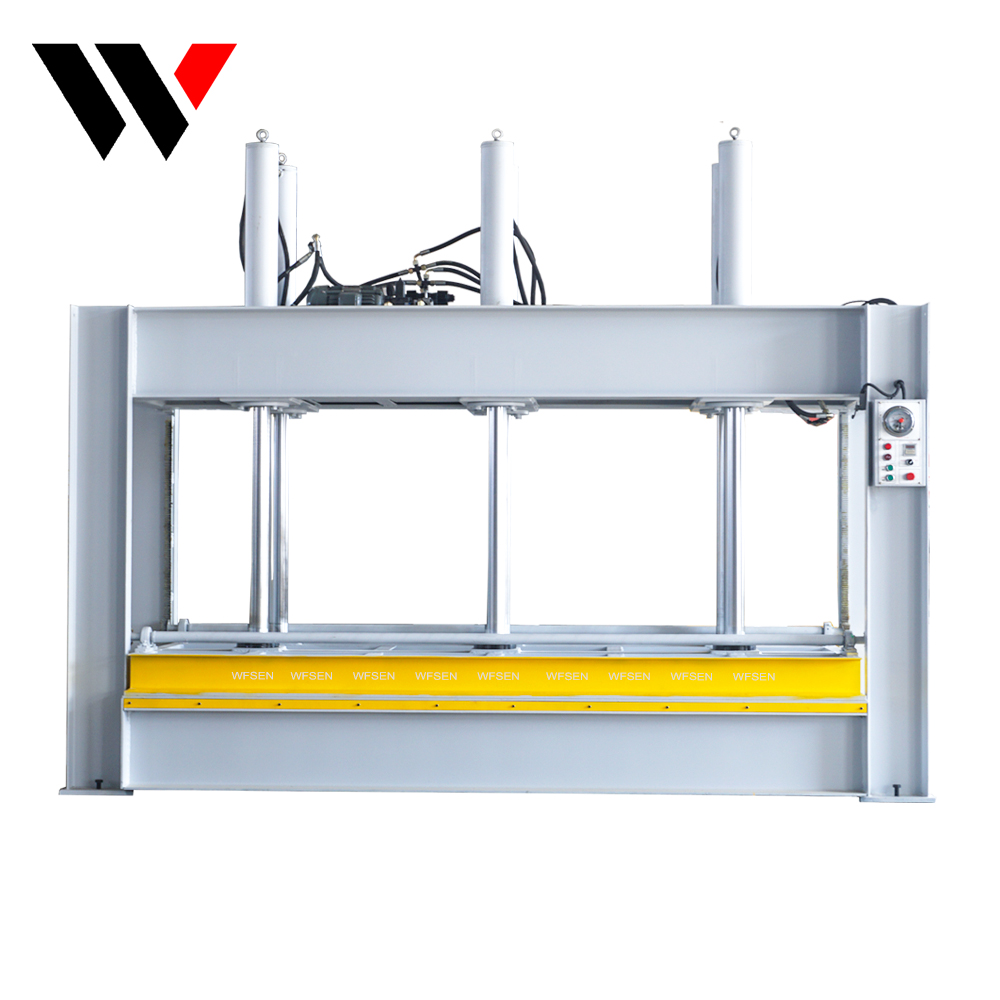
Four hydraulic cold presses are listed on this site, and they are not four sizes of the same machine. One is long, one is dense, one carries feeding rollers, and one holds three platens in a single frame. Tonnage does not follow platen size anywhere in the range.
This page puts the four side by side and reads the differences that actually separate them: cylinder bore, cylinder count, platen length and packing size. How to size a press for your own panels is a different question, and it is answered on the cold press selection guide.
The 50 ton machine carries a 3000 x 1300 mm platen. The 120 ton machine carries 2500 x 1250 mm. The one with three feeding rollers is 3050 x 1300 mm at 100 ton. The three stage unit holds three platens of 1250 x 1000 mm and still works at 50 ton.
The strongest press has the smallest single platen. The longest platen belongs to the weakest press. That is not a catalogue error. It is the shape of the range, and it is the reason the four machines answer four different jobs.
| Machine | Platen | Max pressure | Opening | Cylinders | Weight | Packing |
|---|---|---|---|---|---|---|
| 50 ton | 3000 x 1300 mm | 50 ton | 900-1000 mm | 125 mm x 2 | 1900 kg | 3000 x 1300 x 2300 mm |
| MC120T | 2500 x 1250 mm | 120 ton | 1000 mm | 125 mm x 6 | 3000 kg | 3000 x 1300 x 2800 mm |
| MC100T rollers | 3050 x 1300 mm | 100 ton | 900-1000 mm | 100 mm x 6 | 3500 kg | 3600 x 1500 x 2200 mm |
| Three stage | 1250 x 1000 mm x 3 | 50 ton | 900-1000 mm | 125 mm x 2 x 3 | 3000 kg | 4100 x 1300 x 1900 mm |
Hydraulic power is 4 kW on all four. The three stage unit also lists feed cylinders of 40 x 50 mm, six of them, which move the platens rather than press them.

Look at the cylinder column rather than the badge. The 50 ton press reaches its figure with two rams of 125 mm. The 120 ton press uses the same 125 mm bore, six times over. The roller machine uses six cylinders of 100 mm, a smaller bore in greater number. The three stage unit repeats the two-ram 125 mm layout on each of its three frames.
So the tonnage is built from cylinder area and oil pressure, and the four presses differ in how that area is spread. Adding rams is cheaper than enlarging them, and it changes the shape of the load across the platen: six rams push more evenly on a short platen than two do on a long one.
This is also why every machine in the range lists the same 4 kW hydraulic pack. Force does not come from the motor. A quotation that opens with kilowatts is steering the conversation away from platens, daylight and cylinder count.
Three metres of platen is a panel length decision. A shop pressing 2440 mm boards down the length of the table wants that 3000 mm, and the 3050 mm roller machine a little more. A shop pressing door skins or small cabinet parts spends most of the table pressing air and pays for three metres of steel to do it.
The 120 ton press goes the other way: shorter table, more force per unit of area, six rams. Material that needs real clamping force and does not need length is what that machine was drawn for.
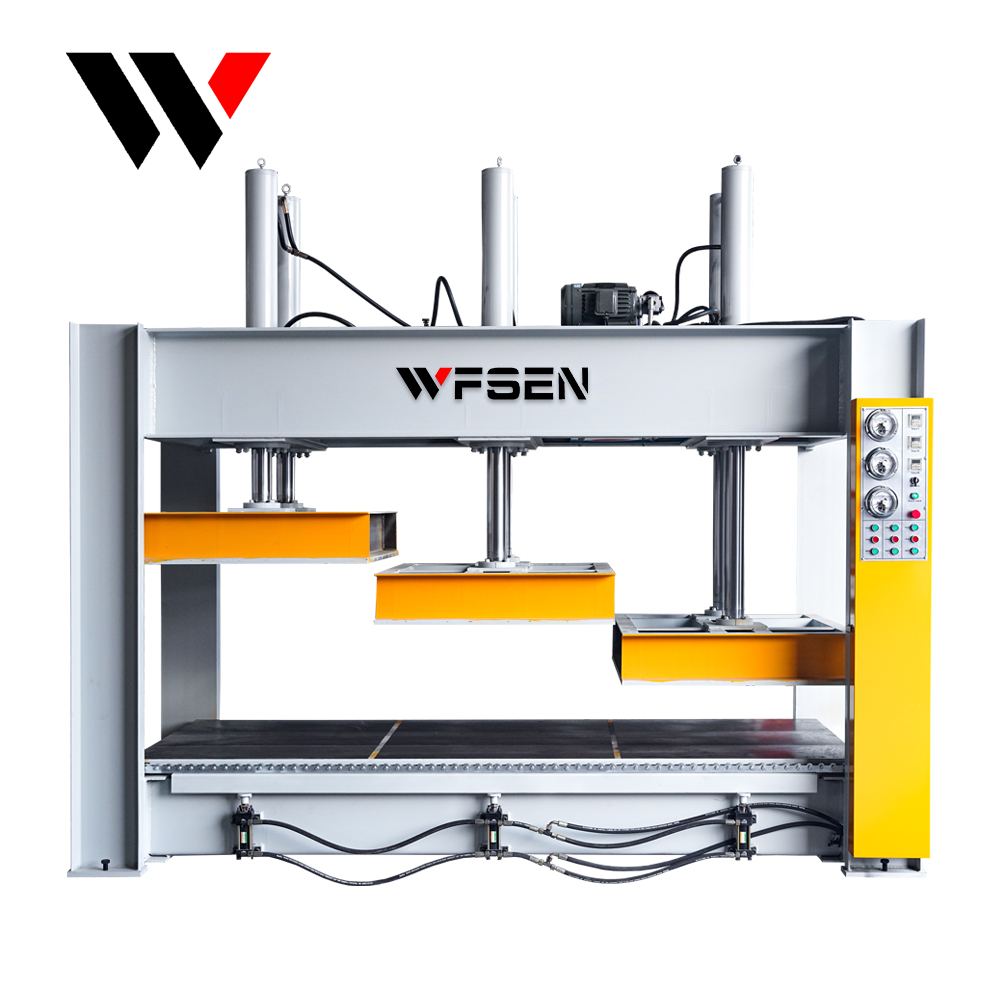
The three stage unit takes a third route. Three separate loads run at once, so one platen can be under pressure while the next is loaded and the third is unloaded. That suits small parts and long clamp times. What it cannot do is press a 2440 mm panel, because three small platens do not assemble into one large one.
The four crates do not occupy the same space. Heights run 2300 mm on the 50 ton, 2800 mm on the 120 ton, 2200 mm on the roller machine and 1900 mm on the three stage unit. Lengths run from 3000 mm to 4100 mm.
That difference is a container or a flat rack, decided at the quotation stage and paid for at the port. It also decides whether the crate goes through the door of the workshop it is bought for. Take the packing line off the page and put it on the floor plan before the deposit, not after.
Weight follows the same pattern: 1900 kg, 3000 kg, 3500 kg and 3000 kg. The roller machine is the heaviest of the four, which matters to whoever quotes the rigging.
The MC120T lists a working speed of 200 mm/min. The 50 ton, the roller machine and the three stage unit all describe theirs as continuously variable, with no figure attached.
Read that as a difference in how the machine is operated rather than a missing specification. A set figure suits a shop running one recipe all day. A valve the operator adjusts suits a shop pressing different thicknesses through the shift, and frustrates the shop that wants every cycle identical.
Voltage is listed as 220V / 380V / 415V on the MC120T. Confirm the supply on your side before the order leaves, because a 4 kW pack wired for the wrong voltage is a workshop problem rather than a shipping problem.
This page compares the four configurations. It does not tell you which one your workshop should buy, and it does not work out how many stacks a week of orders needs.
Tonnage against platen area, daylight and the choice between single, multi-daylight and roller feed sit in the cold press selection guide. Cycle time, loading and whether rollers earn their place are in what the feeding rollers change.
What feeds the press and what takes the load off it belongs to the line, not to the machine: a glue spreader sets the film the press holds closed, and a hot press after it decides how much curing still happens on your floor. The sequence sits under the plywood production line, and all four machines are collected under cold press.