Three machines in our range share a cutting size of 4100 by 1600 mm and a maximum cutting thickness of 60 mm. They are not three versions of the same saw. They are three answers to the question of who moves the head.
On the MJF4116 full automatic, the carriage moves under power at a main motor of 7 kW and a motor speed of 5400 r/min. On the MJF4116 manual, the operator moves it, and the motor is 6 kW at 2800 r/min. On the MJ4116, the operator moves it as well, the motor is 4 kW at 2900 r/min, and the grooving depth stops at 8 mm instead of 20 mm.
All three take the same blade: a 250 mm disc, 30 mm bore, 15 mm kerf, mounted both for cutting and for grooving. That shared tooling tells you the three machines cut the same materials to different production rates, not to different standards of cut.
A vertical panel saw exists because a 1220 by 2440 sheet is awkward and a 4100 by 1600 panel is worse. Laying it flat needs a table bigger than the panel plus clearance on every side; standing it up needs a wall and a frame.
The savings are in floor space first, and in handling second. One person can load a panel upright against the frame, index it to a stop and cut, without walking around a table. In a shop where the panel saw is one station among ten, that is what makes the machine fit at all.
The cost is that the panel is held by gravity and by the frame, not by a sliding carriage and clamps. Everything about cut quality on a vertical saw comes back to how well the panel sits against the frame.
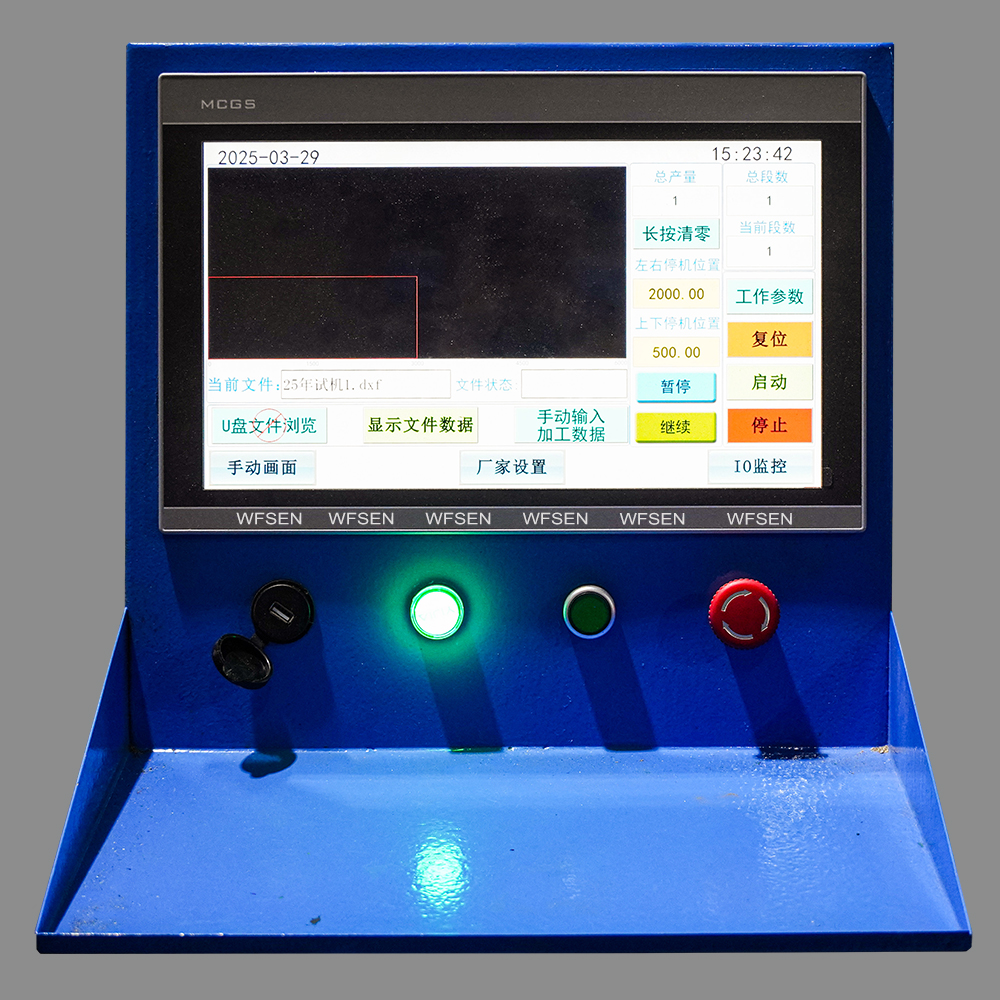
The powered carriage is the whole point of the MJF4116 full automatic. The operator positions the panel and sets the dimension; the machine drives the head through the cut at a rate that does not change between the first panel of the morning and the fortieth.
That consistency is what a 5400 r/min motor buys. Higher spindle speed means more cuts per second at the same feed, which reduces the chip load per tooth and improves the edge on melamine-faced and veneered panels. It also means more heat in the blade, which is why the powered carriage matters: a constant feed keeps the blade from dwelling.
Published cutting precision for this model is within 0.3 mm. Grooving depth runs 0 to 20 mm, which is enough for a hinge recess or a back-panel groove in one setting. The machine is 5500 by 1900 by 2500 mm and weighs 1000 to 1200 kg.
It cuts vertically and horizontally without the panel being turned, which is the feature that turns a two-person job into a one-person job on large panels.
The manual version keeps the 4100 by 1600 mm cutting size, the 60 mm thickness limit and the 0 to 20 mm grooving depth. It drops the powered carriage and the 7 kW motor, and uses 6 kW at 2800 r/min.
Two numbers change and both are honest. The lower spindle speed reduces the cut quality on faced panels slightly, and the hand feed makes the finish depend on how evenly the operator pushes. It is 5400 by 1900 by 2500 mm and 1100 kg, so the footprint and the weight are essentially the same as the automatic.
That last point is the one buyers miss. Choosing the manual does not save floor space. It saves purchase cost and it saves the maintenance of a powered carriage, and it costs you cycle time and a little edge quality. If the machine runs two panels a day, that trade is obviously correct. If it runs two hundred, it is obviously wrong.
Manual does not mean crude. The grooving depth adjustment is the same 0 to 20 mm, and the head still cuts both directions. What changes is who supplies the feed rate.
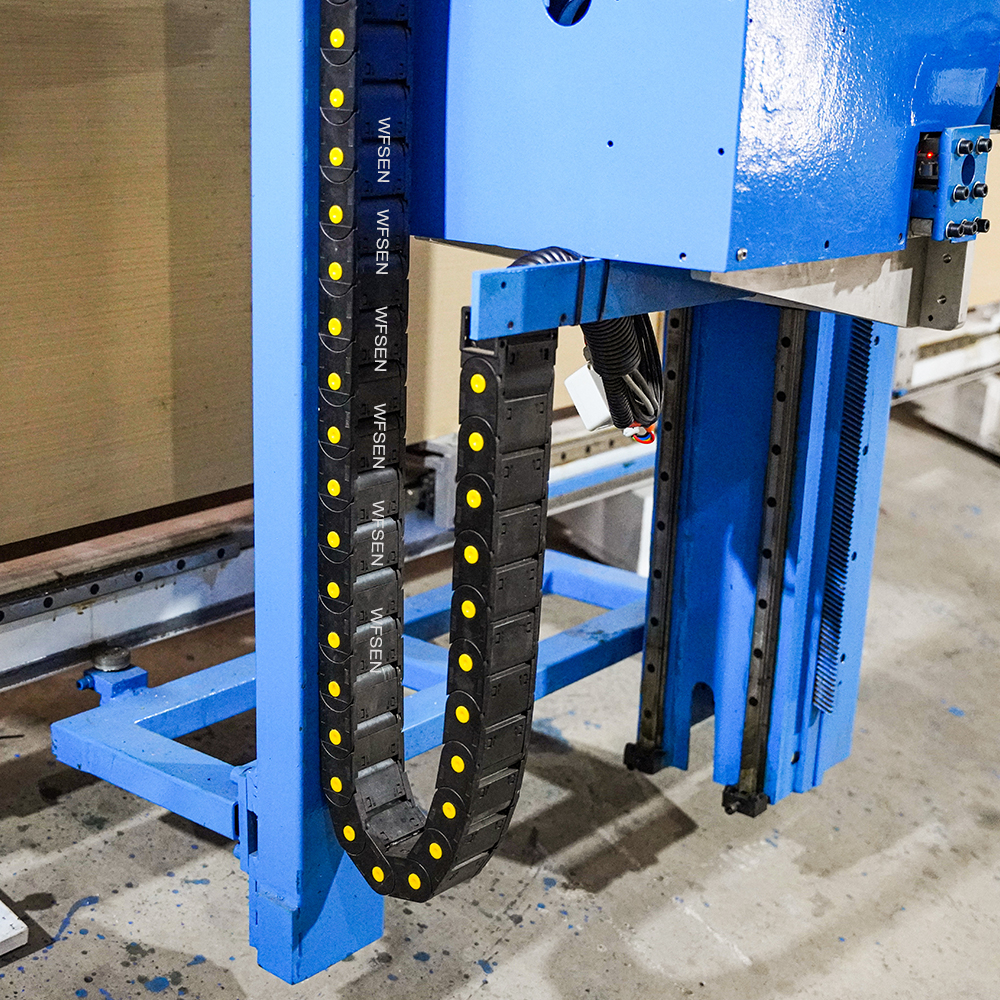
The MJ4116 is the entry machine, and its specification shows exactly where the savings come from. The main motor is 4 kW at 2900 r/min, the grooving depth is 0 to 8 mm rather than 20 mm, and the overall size is 5400 by 1300 by 2600 mm rather than 1900 mm deep.
That 600 mm difference in depth is not cosmetic. The deeper frames on the two MJF4116 models carry a carriage that has to stay square over a longer travel; the MJ4116 uses a lighter structure, which is why it can do 4 kW of cutting and not 7.
The 0 to 8 mm grooving range is the specification that decides the customer. Eight millimetres covers a back panel groove in 8 mm material and a shallow decorative rebate. It does not cover a 20 mm hinge recess. If your joints need a deeper groove, this is the wrong machine regardless of price.
Everything else is shared: 4100 by 1600 mm cutting size, 60 mm maximum thickness, the same 250 mm blade for cutting and grooving. The MJ4116 also carries a digital display and a directional and locking device as standard features on the page, and it cuts aluminium plate, PVC, MDF, multilayer board and solid wood.
One note on published figures. The MJ4116 page states a cutting precision of 1.5 mm in its summary line and a high-precision figure of 0.15 mm over 2000 mm in its selling points. Those two statements do not agree, and we will not guess which applies to your configuration. Ask for the figure in writing at quotation stage if the tolerance matters to your product.
| Specification | MJF4116 full auto | MJF4116 manual | MJ4116 |
|---|---|---|---|
| Cutting size | 4100 x 1600 mm | 4100 x 1600 mm | 4100 x 1600 mm |
| Max. cutting thickness | 60 mm | 60 mm | 60 mm |
| Main motor | 7 kW | 6 kW | 4 kW |
| Motor speed | 5400 r/min | 2800 r/min | 2900 r/min |
| Grooving depth | 0-20 mm | 0-20 mm | 0-8 mm |
| Overall size | 5500 x 1900 x 2500 mm | 5400 x 1900 x 2500 mm | 5400 x 1300 x 2600 mm |
| Weight | 1000-1200 kg | 1100 kg | 1000-1200 kg |
Read the table down the motor column and the decision is mostly made. The cutting envelope is identical across all three, so nobody buys the extra power to cut bigger panels. They buy it to cut the same panels consistently and faster.
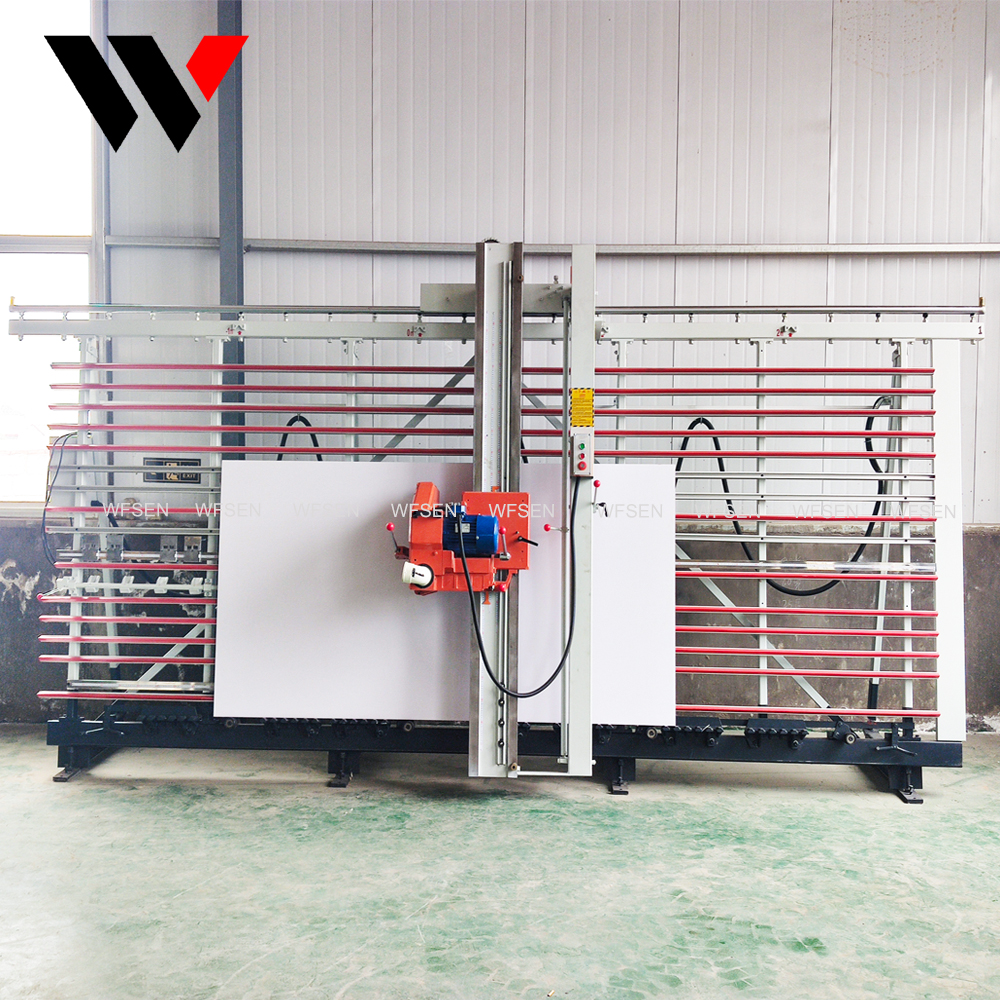
Buyers compare motor power and ignore grooving depth, and then discover they cannot cut the joint they designed.
Twenty millimetres is a working range. It covers a hinge cup, a back panel groove in thick stock, and a rebate deep enough to take a cleat. Eight millimetres is a panel groove. If your product is cabinet backs and drawer bottoms, 8 mm is enough and the MJ4116 is the sensible machine. If your product includes doors with concealed hinges, you need the 20 mm range and the choice is between the two MJF4116 models.
The same blade cuts and grooves on all three machines, which keeps the tooling simple and the spare parts cheap. The limitation is in the head travel, not in the cutter.
A vertical saw holds a panel by leaning it against the frame, and everything about accuracy follows from that. Three habits separate a clean cut from a tapered one.
Set the panel on the bottom support before releasing it, so its weight is carried by the frame and not by the fence. Check the panel is flat against the frame at the top and the bottom, not just in the middle where you can reach. And run the cut in one continuous stroke: stopping mid-panel lets the blade dwell and leaves a mark that no setting removes.
On the automatic, the same three habits apply but the feed rate is no longer your problem, which is why shops running thin melamine tend to move to the powered machine. Thin faced panels are where a varying hand feed shows up first. A 0.3 mm chip on a white melamine edge is visible from across a room, and it is the defect that decides whether a customer accepts a kitchen.
All three need a wall, and the wall needs to be straight. A vertical saw bolted to a wall that is out of plumb will cut out of square no matter how the frame is adjusted, because the frame follows the wall.
Height matters too. The two MJF4116 models stand 2500 mm tall and the MJ4116 stands 2600 mm. Add the panel above the machine and you need clear headroom of roughly 4.5 m to load a 4100 mm panel upright. That number rules out a lot of mezzanine floors, and it is worth measuring before you order rather than after delivery.
A 1000 to 1200 kg frame does not need a special foundation. It does need to be fixed to something structural, because a tall narrow machine with a panel leaning on it is a lever.
A vertical panel saw breaks sheets down accurately and quickly, and it does not nest parts. Thirty small rectangles from one sheet is a slow job on any of these three machines, and the arithmetic does not improve with a bigger motor.
For nested production the route is a CNC beam saw, and our six-model panel cutting comparison sets out where each machine stops paying. If the panels are composite rather than wood-based, the MJR1325 reciprocating saw handles honeycomb and WPC that a toothed panel saw tends to crush.
Downstream of the saw, panel edges go to an edge banding machine, and the choice between portable, manual and automatic is covered in our edge banding selection guide.
If you groove deeper than 8 mm, the MJ4116 is out. If you groove up to 20 mm and cut fewer than about twenty panels a day, the manual MJF4116 is the sensible buy: same envelope, same groove, less money, and the operator sets the pace. If the machine feeds a production line, if the panels are faced and the edge matters, or if the same person also has to stack, the powered carriage at 7 kW and 5400 r/min pays for itself in consistency rather than in speed.
All three are on the saw machine range page. Full figures are on the individual pages for the full automatic MJF4116, the manual MJF4116 and the MJ4116.
Send the panel sizes and the joint detail, and we will tell you which of the three fits before you compare prices.